Classical Archaeology at the University of Mainz is exercised as a modern cultural studies discipline dedicated to the comprehensive study of the material culture of the Greeks, Romans and their neighbors. In both teaching and research, we therefore deal with all facets of the ancient world: Domestic culture, sanctuaries, funerary practice, social history, object and image analysis and more. The subject content and the introduction to academic papers are taught in lectures and seminars/practice classes, but also as part of special internships and teaching projects. For example, on the basis of our own collections (originals and plaster casts), we regularly work together on special exhibitions, including for the so-called School of Vision, the showcase for science and arts at Mainz University. Other practical work experience can also be gained during the program of study. In addition to these wide-ranging course offerings, we offer our students intensive individual supervision from the start of their studies through to their final theses, help them make the transition to the job market, regularly organize field trips in Germany and abroad, are happy to arrange participation in excavations in Germany or the Mediterranean countries and establish contacts for internships, e.g. in the preservation of monuments or in publishing. Through our participation in numerous collaborative research projects, we also have the opportunity to grant grants to dedicated doctoral candidates.
The history of Classical Archaeology at JGU Mainz begins with the first appointment to the chair. The process, in which several distinguished figures in the field were put forward for the post, dragged on for some time and initially came to no conclusion. The chair was finally awarded in 1948 to Roland Hampe (1908–1981), who moved from Kiel to Mainz and worked there for nearly ten years before leaving the University of Mainz in 1957 to take up a teaching position in Heidelberg. Hampe started practically from scratch in Mainz. As the old University of Mainz had ceased to exist following the end of the Electorate of Mainz, the newly re-established JGU had no archaeological teaching faculty, unlike other traditional universities where such a body had been gradually assembled, particularly in the 19th and early 20th centuries, which Hampe could have drawn upon. Nevertheless, he and his colleagues, including Erika Simon (1927–2019) and German Hafner (1911–2008), set about with great enthusiasm first establishing a library and soon afterwards their own collections for teaching purposes. The latter also served to facilitate outreach work both within and outside the university, aimed at a non-specialist, generally interested audience.
Hampe’s research clearly had a Greek focus. Of particular note from his time in Mainz are the fundamental investigations into an Attic grave find, which came to JGU through his efforts, and his early interdisciplinary interest in Greek pottery and the associated manufacturing techniques. Hampe worked closely with Adam Winter, a ceramist living in Mainz-Kastel, with whom he undertook joint research trips, resulting in several publications. This laid the foundation in Mainz for later DFG projects in Heidelberg, in which natural sciences subjects were also involved. Hampe did real pioneering work here.
Durch German Hafner und Erika Simon wurden darüber hinaus zum Teil andere Lehr- und Forschungsimpulse gesetzt. So habilitierte sich Hafner 1951 mit einer Untersuchung über Späthellenistische Bildnisplastik – Versuch einer landschaftlichen Gliederung (erschienen 1954). Diese Forschungen dehnte er später auf den Bereich der etruskischen Terrakottavotivköpfe aus. In mehreren Aufsätzen publizierte er in den 1960er Jahren den entsprechenden Bestand des vatikanischen Museo Gregoriano Etrusco. Hervorzuheben sind ferner Hafners populärwissenschaftliche Bemühungen. Schon 1961 legte er im Züricher Atlantis-Verlag eine Geschichte der griechischen Kunst vor, der wenige Jahre später in der Reihe Kunst im Bild des Baden Badener Verlages Holle die Bände Kreta und Hellas (1968) sowie Athen und Rom (1969) folgten. Hafners berühmtestes Buch dürften freilich seine 1978 publizierten Sternstunden der Archäologien – Wissenschaftler auf Spuren alter Kulturen sein. Bis zu seinem Tod publizierte Hafner weitere wissenschaftliche als auch populärwissenschaftliche Abhandlungen.
Compared to German Hafner, Erika Simon only worked in Mainz for a relatively short time. Her professorial dissertation on the Portland Vase, submitted in the winter semester of 1956/1957, was published shortly afterwards in 1957 by the Römisch-Germanisches Zentralmuseum Mainz. Simon researched and taught on both Greek and Roman topics during her time in Mainz, so that together with Hafner she formed an ideal complement to Hampe. After leaving Mainz and moving to Heidelberg in 1959, she became one of the most influential and academically productive German-speaking archaeologists of the 20th century.
Zugleich mit Hampe, Hafner und Simon wirkte von 1953 bis zu seiner Emeritierung 1959 der von der Universität Jena wegen seiner NS-Vergangenheit entlassene Walter Hahland (1901–1966) als sogenannter „Professor zur Wiederverwendung“ an der Mainzer Universität. Hauptberuflich war er in dieser Zeit als Leiter der Presseabteilung der in Mainz ansässigen Jenaer Glaswerke Schott tätig.
Die durch Hampe und seinen Mitarbeitern gebotene thematische Vielfalt wurde auch unter Hampes Nachfolger Frank Brommer (1911–1993) beibehalten, der selbst wie sein Vorgänger auf dem Lehrstuhl vor allem einen griechischen Forschungsschwerpunkt hatte. Brommer blieb von 1958 an bis zu seiner Emeritierung im Jahr 1976 in Mainz und entfaltete hier eine reiche Lehr- und Forschungstätigkeit. Entsprechend seiner Bedeutung als einer der angesehensten Parthenon-Forscher seiner Zeit – er verfasste mehrere Monografien zum Bildschmuck des Tempels – wirkte er darüber hinaus während seiner Mainzer Professur gastweise an bedeutenden Forschungsinstituten in Amerika und an einer englischen Universität.
In contrast to Hampe, Brommer placed greater emphasis on expanding the plaster cast collection. He achieved significant growth in this area. He was also the driving force behind the Institute’s move from Schönborner Hof on Schillerplatz in the city center to the newly built Philosophicum on the campus grounds at the end of the 1960s. The decisive factors in his decision were the proximity to the other ancient studies libraries and the university library and the fact that the institute finally had a modern infrastructure including its own premises for the library, the photo library, the original collection and the cast collection. With the establishment of his own photo library and contemporary slide library, Brommer put the finishing touches, so to speak, to the development of the classical archaeology teaching apparatus. After more than twenty years of intensive efforts, Mainz was thus one of the better equipped chairs in Germany. Consolidation also continued in terms of personnel. Hafner, who had held the title of adjunct professor since 1957, was given the appointment of scientific advisor in 1963, which meant that his position was finally made permanent. After his retirement in 1976, this position was repeatedly filled as the second Mainz professorship for Classical Archaeology.
Ebenso gelang es, zusätzlich zu den beiden festangestellten Professores eine ganze Reihe von Nachwuchswissenschaftler*innen für Mainz zu gewinnen, von denen einige in Mainz habilitierten. Zu nennen ist zunächst Hagen Biesantz (1924–1996), der ab 1959 als Assistent von Brommer in Mainz lehrte. Seine Habilitationsschrift von 1962 trägt den Titel Die thessalischen Grabreliefs – Studien zur nordgriechischen Kunst und erschien 1965. Biesantz‘ archäologische Karriere endete nur wenig später, da er sich ab 1966 zunehmend und dann ausschließlich auf seine Arbeit im Vorstand der Allgemeinen Anthroposophischen Gesellschaft am Goetheanum in der Nähe von Basel konzentrierte. Klaus Tuchelt (1931–2001), der 1964 nach Mainz kam und hier 1968 eine Habilitationsschrift zu Die archaischen Skulpturen von Didyma – Beiträge zur frühgriechischen Plastik in Kleinasien vorlegte, blieb der Wissenschaft hingegen erhalten. Von Mainz führte ihn sein Weg 1969 nach Istanbul, wo er als Zweiter Direktor der dortigen Abteilung des Deutschen Archäologischen Instituts tätig war, bis er 1981 als Erster Direktor und Stellvertreter des Präsidenten an die Zentrale nach Berlin ging. Lange Jahre leitete er zudem die Ausgrabungen in Didyma. Ein anderer Assistent Brommers, Hermann Büsing, kam nach dem DAI-Reisestipendium 1968/69 an die Mainzer Universität. Dort wählte er ein lokales Thema für seine Habilitationsschrift Römische Militärarchitektur in Mainz (erschienen 1982), die er allerdings erst 1977 nach seinem Wechsel an die Ruhr-Universität Bochum vollendete und dort einreichte. Nach dem Weggang Büsings kümmerte sich zunächst auf Bitten Brommers Ursula Höckmann um die frei gewordenen Dienstgeschäfte. Auch sie habilitierte sich in Mainz, jedoch erst im Wintersemester 1979/1980 unter Fleischer und Wesenberg. Zum Gegenstand ihrer Arbeit wählte sie sich Die Bronzen aus dem Fürstengrab von Castel San Mariano bei Perugia (erschienen 1982). Höckmann war damit eine der wenigen deutschsprachigen Wissenschaftler*innen in der sehr kleinen Runde der internationalen Etruskolog*innen. Von ihr stammt auch der 1987 veröffentlichte Band zu etruskischen Spiegeln diverser deutscher Sammlungen in der Reihe des Corpus Speculorum Etruscorum. Ab 1997 arbeitete Höckmann schließlich als Teilprojektleiterin in einem DFG-Sonderforschungsbereich (s.u.) und widmete sich fortan intensiv Naukratis sowie der zyprischen Kunst. Brommer ließ seinen Mitarbeiter*innen mehr oder minder freie Hand bei der Auswahl ihrer Qualifikationsarbeiten. Dies führte in einem positiven Sinn zu einer thematischen Vielfalt, die ihre Spuren auch in der Lehre hinterlassen hat und von der die Mainzer Studierenden damals nur profitieren konnten.
Mit der 1977 erfolgten Berufung Robert Fleischers auf den Lehrstuhl begann eine neue Ära. Da auch German Hafner 1976 pensioniert worden war, stand insgesamt ein Generationenwechsel ins Haus, der 1978 mit dem Amtsantritt von Burkhardt Wesenberg als Nachfolger Hafners einen vorläufigen Abschluss fand. Bis zum Weggang Wesenbergs 1985 nach Regensburg dominierten am Mainzer Institut die thematischen Schwerpunkte der beiden Professores, Archäologie des antiken Kleinasiens und benachbarter Regionen sowie Kunst des Hellenismus (Fleischer) und antike Architektur (Wesenberg), den Lehr- und Forschungsalltag, wobei in der Ausbildung der Studierenden stets auch andere Themen zur Sprache kamen. Während seiner Tätigkeit in Mainz publizierte Fleischer mehrere ausführliche Untersuchungen zu wichtigen Einzelmonumenten bzw. Denkmälergruppen, so die Arbeiten zum Klagefrauensarkophag aus Sidon (1983), den Studien zur seleukidischen Kunst – Herrscherbildnisse (1991) und dem Wiener Amazonensarkophag (1998). An der letzten Arbeit waren zahlreiche Mainzer Studierende beteiligt. Daneben publizierte er auch zu provinzialrömischen Themen (Die römische Straßenstation Immurium-Moosham im Salzburger Lungau,1988) und zu Fragen des Kulturkontaktes (Figurale Bronzen ägyptischer und griechisch-römischer Art vom Jabal al-´Awd, Jemen, 2012). Zuletzt erschien seine Abhandlung zu den Felsgräbern der pontischen Könige in Amasya (2017).
Zusätzlich zu der fest installierten Assistentenstelle konnte bald noch eine weitere feste Mitarbeiter*innenstelle besetzt werden, die sich hauptsächlich um die Bibliothek zu kümmern hatte. Sie wurde zunächst von Dagmar Kemp-Lindemann bekleidet, der 1981 Renate Bol folgte. Bol habilitierte sich 1994 mit einer Arbeit zu den Amzones Volneratae – Untersuchungen zu den ephesischen Amazonenstatuen (1998). Ab 1997 war Bol ebenso wie Höckmann als Teilprojektleiterin in einem geisteswissenschaftlichen Sonderforschungsbereich (s. u.) tätig, wo sie sich hauptsächlich mit der Kunst und Kultur der Phönizier sowie des antiken Zyperns befasste. Zu Fleischers Assistenten zählten Friederike Naumann, der heute als Professor für Etruskologie der Universität Roma Tre lehrende Stephan Steingräber und Klaus Junker, von denen sich die beiden letztgenannten auch in Mainz habilitierten: zunächst Steingräber 1994 mit der Schrift Arpi – Apulien – Makedonien – Studien zum unteritalischen Grabwesen in hellenistischer Zeit (2000) und dann Junker 2001 mit Legend and myth criticism – hermeneutic studies on Greek legends of the 6th and 5th centuries BC. Darüber hinaus gab es zwei externe Habilitationen am Mainzer Institut. In 1996, Brommer student Thomas Weber-Karyotakis, who had worked on Gadara Decapolitana, and in 2003 Caterina Maderna, who obtained her doctorate with a doctoral degree in Heidelberg under Tonio Hölscher, successfully received one’s post-doctoral professorial qualification with Der Kampf der Götter gegen die Giganten – Zur Geschichte und Funktion des Mythos in der griechischen und römischen Bildkunst (from [XY University]). From 1997, Weber, together with Bol and Höckmann, was also one of the classical-archaeological sub-project leaders of the Mainz SFB (see below). His students Michael Siebler and Dominique Svenson as well as Hendrik Svenson-Evers, who obtained a doctorate from Burkardt Wesenberg, and Leibundgut’s student Friederike Fless, who now heads the German Archaeological Institute as president after holding a professorship at the FU Berlin, also worked at the Institute for a shorter period under Fleischer’s aegis.
In 1987, Annalis Leibundgut (1932-2014) moved from Trier to Mainz to take up the vacant second professorship, which she held until 1997. She was succeeded in 1998 by Detlev Kreikenbom, who retired in 2018. It is thanks to Leibundgut that Classical Archaeology in Mainz played a central role from the very beginning in the establishment and then the regular continuation of the Collaborative Research Center 295 “Cultural and Linguistic Contacts – Processes of Change in Historical Fields of Tension in Northeast Africa/West Asia”. During the twelve-year funding period from 1997 to 2008, numerous scholars conducted research on a wide variety of topics in several classical archaeological sub-projects. During this time, many international symposia were organized in Mainz with the funding, and the numerous publications, some of which appeared in specially founded scientific series, testify to the scientific research results of the CRC. The activities of Detlev Kreikenbom and his team in Leptis Magna are particularly noteworthy, as the classical archaeologists in Mainz had their own excavation abroad. Detlev Kreikenbom also succeeded in acquiring further third-party research funding on several occasions: Greek-Roman marble sculpture from Syria; The military edict of Emperor Athanasios I from al-Hallabat; Edition of Jacob Burckhardt’s writings on the arts of antiquity; Greco-Roman metal sculpture from the Oriental provinces of the Imperium Romanum and the Arab Barbaricum. He was also involved in the successful application for a Research Training Group on the topic of Space and ritual – function, meaning and use of sacred spaces and places involved. With Annalis Leibundgut and Detlev Kreikenbom, the institute included internationally recognized specialists in the field of ancient sculpture and the history of its reception. In this way, both formed an ideal complement to Robert Fleischer’s main areas of interest. Unfortunately, Leibundgut was unable to complete her “intellectual biography”, as she herself called it, of the famous Apollo of the Belvedere before her death. The manuscript and the accompanying documents are kept in the Mainz University Archives.
During the years Fleischer and first Leibundgut and then Kreikenbom worked together, a whole series of other researchers worked in Mainz. Some Mainz students successfully obtained a doctorate (from.) with corresponding dissertation projects as employees of the CRC. [XY University] with a dissertation on …): Mohammed Al-Daire, Die fünfschiffige Basilika in Gadara-Umm-Quais Jordan (2001); Simone Frede, Die phönizischen anthropoiden Sarkophage, Teil 1, Fundgruppen und Bestattungskontexte (2000); Karl-Uwe Mahler, Die Architekturdekoration der frühen Kaiserzeit in Lepcis Magna (2005); Andreas Stylianou, Der Sarkophag aus Amathous als Beispiel kontaktinduzierten Wandels (2004). However, the focus at that time was not exclusively on SFB-relevant topics. In addition to the intensive research activities, important teaching impulses were also provided. For example, under Klaus Junker’s direction, Mainz students developed a special exhibition with a printed catalog on the Greek vases from the Mainz University collection, entitled From Myth and Lifeworld, which was on display at the Mainz State Museum in 1999. In addition, even before the actual reform process began, Klaus Junker was in charge of developing a completely new type of archaeological bachelor’s degree program that encompassed all the archaeological disciplines represented at Mainz University (Biblical, Christian, Classical, Ancient Near Eastern Archaeology and Pre- and Protohistoric Archaeology) and in which students were able to enroll for the first time in 2004.
When Robert Fleischer became emeritus professor in 2006 and the SFB came to an end in 2008, another phase of reorientation in terms of content and personnel began, which lasted until 2019. The first step was the appointment of Heide Frielinghaus as Fleischer’s successor in 2008. Following on from Hampe and Brommer’s research units [im Rahmen der Forschungsinitiative 2008-11], she now focused on the archaeology of Greece. Visible signs of this include the establishment of her own series, published jointly with Jutta Stroszeck of the DAI Athens “Beiträge zur Archäologie Griechenlands” and the relevant international research colloquia published in it, which have already brought numerous Greek co-workers to Mainz. In 2017, Frielinghaus’ assistant Oliver Pilz received his academic staff members with a habilitation on a Greek topic(cults and sanctuaries in Elis and Tripyhlia) and has been teaching as a professor (DAAD long-term lecturer in Classical Archaeology) at the Department of Archaeology, School of Archaeology and Tourism at the University of Jordan in Amman since 2019. Pilz’s successor Anne Sieverling also has a Greek research unit [im Rahmen der Forschungsinitiative 2008-11]. Students from Mainz were and are regularly involved in Pilz’s (Kaulonia in Calabria) and Sieverling’s (Palairos in Acarnania) projects abroad.
In the course of Heide Frielinghaus’ appointment negotiations, it was also possible, exactly 60 years after the founding of Classical Archaeology in Mainz, to establish a permanent curatorial position for the collections, held by Patrick Schollmeyer. Since then, both collection rooms have been renovated and special exhibitions are held regularly. Together with Art History, a proposal to establish a university-wide exhibition pavilion, the so-called School of Seeing, was also successful in 2010/11, in which the classical archaeology collections have already been a frequent guest. However, a presence was also shown outside the university, for example in 2014 with a studio exhibition in the Mainz State Museum to mark the 2000th anniversary of the death of Emperor Augustus. Other outreach activities include the establishment of the Mainz Archaeological Network University School(MANUS), within the framework of which the advanced training events for pupils and teachers in Rhineland-Palatinate schools, mainly supervised by Schollmeyer, take place, and the founding of the “Friends of Classical Archaeology at JGU Mainz” at the end of 2019.
As part of a joint appointment procedure, Classical Archaeology in Mainz was able to add another professorship to its staff: With the 2018 appointment of Alexandra W. Busch as Director General of the RGZM and University Professor, an additional focus in the field of archaeology of the Roman provinces, which is very rarely represented at German universities, was successfully established. It is an ideal complement to the other specialist areas of Classical Archaeology in Mainz, within which the two older chairs are primarily dedicated to the archaeology of Greece and Rome.
The appointment of Johannes Lipps as successor to Detlev Kreikenbom in 2019 brought new research projects in the field of Roman archaeology to Mainz: Ancient cities on Djerba, Excavations in the so-called Comitium of Pompeii, The ancient building elements in the Gregoriano Profano Museum, The Roman architecture of Ladenburg, The late antique destruction of the Basilica Aemilia at the Forum Romanum, disiecta membra. Stone architecture and urbanism in Roman Germany. Zudem konnte ein GFK-Fellowship „Roman-City“ eingeworben werden. Lipp’s assistant, Paul Pasieka, in turn, writes with the project he is leading together with Mariachiara Franceschini (University of Freiburg) Cityscape and urban development of ancient Vulci he is continuing the Etruscan tradition (see above) of Classical Archaeology in Mainz.
Thanks to the different areas of interest of the three professors and their respective employees, the subject of Classical Archaeology can be studied at JGU in its entire chronological, geographical and thematic breadth. In addition, the Mainz location is particularly well connected with a large number of other ancient studies disciplines (Egyptology, Ancient History, Ancient Near Eastern Archaeology, Biblical Archaeology, Christian Archaeology, Classical Archaeology, Near Eastern Archaeology, Pre- and Protohistoric Archaeology), which is only found in this breadth at a few other German universities and which has already been reflected in joint projects (interdisciplinary courses, lecture series, conferences, exhibitions, publications and research proposals). To strengthen the joint activities, the majority of the subjects mentioned joined forces to form the joint Institute for Ancient Studies (IAW) with effect from October 1, 2013. In addition, the cooperation with the universities and non-university research institutions in the Rhine-Main area(VARM Rhine-Main Archaeology Network) enables further joint research and teaching projects, from which students in particular benefit, as they can, for example, attend lectures and seminars at all participating universities without major administrative hurdles. Additional important impetus has also been provided recently in the area of research and the expansion of international relations. Among a whole range of other interdisciplinary efforts, the two Research Training Groups Man and Nature and Byzantium and the Euromediterranean War Cultures as well as the large joint project 40,000 Years of Human Challenges: Perception, Conceptualization and Coping in Premodern Societies and the academic network Test of Strength: Domination – (Re-)Construction of Premodern Ruler Figures between Challenge and Assertion in which Classical Archaeology is involved. Further initiatives are currently being developed.
After more than 70 years of Classical Archaeology at JGU Mainz, the subject has reached a level of development that the first chair holder in 1948 could only have dreamed of. This applies both to the staffing and other resources (teaching apparatus) of the working group as well as its diverse activities in research, teaching and outreach.
Other academic staff members in the SFB 1391 “Andere Ästhetik” at the University of Tübingen
Professors emeritus
- Apl. Professor Dr. Renate Bol
- Univ.-Prof. Dr. Robert Fleischer
- PD Dr. Matthias Grawehr (substitute professor)
- Apl. Prof. Dr. Ursula Höckmann
- Apl. Prof. Dr. Klaus Junker
- Univ.-Prof. Dr. Detlev Kreikenbom
- Univ.-Prof. Dr. Annalis Leibundgut ✝
- Prof. Dr. Stephan Steingräber
- Prof. Dr. M. Thomas Weber-Karyotakis (adjunct professor)
Employees
- Elisa Schuster (2020-2025) │ Administrative assistant
- Linda Stoeßel (2023-2025) │ Academic project member
- Daniel Richter (2024) │ Academic project member
- Angelika Schurzig (1981-2024) │ Photographer
- Dominic Bärsch (2022-2024) │ Non-scientific project member
- Anna Sophie Ruhland (2023-2024) │ Academic project member
- Elwira Janus (2019-2021) │ Academic project member
- Felix Levenson, Dr. (2019-2021) │Non-scientific project member
- Lucas Hafner (2018-2020) │ Academic project member
- Norbert Franken,Dr. (2017-2020) │ Academic project member
- Oliver Pilz, Dr. PD (2019) │ Habilitation Classical Archaeology JGU Mainz
- Frederik Berger, Dr. (2017-2018) │ Academic project member
- Sabine Wilke (2011-2016) │ Administrative assistant
- Mustafa Kocak, Dr. (2014-2016) │ Academic staff member
- Nicola Nappert (2014-2016) │ Academic staff member
- Karl-Uwe Mahler, Dr. (2003-2015) │ academic staff member
- Constanze Graml, Dr. (2011-2013) │ academic staff member
- Maderna Caterina, Dr. PD ✝ (2003) │ Habilitation Classical Archaeology JGU Mainz
- Stephan Steingräber, Dr. PD (1994) │ Habilitation Classical Archaeology JGU Mainz
If you have any questions regarding registration (courses, examinations), please contact the “student advising office for Classical Studies” (Studierendenbüro Altertumswissenschaften)
Admission Requirements
The enrollment to study in Classical Archaeology is without admission requirements. Knowledge of modern foreign languages is a prerequisite for successful completion of the course of study and proof of the required language proficiency can be attained during the course of study. The requirements in ancient languages differ depending on the degree program (ALPHA-BA, ALPHA-MA, doctorate). If you are unsure about the language requirements, we strongly advise you to consult an academic advisory office.
There is a simple idea behind the term “mentoring”: an experienced person (mentor) supports and advises a less experienced, usually younger person (mentee) for a fixed period of time. The mentoring program offers a special opportunity to discuss all issues related to the program of study and also to talk about possible difficulties. In view of the great freedom in the implementation of the program of study, experience has shown that there is a great need for orientation, to which we respond with this program. This includes, for example, access to internships, stays abroad, considerations regarding possible changes of subject and career prospects. Participation in the program is free of charge, but obligatory
Kai Gaßmann (Master degree student) and Maximilian Amstad (Bachelor degree student) are available as mentors for questions and suggestions.
We are happy to share our knowledge and experience! Please, feel free to contact us.
Kai Gaßmann kgassman@students.uni-mainz.de
Maximilian Amstad mamstad@students.uni-mainz.de
The department for Classical Archaeology offers students and doctoral candidates at the JGU to subscribe to a mailing list. Subscribers receive up-to-date information on events, study-related topics, working group activities and job advertisements. No information relevant to courses or examinations will be communicated via the mailing list; such notifications will continue to be sent exclusively via Jogustine.
(Please use the university e-mail address specifically)
If you wish to no longer receive the emails, you can unsubscribe at any time at the same place.
The department for Classical Archaeology regularly offers spring and summer schools for students in cooperation with other institutes, both locally and in the Mediterranean region. As part of these courses, subject-specific methods such as archaeological visualization and processing of finds, as well as digital reconstruction and documentation techniques are practiced in a practical manner.
Current offers
The summer school will be five full days, from September 22 to 26, 2025 based at JGU in Mainz with field trips throughout the city. The course will be taught in English and German. An information session will be held on Tuesday 15 April at 18:00 in a hybrid format – in Philo I, P 210 and online. Please email for the link to participate remotely. Enrollment is also possible for non-JGU students.
How do blocks make buildings, how do buildings make settlements, and how do places transform over time? This one week intensive summer school aims to answer these questions though a hands-on investigation into stone architecture in Roman Germany. The course offers a deep dive into the theories and methods of architectural and urban studies. Participants will learn and practice different techniques of architectural recording and structural analysis as well as participate in broader discussions about urbanism, settlement, and space on the frontier.
Drawing on the resources of Akademie des Wissenschaft project disiecta membra, this course will offer practical experience of recording architectural materials and structures in Mainz. With the successful completion of the course, students have the opportunity to participate in upcoming field projects in Great Britain and North Macedonia.
Research-based learning Fund processing for students
In the annual summer schools in Greece, students can acquire skills and knowledge of archaeological finds processing on the basis of finds from excavations and surface prospections in Greece.
In small groups, students learn how to technically draw, clause, photograph, catalog, archive and digitally process the finds. This not only trains their eye for different types of finds such as vessels, bricks, terracotta, weaving utensils and weapons, but also prepares them for future work in the scientific and museum sector. The internship also opens up the opportunity to write research and practice-oriented qualification papers during the program of study.
On the weekends, field trips to archaeological museums and ancient sites are offered, which allows students to link the finds they have seen and worked on with their sites and with comparable objects at other locations. The summer schools take place in the region of Acarnania (Palairos and Stratos) and in Olympia.
Follow-up reports
Program in Vulci, 19-27.3.2022
Roof tile finds are often among the most quantitatively extensive types of finds on excavations in the Mediterranean region. The graphic, photographic and descriptive documentation of several thousand, sometimes large and heavy fragments per campaign is often just as challenging as the subsequent evaluation, which is why undecorated roof tiles in particular often remain unprocessed. As part of the Vulci Cityscape project, from March 19 to 27, 2022, in cooperation with the DIGITAL ROOFS project of the headquarters of the German Department of Archaeology and with the support of the Soprintendenza Archeologia Belle Arti e Paesaggio per la provincia di Viterbo e l’Etruria meridionale and the Fondazione Vulci, Parco Archeologico di Vulci, the Spring School “Vulci Cityscape meets DIGITAL ROOFS. Digital documentation of Etruscan roofs” in Ischia di Castro and Vulci (both Italy).
Group photo in front of the Castello della Badia (Vulci)
Under the instruction of Friederike Fless (DAI Berlin), Annalize Rheeder (DAI Berlin), Mariachiara Franceschini (University of Freiburg) and Paul Pasieka (JGU Mainz), students from Johannes Gutenberg University Mainz, Albert-Ludwigs-Universität Freiburg and Freie Universität Berlin were given an introduction to the Technics Department and methods of documenting and handling roof tile finds. This included descriptive data collection, photographic documentation, classification of the types of goods with a hand-held microscope (Dino-Lite), recordings with a 3D scanner, clause of specific weight, etc. In addition, examples of tile finds dating from the beginning of Etruscan clay roofs in the late 7th century BC to the Roman imperial period were processed. 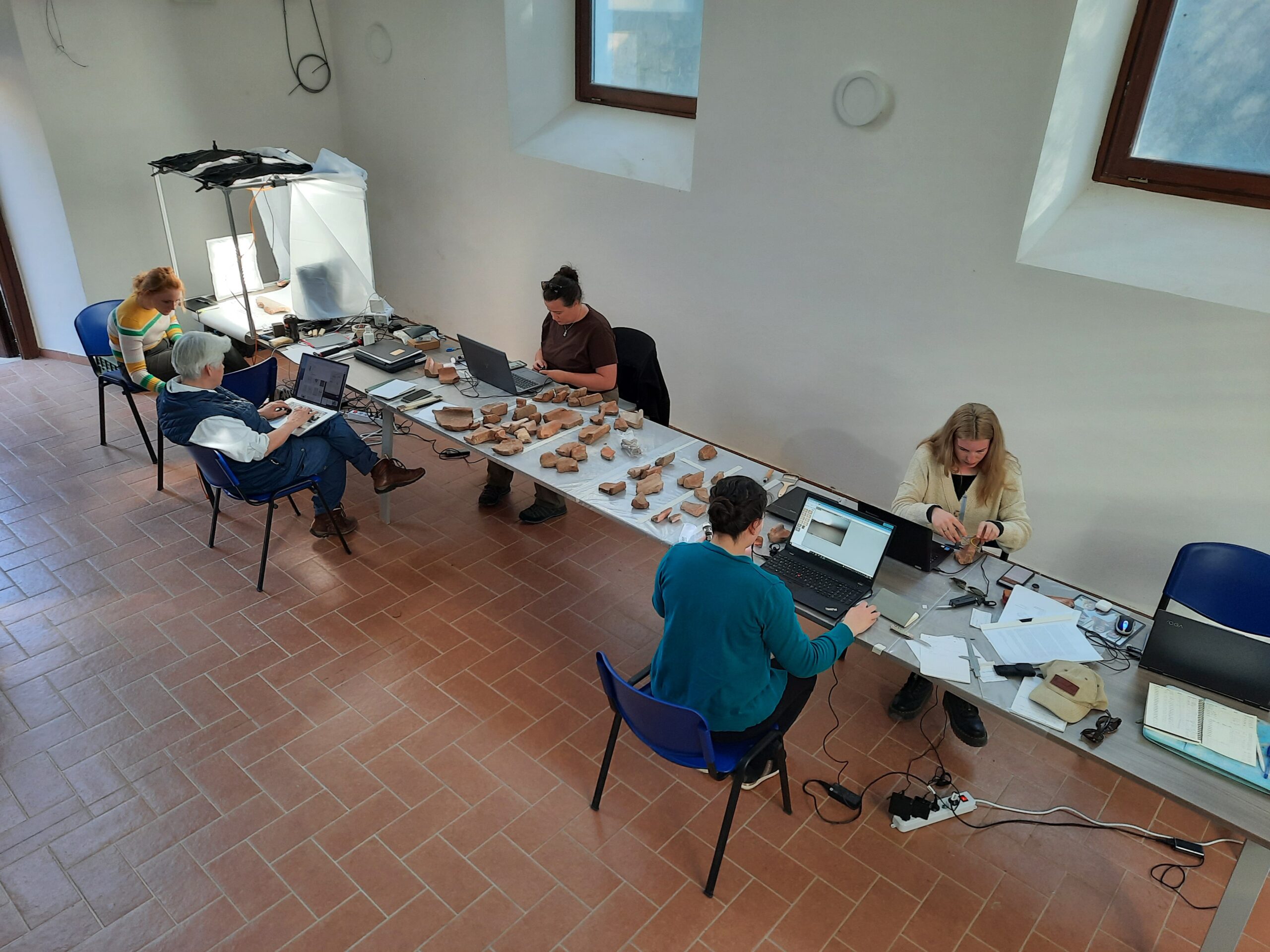 Dokumentation der Dachziegel
 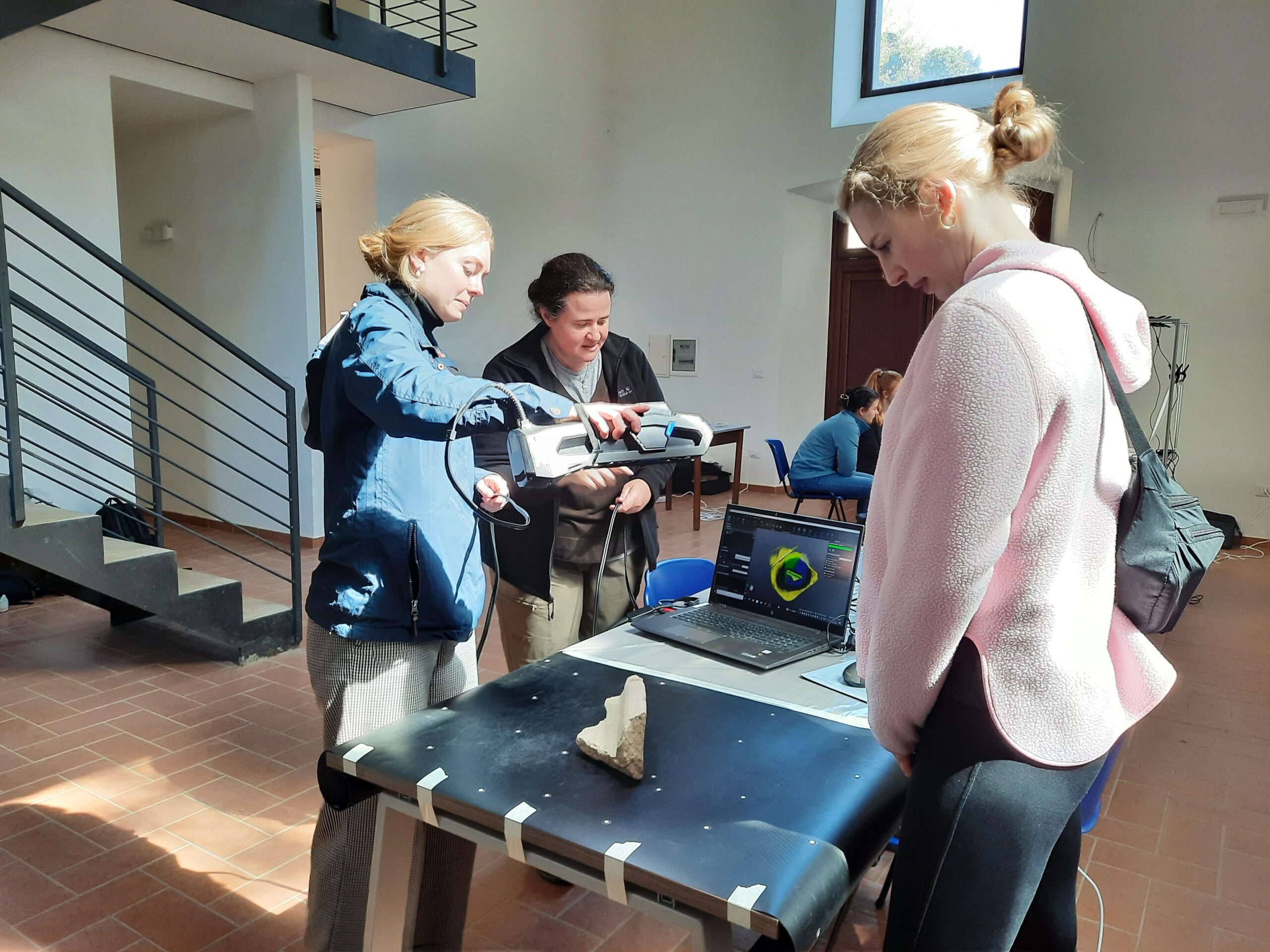 Employees working with the 3D scanner
The Spring School also included joint excursions to the Vulci Archaeological Park, the Museo della Badia in Vulci and the Museo Archeologico Nazionale di Viterbo, where the famous roofs of Acquarossa are on display.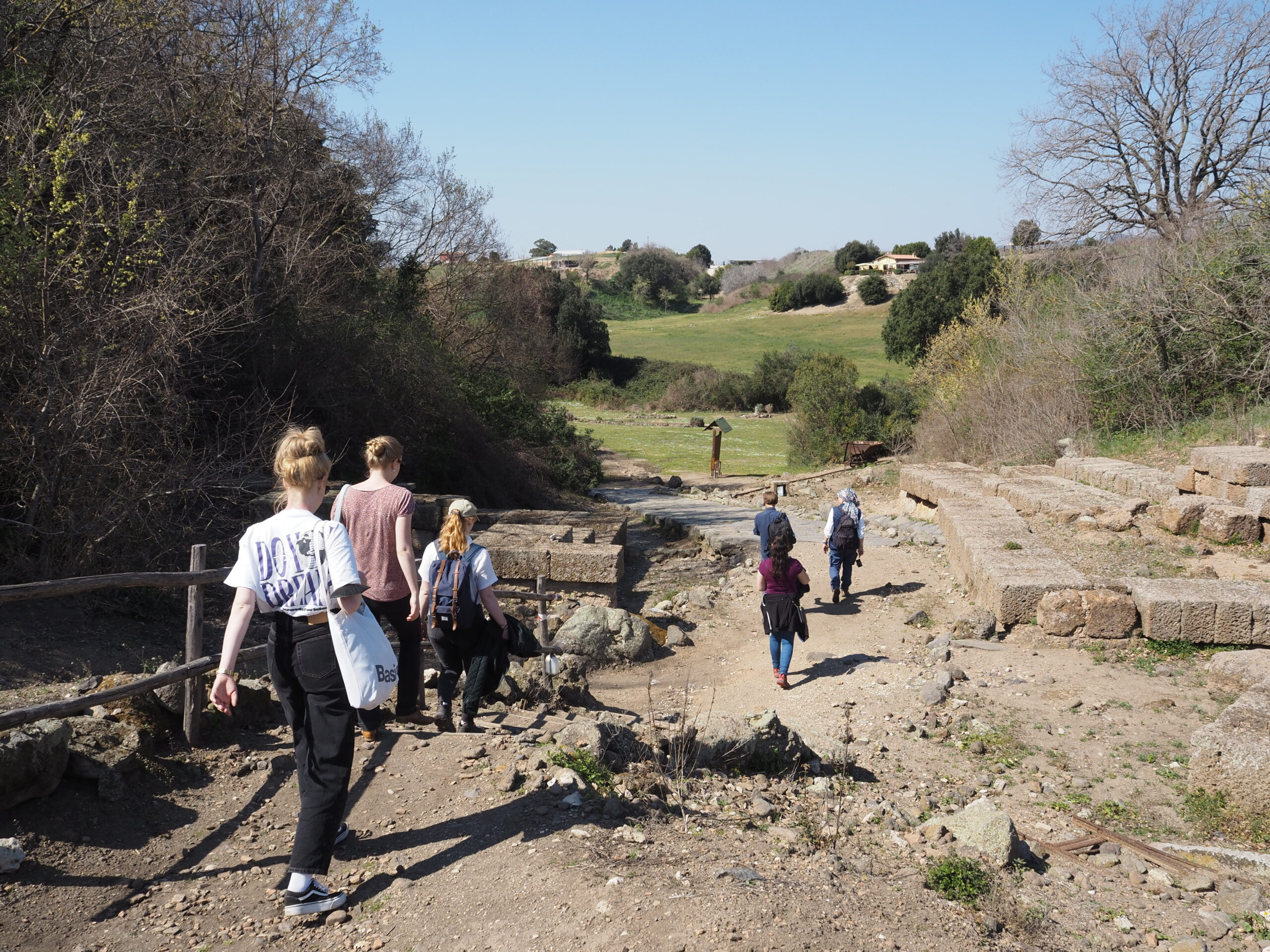
Joint excursion in Vulci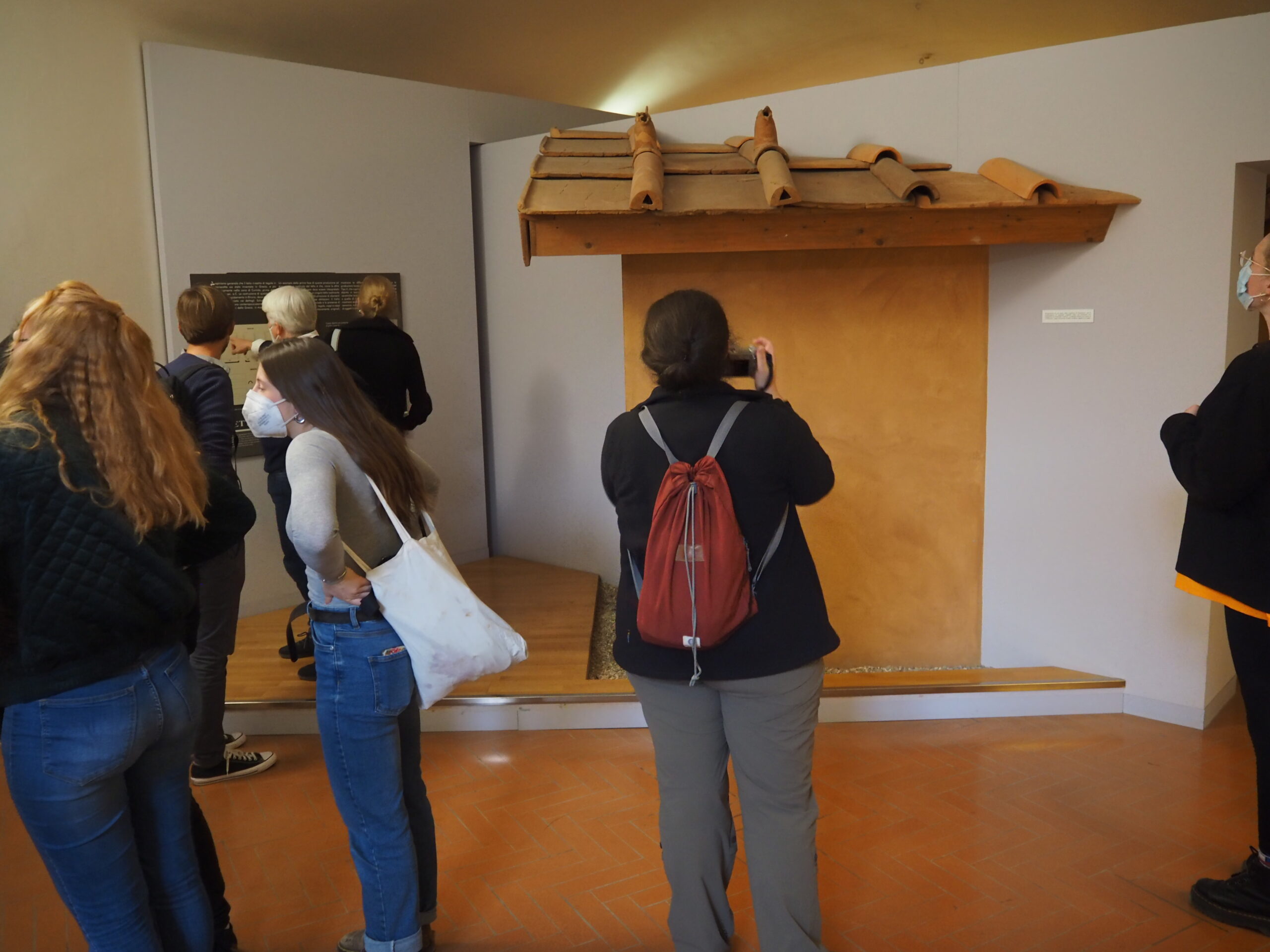 Visit to the Museum of Viterbo
A student report can be found at the following link.(Spring School on the roofs of Vulci – Vulci Cityscape (hypotheses.org)). The Spring School takes place in the archaeological laboratory in Ischia di Castro with the kind support of the Fritz Thyssen Foundation, the German Department of Archaeology and the Comune die Ischia di Castro.
Program in Mainz, Frankfurt and Darmstadt, 28.3. to 1.4.2022
From its beginnings as a scientific discipline, archaeology has been dependent on the visualization of its objects. Whether a simple clay vessel or a representative building – almost everything has survived in fragments and requires precise visual recording in order to be reconstructed as far as possible. 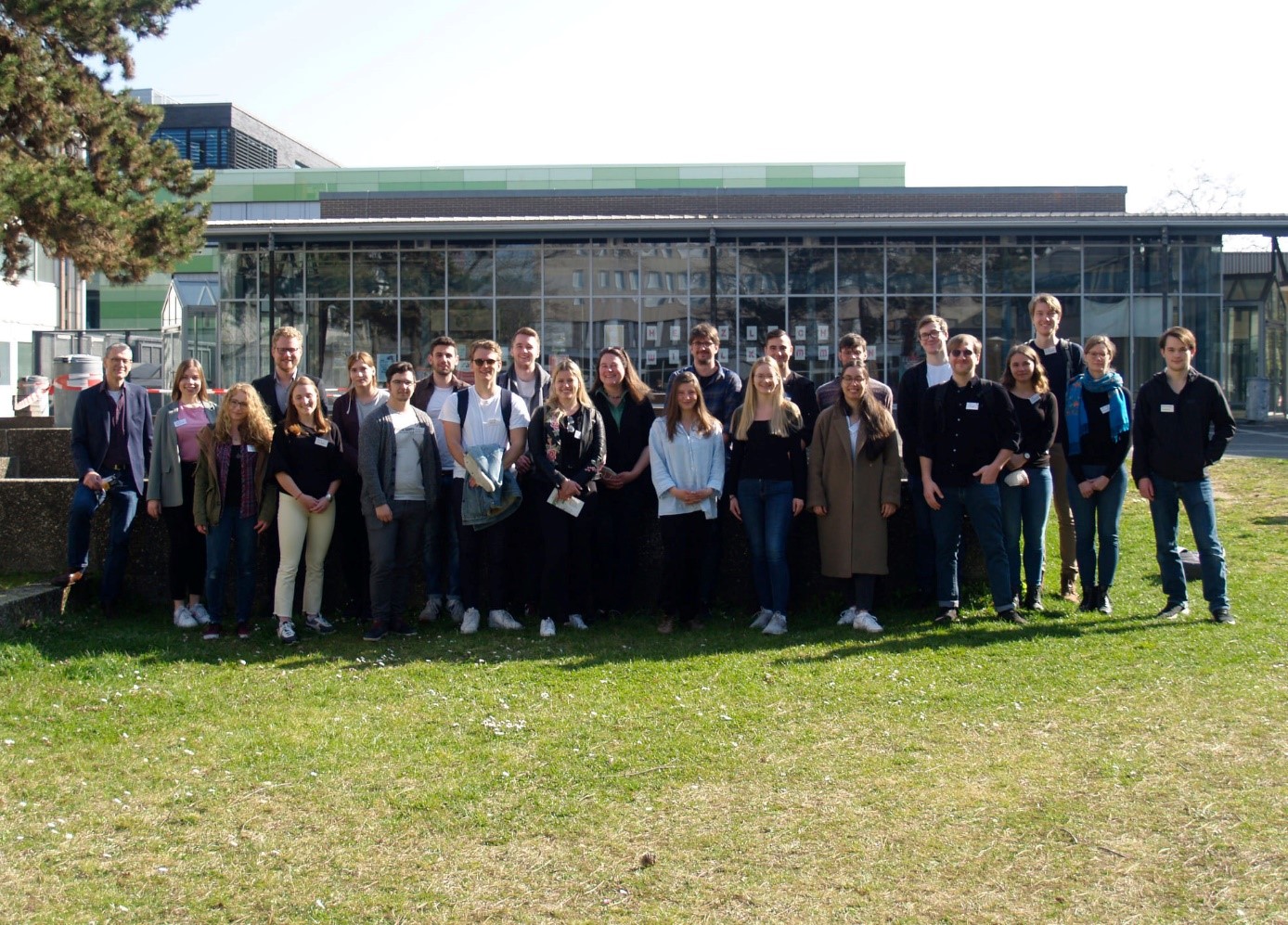
Before the start on the campus in Mainz
The study week was dedicated to this central cross-sectional topic of archaeology. It was jointly organized by the institutions for Classical Archaeology at the universities of Mainz, Frankfurt and Darmstadt, with financial support from the Rhine-Main Universities (RMU) Teaching Fund. The organizers were Klaus Junker (Mainz, in charge), Anja Klöckner (Frankfurt) and Franziska Lang (Darmstadt), actively supported by the student assistants Laura Rausch (Mainz), Moritz Fornoff (Frankfurt) and Lara Reusch (Darmstadt). 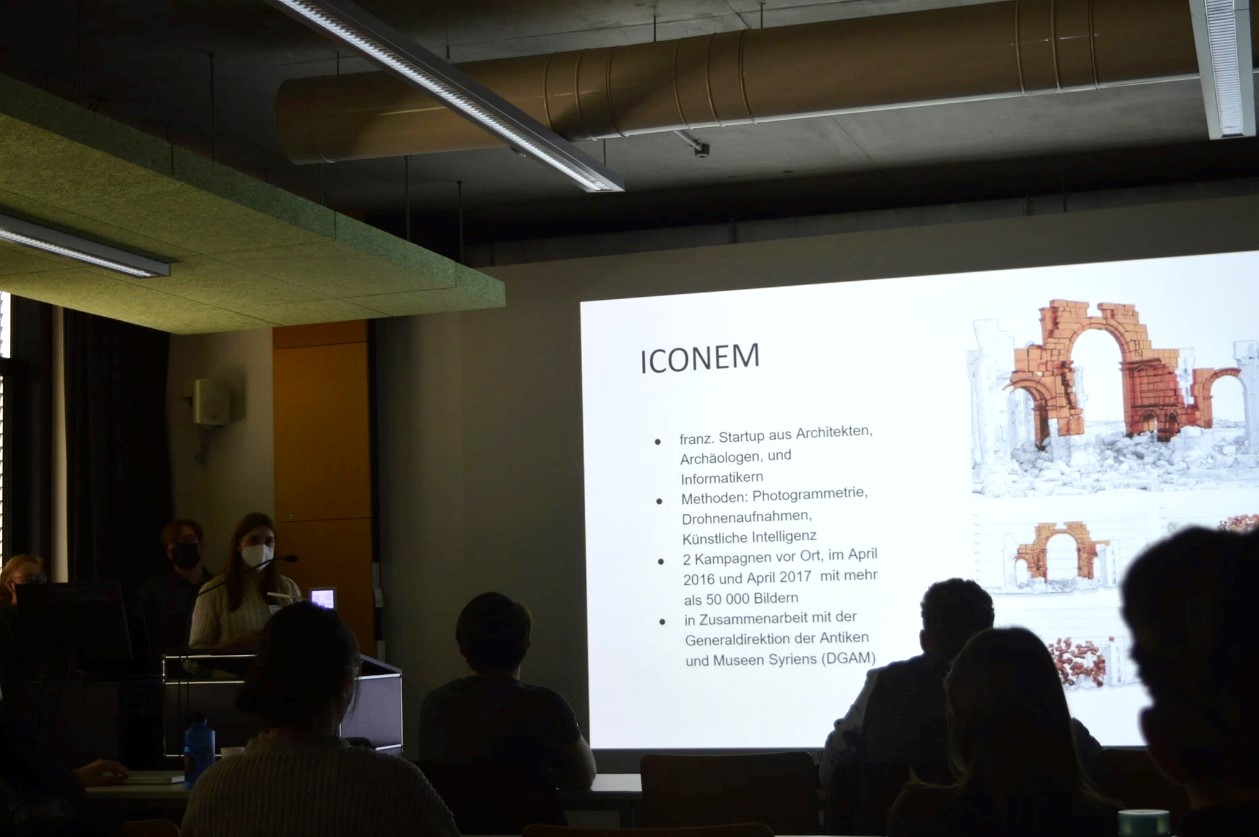 One of the student topics is presented
The programme comprised 13 lectures and seminars on a wide range of topics, starting with historically oriented contributions on forms of visualization and reconstruction from the Renaissance onwards, but was largely dedicated to the current state of the art in the field of computer-aided visualization. – Due to the coronavirus, masks had to be worn indoors, but there were no restrictions on the implementation of the program. 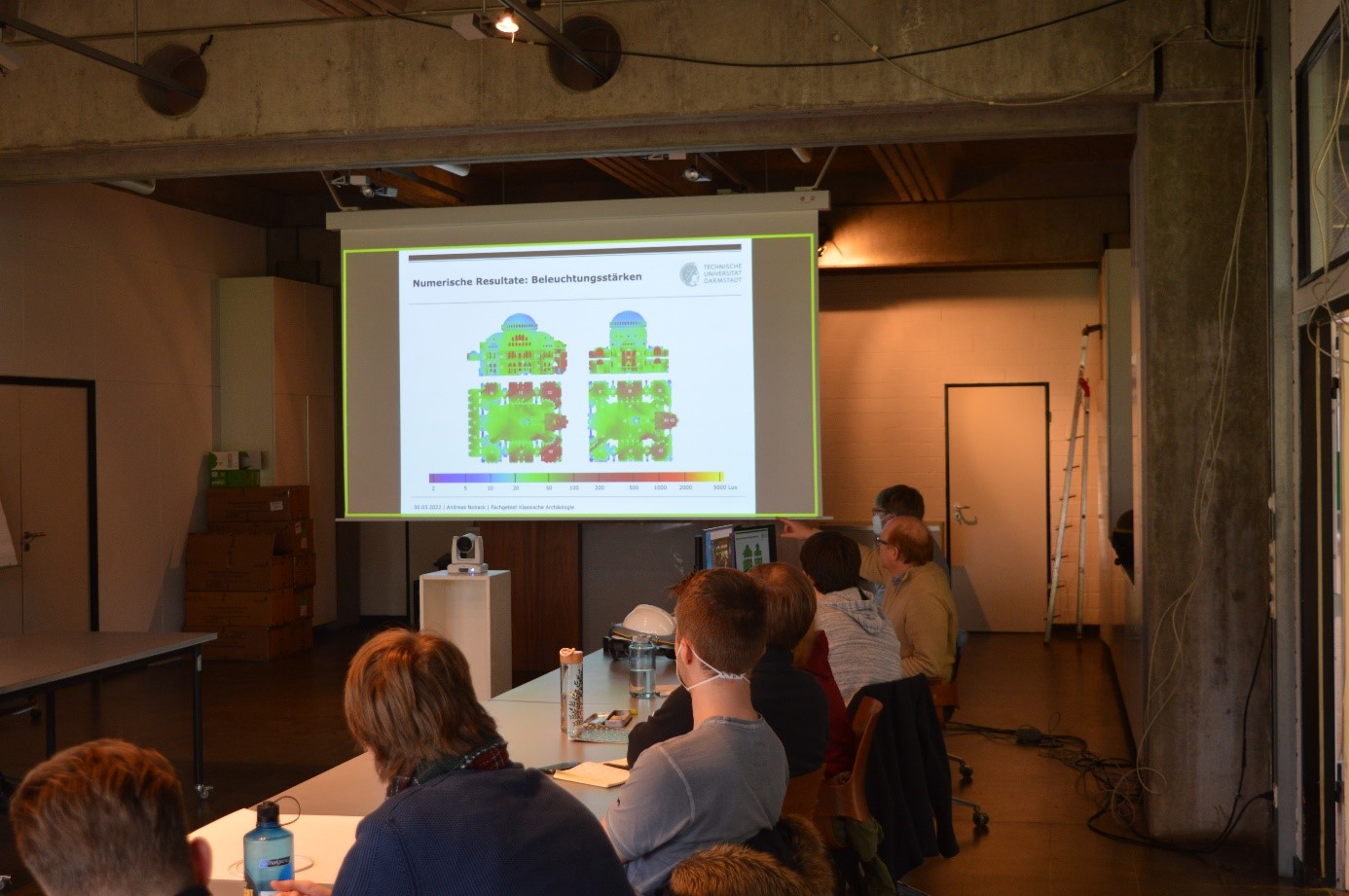 Contribution by Andreas Noback, Building of the Faculty of Architecture at TU Darmstadt
The focus was on architecture, but there were also insights into its application in the field of philology and research into ancient sculpture. The speakers came from the RMU and the universities of Göttingen, Heidelberg, Cologne and Trier. The central question of the intensively discussed contributions on current projects was the examination of the tension between the technical possibilities and the cultural implications of 3D visualizations. 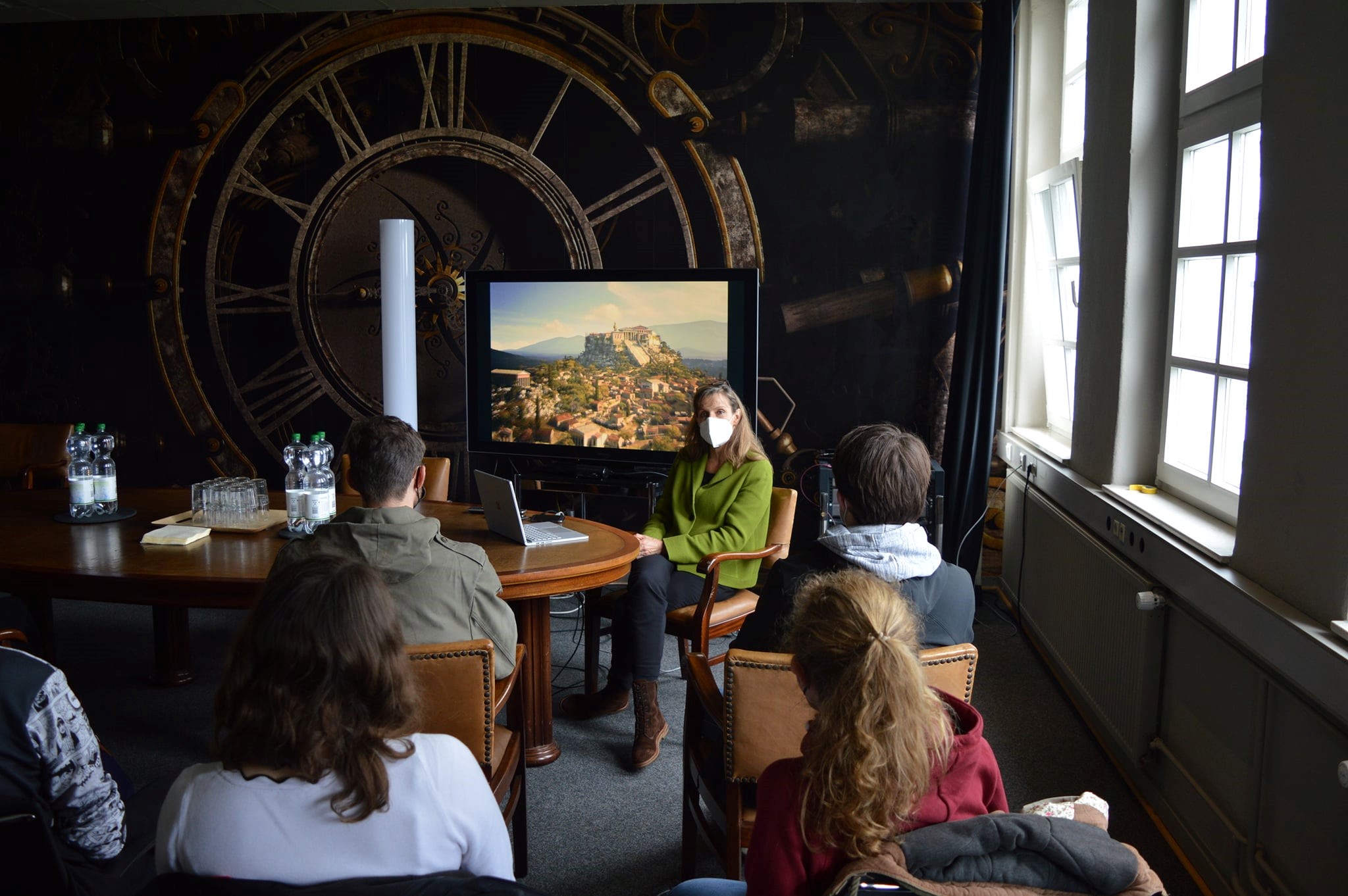 Discussion with Maria Courtial, Design-Studio Faber-Courtial, Darmstadt
The 18 student participants, who came from RMU and five universities in other parts of Germany, also addressed this topic in contributions that were developed in five groups.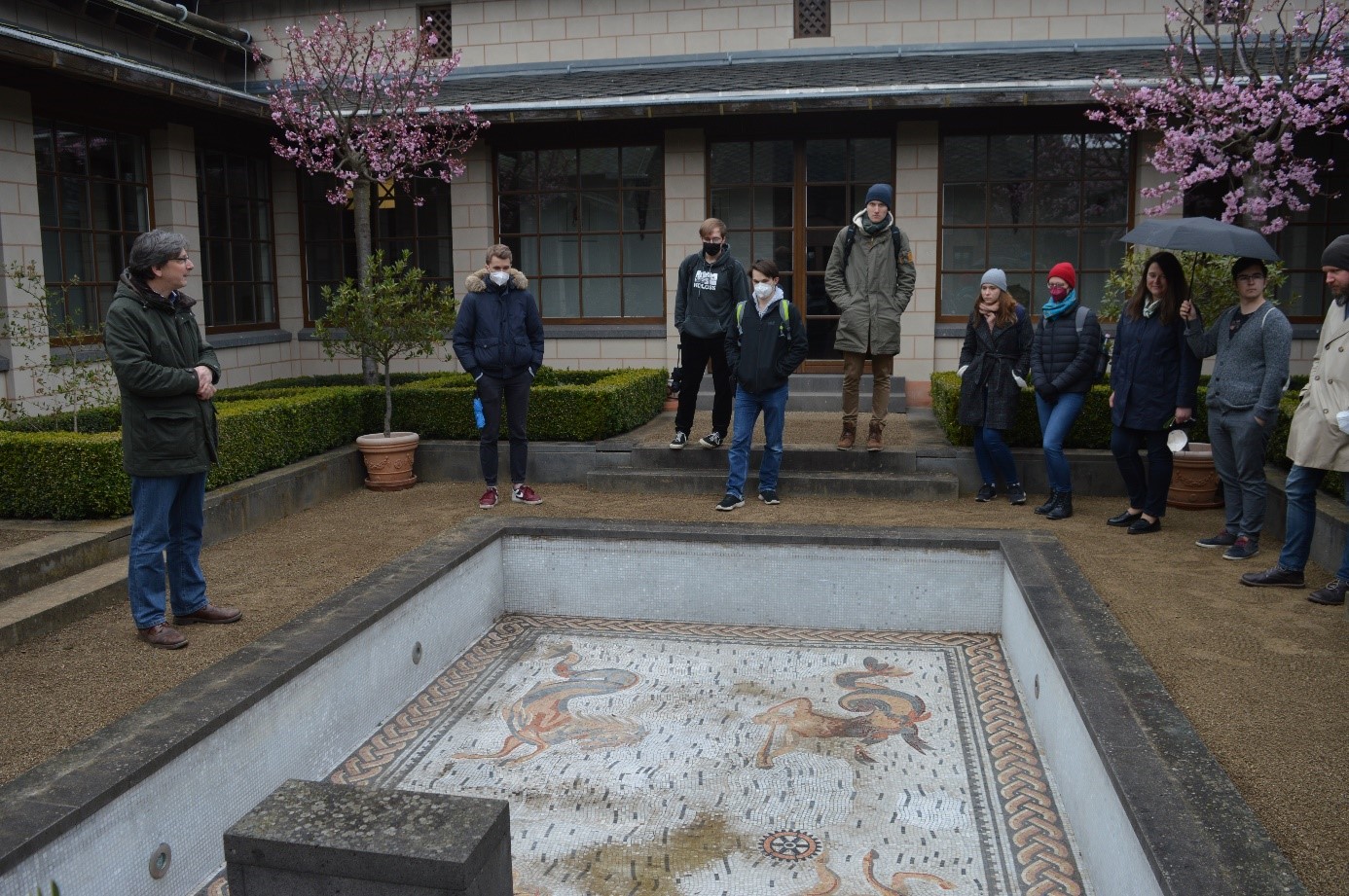
The programme was supplemented by a visit to the Faber-Courtial design studio in Darmstadt, which specializes in photorealistic visualizations, and to the Saalburg in Bad Homberg vor der Höhe as an example of a comprehensive physical reconstruction of an ancient building complex.
Prof. Dr. Klaus Junker
The joint interdisciplinary project of the universities of Freiburg and Mainz and other national and international partners uses geophysical prospection and targeted excavations (including a newly discovered monumental Late Archaic temple) to investigate the diachronic urban development of the Etruscan metropolis of Vulci (Lazio, Italy) from its beginnings in the Early Iron Age to the end of the city in the Early Middle Ages.
The internship will be offered from September 1 to 20, 2025 as part of the archaeological, geoarchaeological and geophysical field research in the immediate periphery of the sanctuary of Olympia, which has been carried out by the Institute of Geography at JGU Mainz and the Athens Department of the German Archaeological Institute (DAI) since 2021. It offers an introduction to excavation practice including the analog and digital documentation of archaeological finds and features. Participation takes the form of a voluntary internship at the DAI. Travel expenses will be covered; accommodation in the excavation house in Olympia (double room) is free of charge. For further information, please contact the project manager Apl. Professor Dr. Oliver Pilz.
Upcoming events
Major field trip “Etruria” in September 2025
led by Dr. Paul Pasieka
Day excursion Liebighaus Frankfurt (February 06, 2026)
under the direction of Prof. Johannes Lipps
Follow-up reports
On the Ides of February, the Classical Archaeology research unit went on a field trip to the Terra Sigillata Museum Rheinzabern, which was organized and led by Anne Sieverling and Manuel Flecker. On site, museum director Barbara Thomas gave us deep insights into the history and structure of the Terra Sigillata production area of Rheinzabern, the ancient Tabernae, which is so important for the north-western provinces. At the beginning, she gave us the opportunity to visit the museum’s outposts.
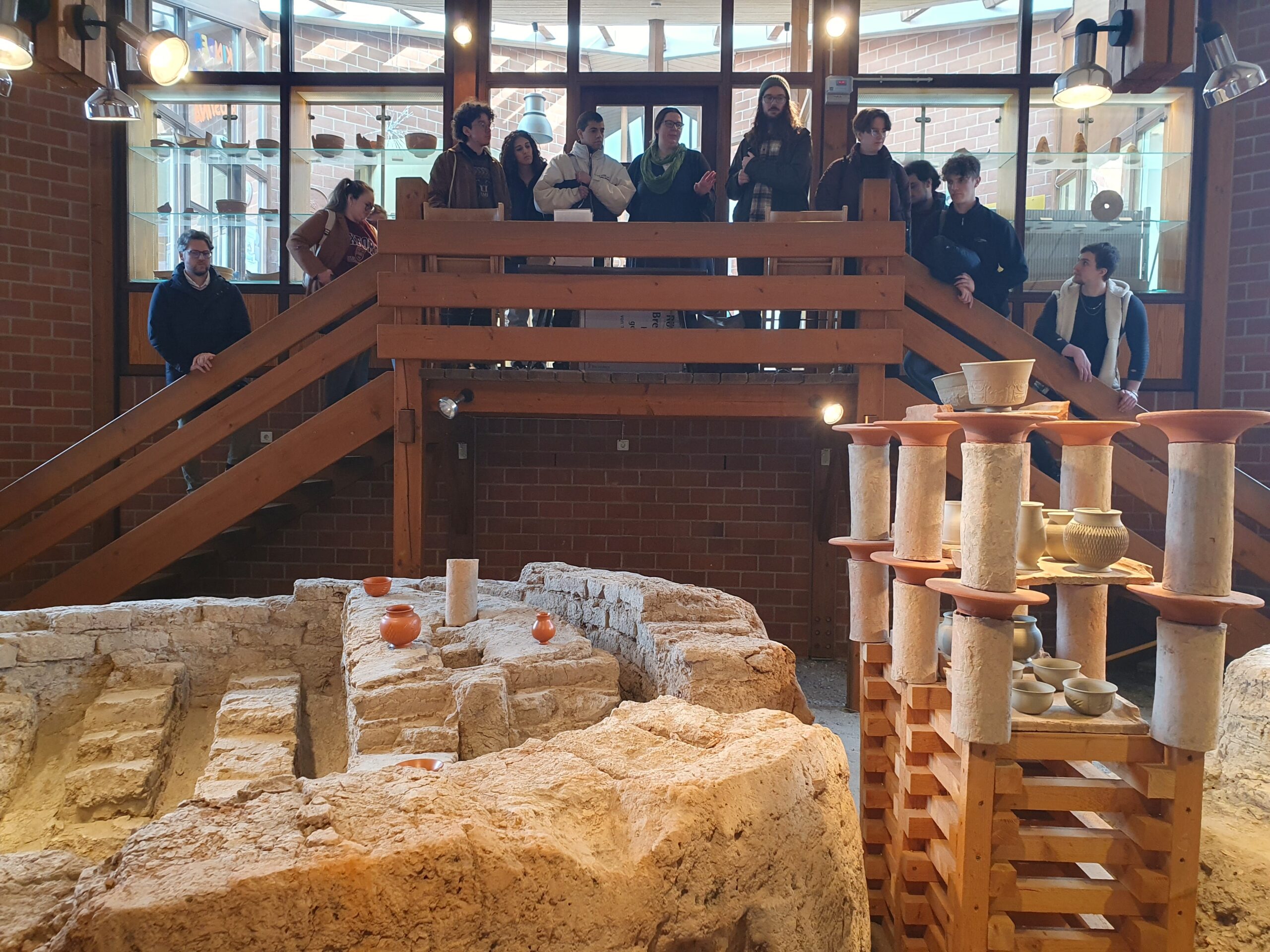
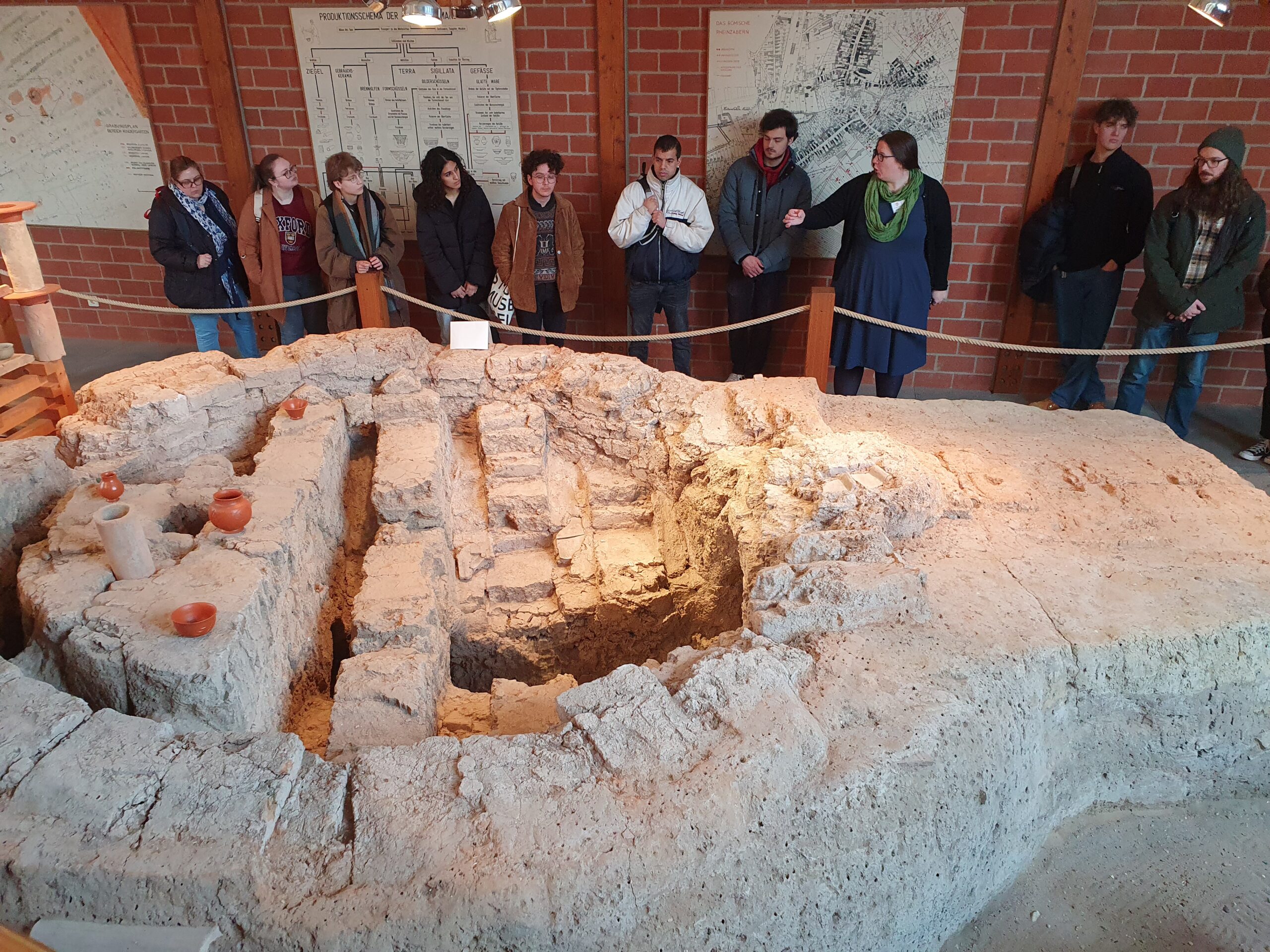
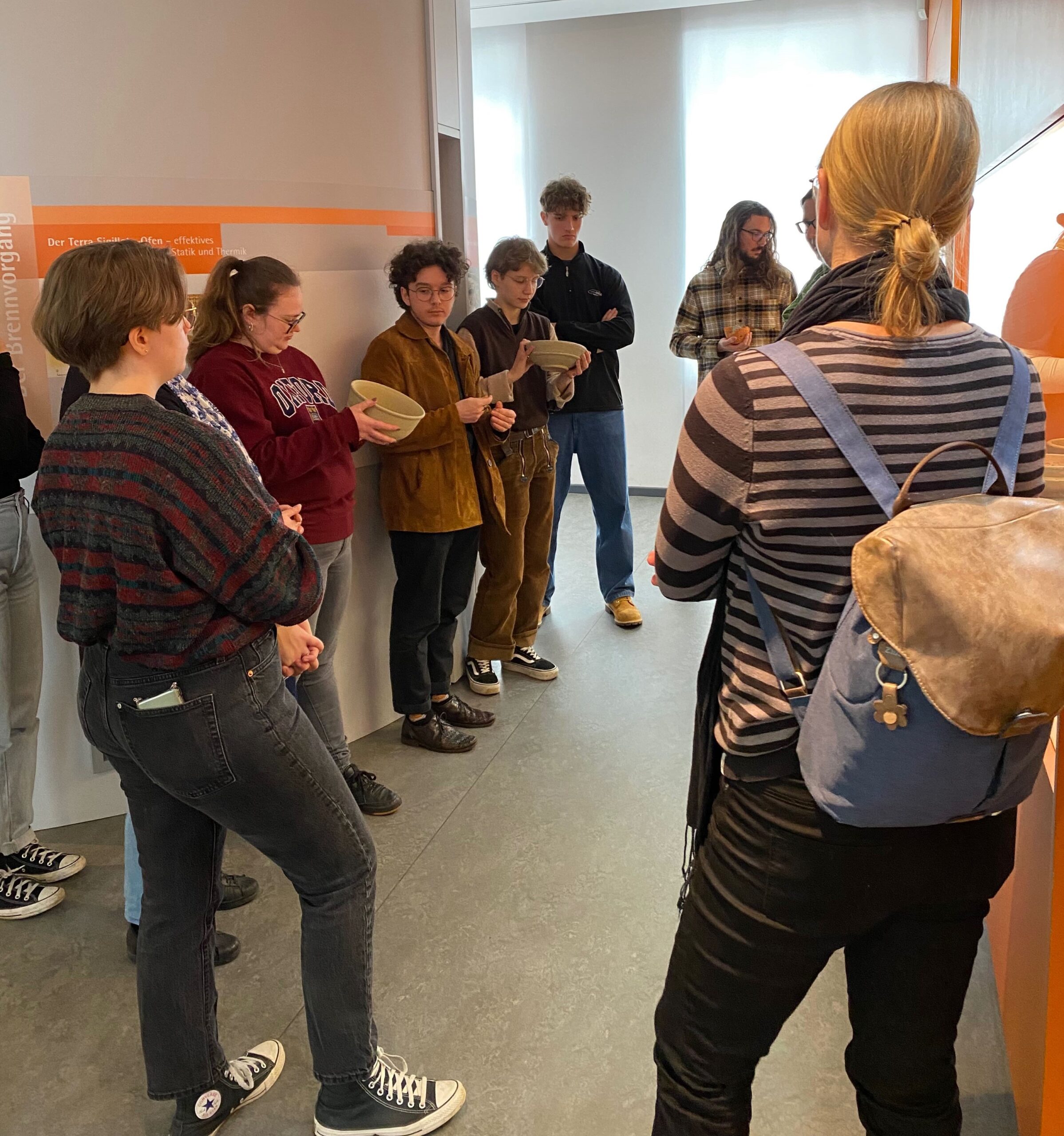
Using the two monumental brick and sigillata kilns still in situ there, we were able to discuss not only their construction, but also the different firing processes involved in ceramic production. Back in the museum, we also internalized the different decoration techniques of terra sigillata on the exhibits and replicas, which were passed around for better autopsy. On the basis of the exhibits, we also discussed fundamental questions about terra sigillata in greater depth, such as its variety of shapes and decoration, its imagery, as well as economic and trade history issues.
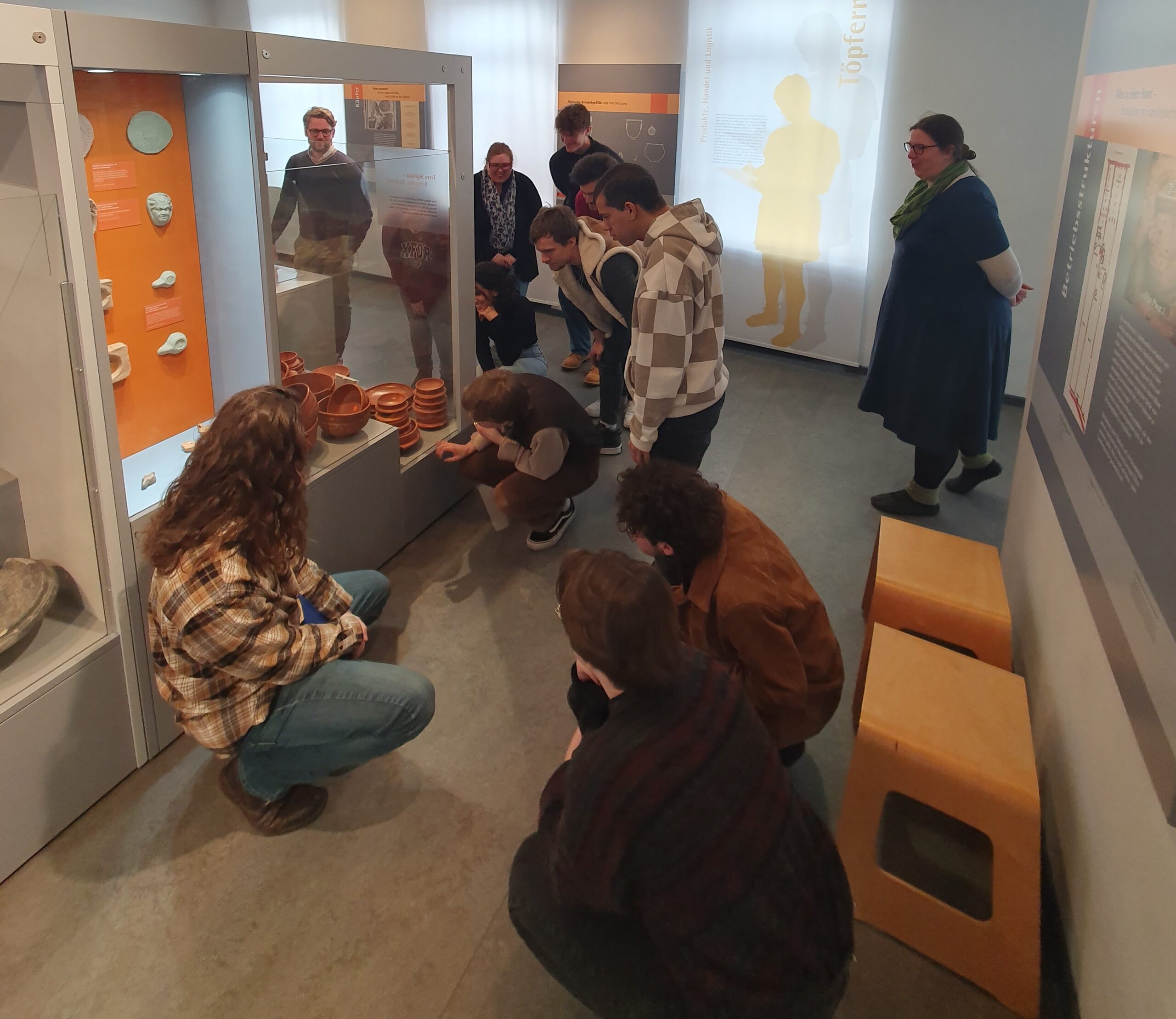
Other types of pottery such as terra nigra, household items and lamps helped us to view the sigillata in context. In addition to the pottery, other finds from ancient Tabernae, such as fibulae, bone objects, bricks with impressions and stone monuments are also on display. Among them, we took a closer look at the unusual five-god stones in particular and not only deepened our knowledge of the iconography of the Roman world of gods, but also explored their significance for ancient Tabernae.
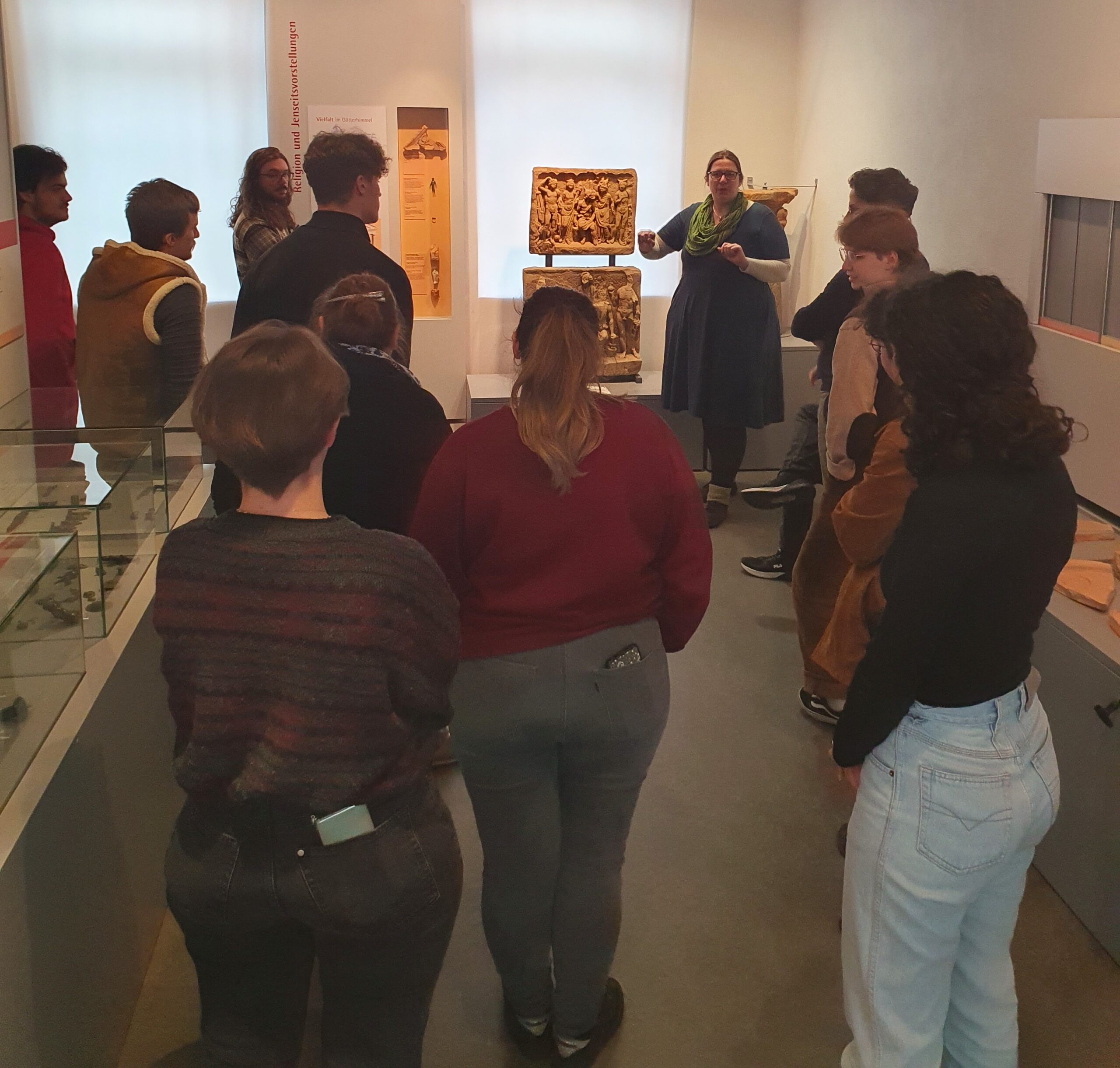
Finally, Barbara Thomas invited us to a practical pottery lesson in which we learned how to form picture bowls from replica molds, pull them out of the model and attach stand rings, which led to a better understanding of the shaping technique in addition to the pottery fun.
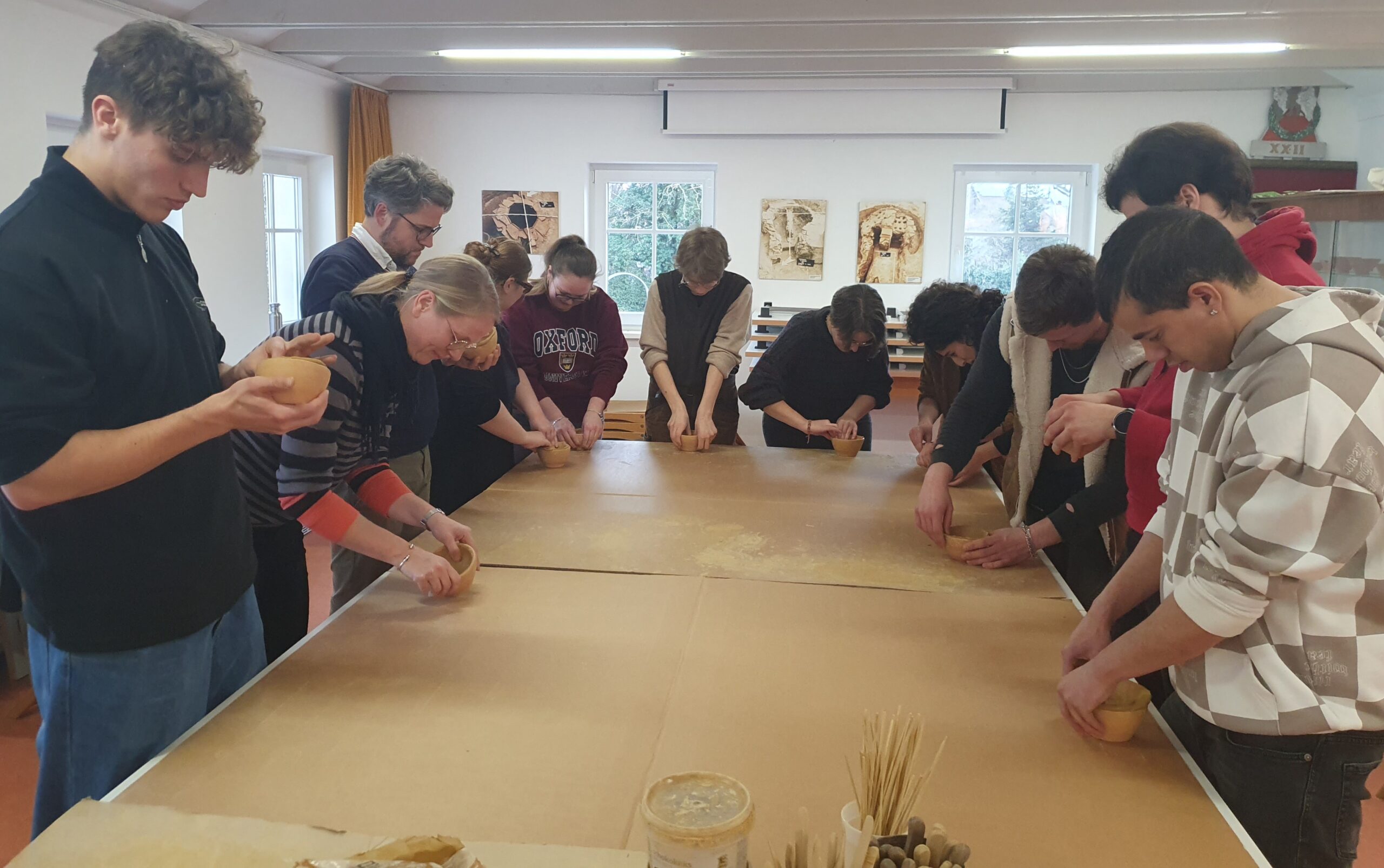
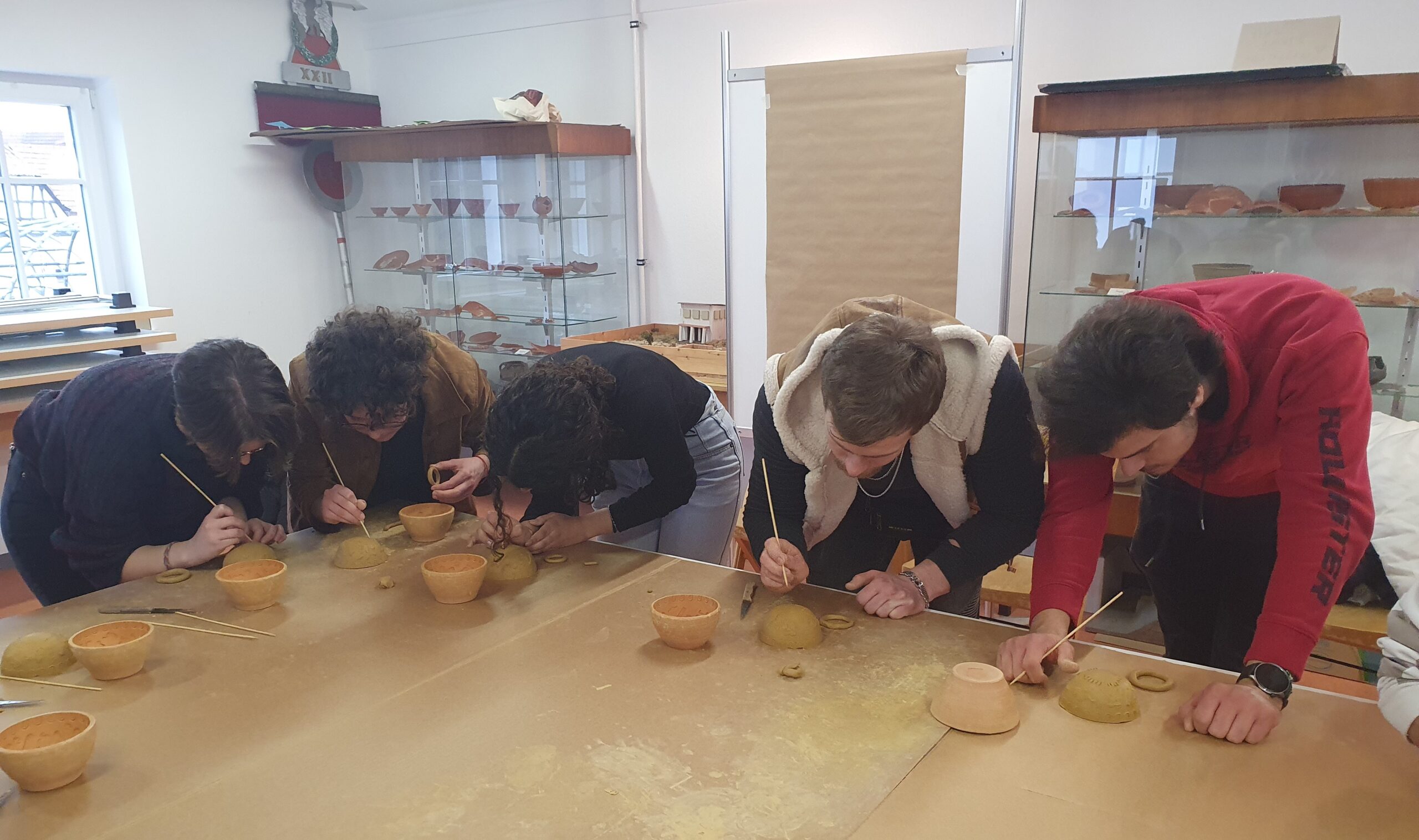
We would like to thank Barbara Thomas for the intensive and very interesting guided tour through the beautifully constructed Education Museum and the pottery kilns in Rheinzabern, as well as for the opportunity to shape picture bowls ourselves. We would love to come back soon!
From June 7 to 11, 2023, twelve Classical Archaeology students traveled to Paris to gain a small insight into the museum landscape of the French capital and get to know some of the important archaeological objects kept there.
The field trip was headed and organized by Matthias Grawehr and Johannes Lipps. As we had two lecturers with us, we had the opportunity to explore the museums in small groups, which was particularly useful at the Louvre. We spent two days there, divided into two groups, looking at the collection of antiquities. Our focus was somewhat on the Greek objects, as the rooms in the Roman section were only partially open. Nevertheless, we were given a varied insight into different types of material and also had time to visit the Etruscan and Near Eastern sections. We mainly found Roman objects in sarcophagi and Roman copies of ideal Greek sculptures. Presentations, expert topics and the small groups made the field trip very interactive and we were able to talk to each other at any time about objects that had aroused our interest.
On the third day of the field trip, we took the train to Saint-Germain-en-Laye to the National Archaeological Museum of France. Unfortunately, the Roman section was also being renovated here, which is why we took a closer look at the exhibition on the prehistory and early history of France and the two rooms dedicated to the Battle of Alesia. Not only did we learn about provincial Roman archaeology, but we were also able to talk a lot about the history of research and archaeology in the 19th century. Afterwards, we visited the amphitheater in Paris and still had time to look around Paris on our own.
We also used the day of departure to visit the Bibliothèque nationale de France and the Musée de Cluny. In the collection of the National Library in particular, we employed ourselves with some highlights, such as the Grand Camée de France, the largest antique cameo, and the magnificent Berthouville silver treasure. But the new Musée de Cluny, whose exhibition is mainly dedicated to the Middle Ages, also aroused great interest among fans of Roman archaeology with finds from the Roman city of Lutetia, exhibited in the impressively preserved frigidarium of the Roman baths (report by Valentin Maki Müller-Quade).
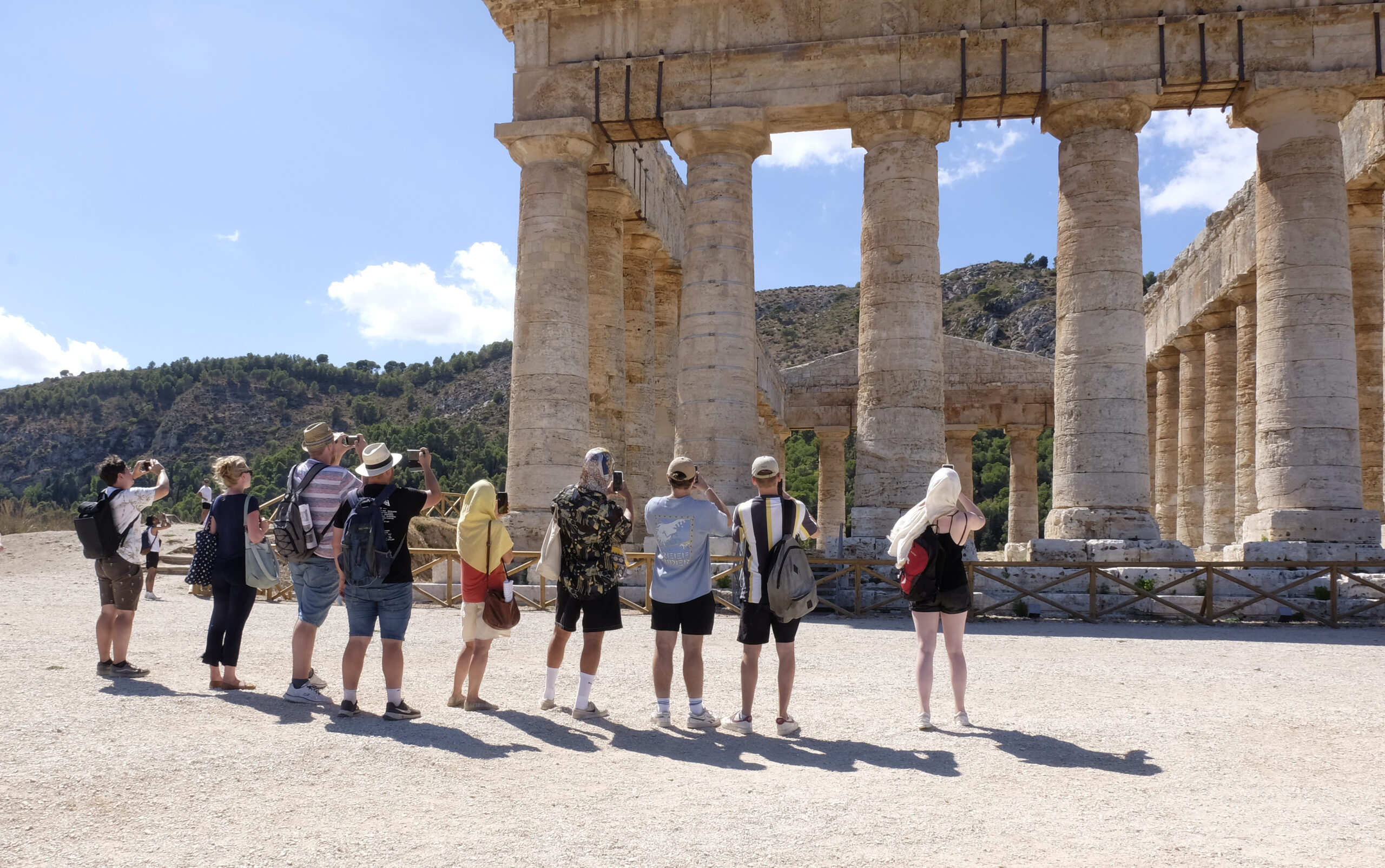
From September 3-13, 2022, 15 students undertook a ten-day field trip to Sicily under the direction of lecturer Dr. Matthias Grawehr. In a previous seminar, we had already gained an overview of the ancient sites in the south-eastern part of the island. We now wanted to expand on this by visiting sites in the north-western part of Sicily. Starting from our accommodation in the capital Palermo, we went to one or more archaeological sites every day. Presentations by the students and lectures by Dr. Matthias Grawehr supported the explorations, and museum visits supplemented what we had seen on site.
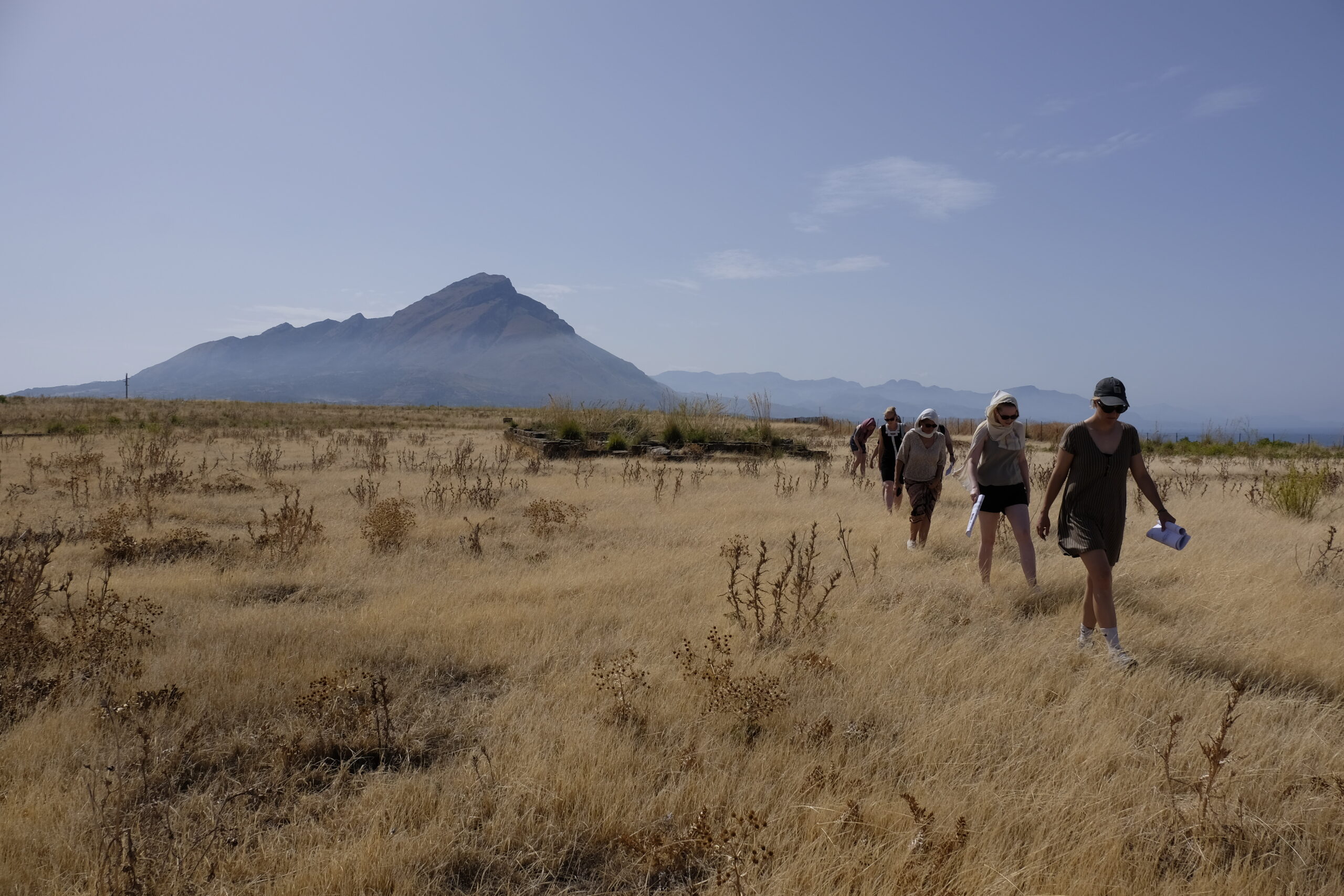
During the first few days, we explored the Roman remains in Palermo and took a ferry to the Phoenician city of Mozia on a small island off the coast of Sicily. On the fourth day, after a short stay in Termini Imerese, we went to Himera, where we visited the Temple of Victory. Spontaneously, we went on a hike up to the upper town, where we explored the settlement complex from afar.
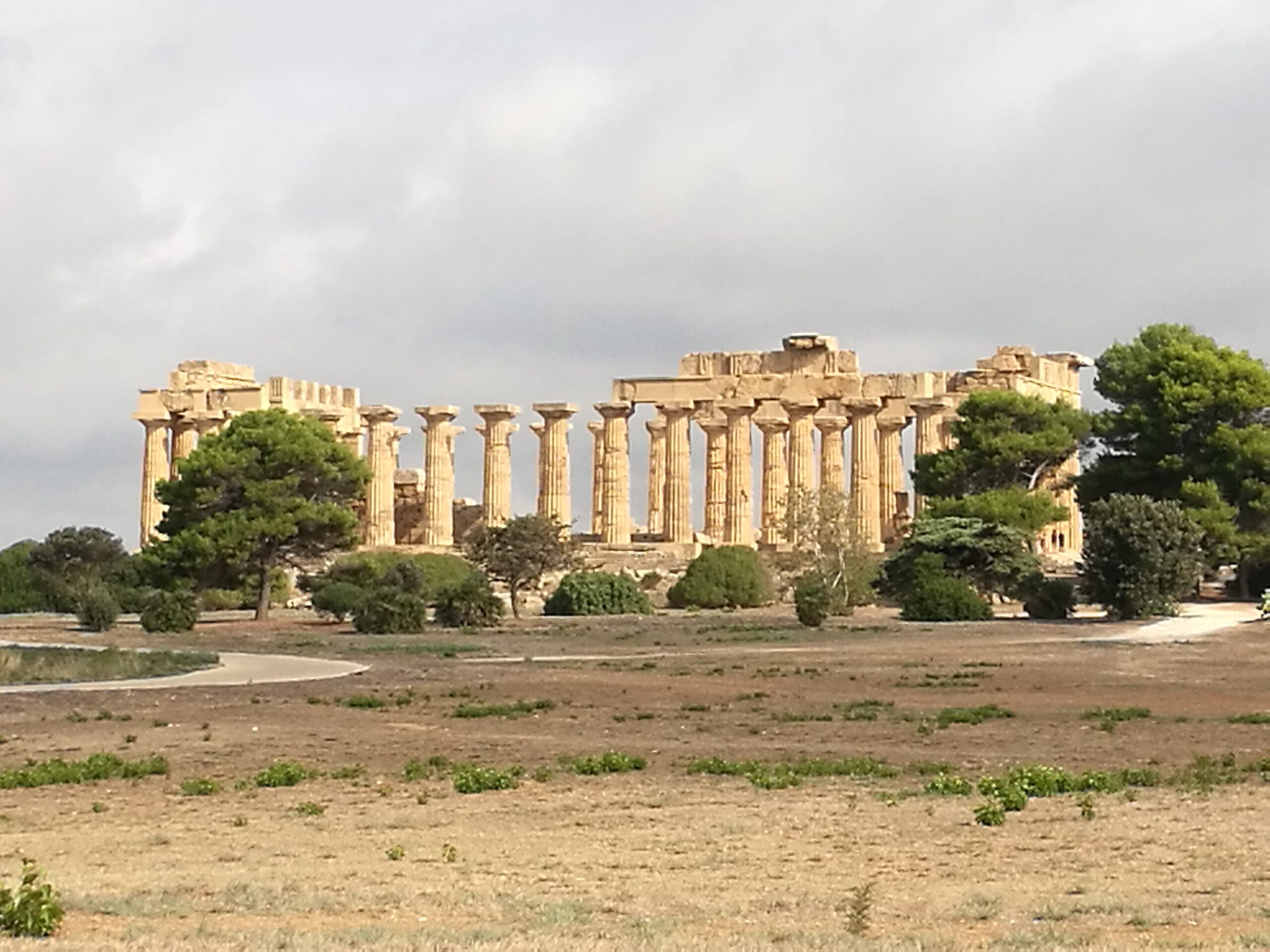
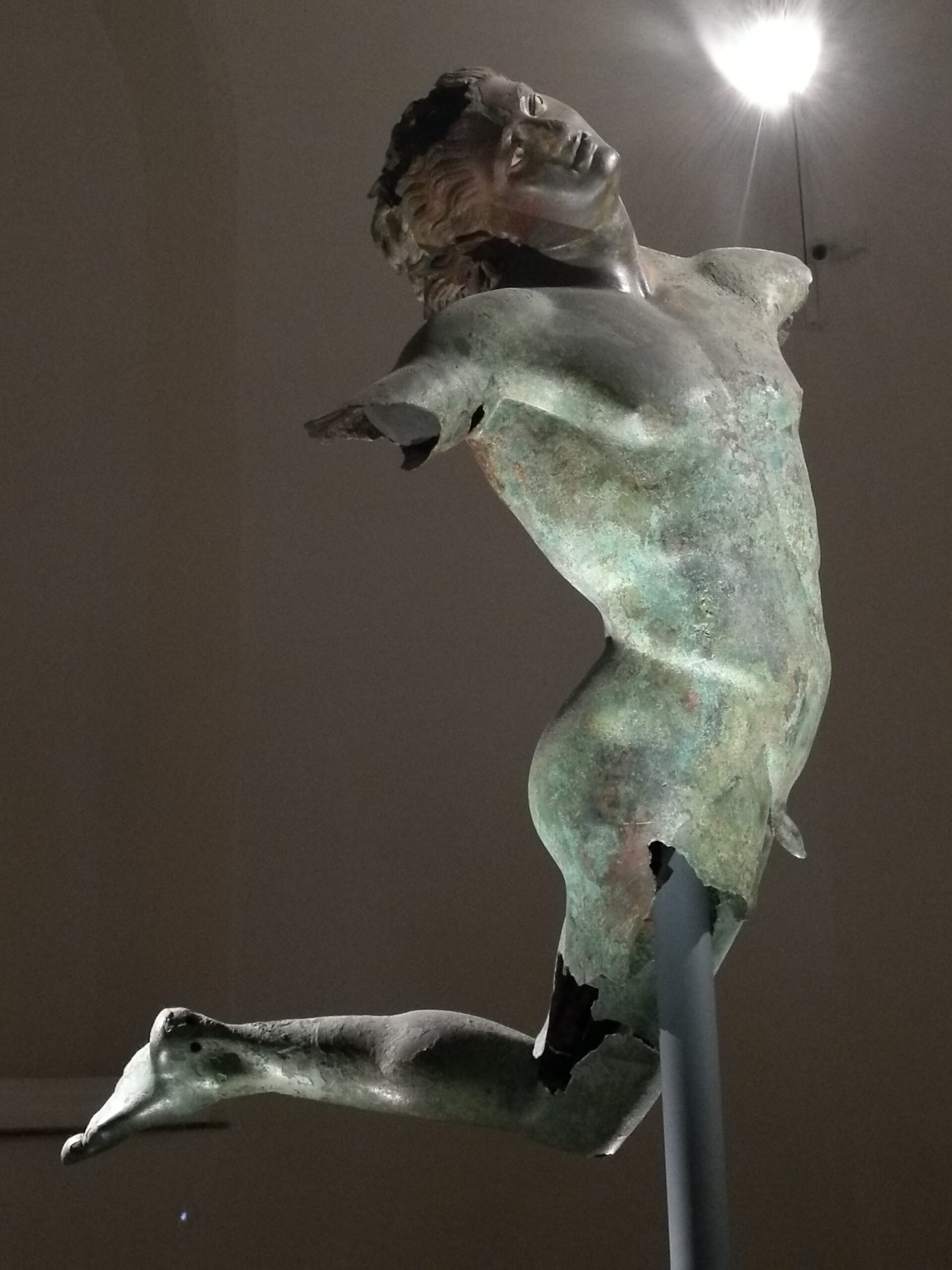
Our next destination was the Greek town of Selinunte with its countless temples. The following day, we supplemented our visit with a hike through the Cave di Cusa, an ancient quarry where you can see unused column drums that were intended for Selinunte’s largest temple. In the Museo del Satiro, we studied an original Greek bronze statue. Another underwater find was in the form of a Punic shipwreck in Marsala.
We then walked through the remains of the ancient city of Lilybaeum excavated behind the museum. The next day we went up to Monte Iato, where we were kindly given a guided tour of the culturally rich city complex by the excavation director himself. Thanks to the spectacular view, we were even able to visually capture a large part of the archaeologically exciting hinterland. In the Museo Archeologico Regionale in Palermo, which we visited the following day, we trained our eyes on the metope friezes of the temples of Selinunte. The remains of the ancient city of Solunt were planned for the penultimate day, on which we also had the opportunity to enjoy the Mediterranean Sea.
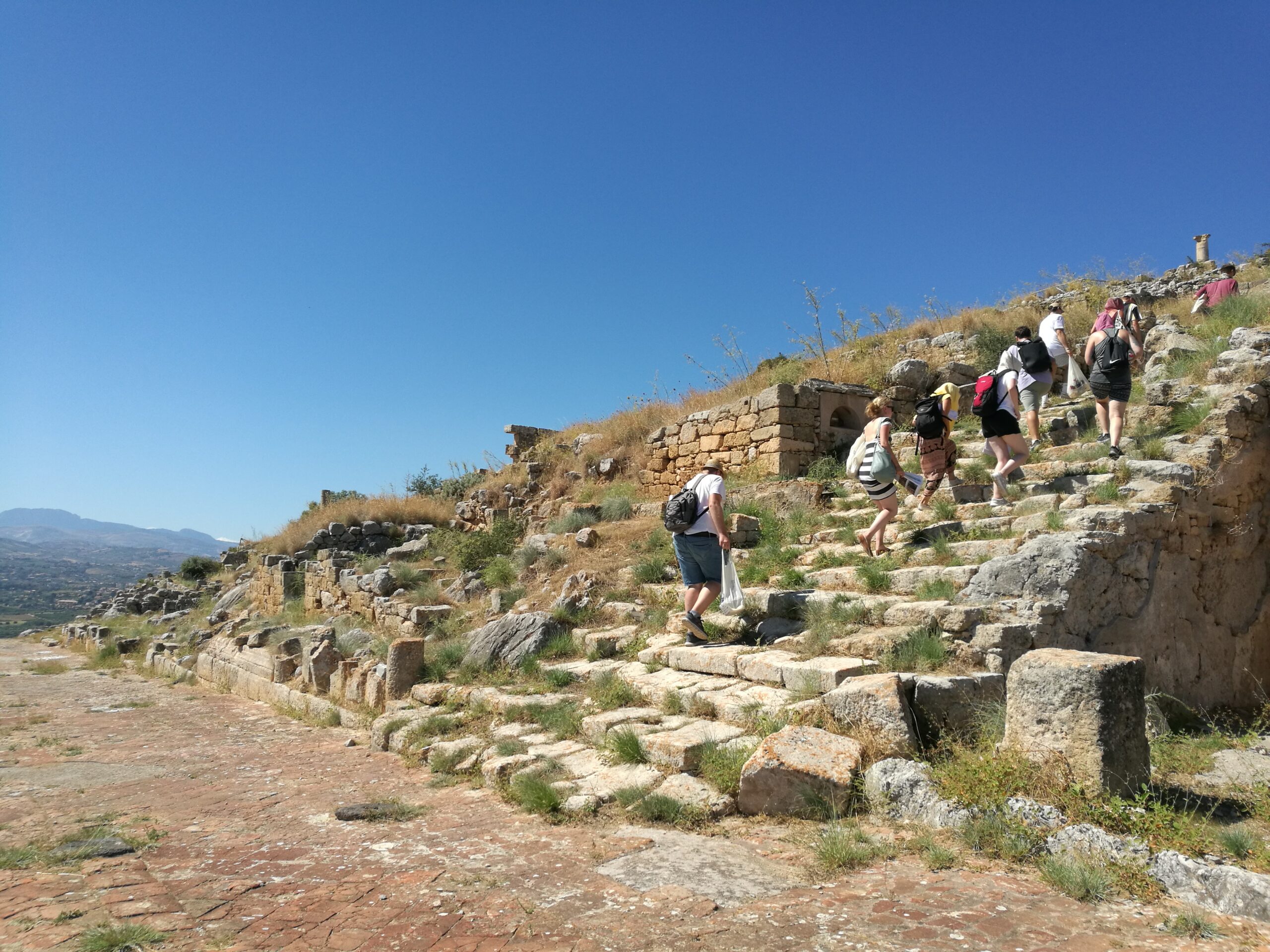
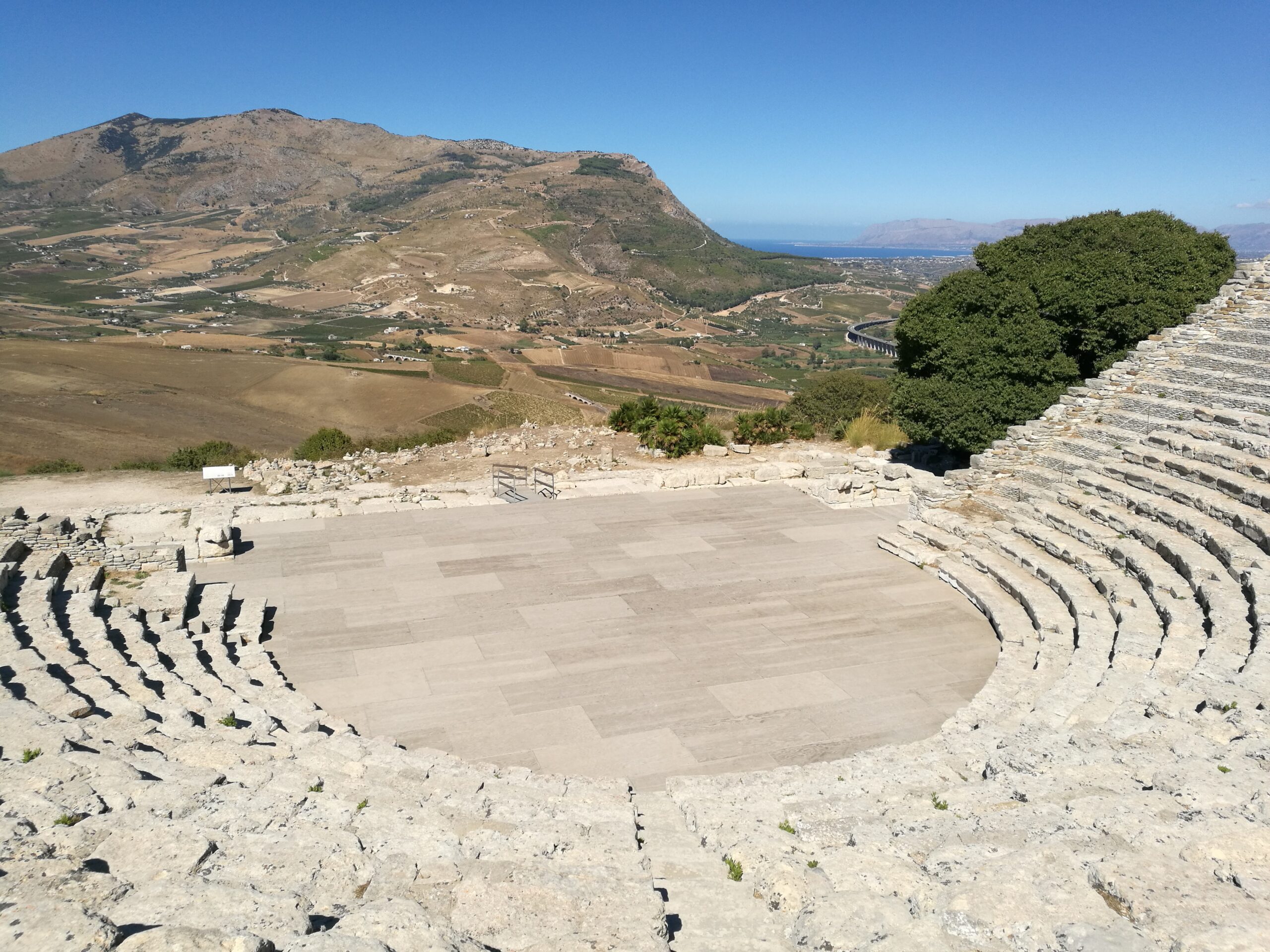
Finally, we went to Bronze Age Mokarta, the oldest settlement we visited on our field trip. The final stop was the Elymian, later Roman Segesta with its still completely upright temple and a large theater.
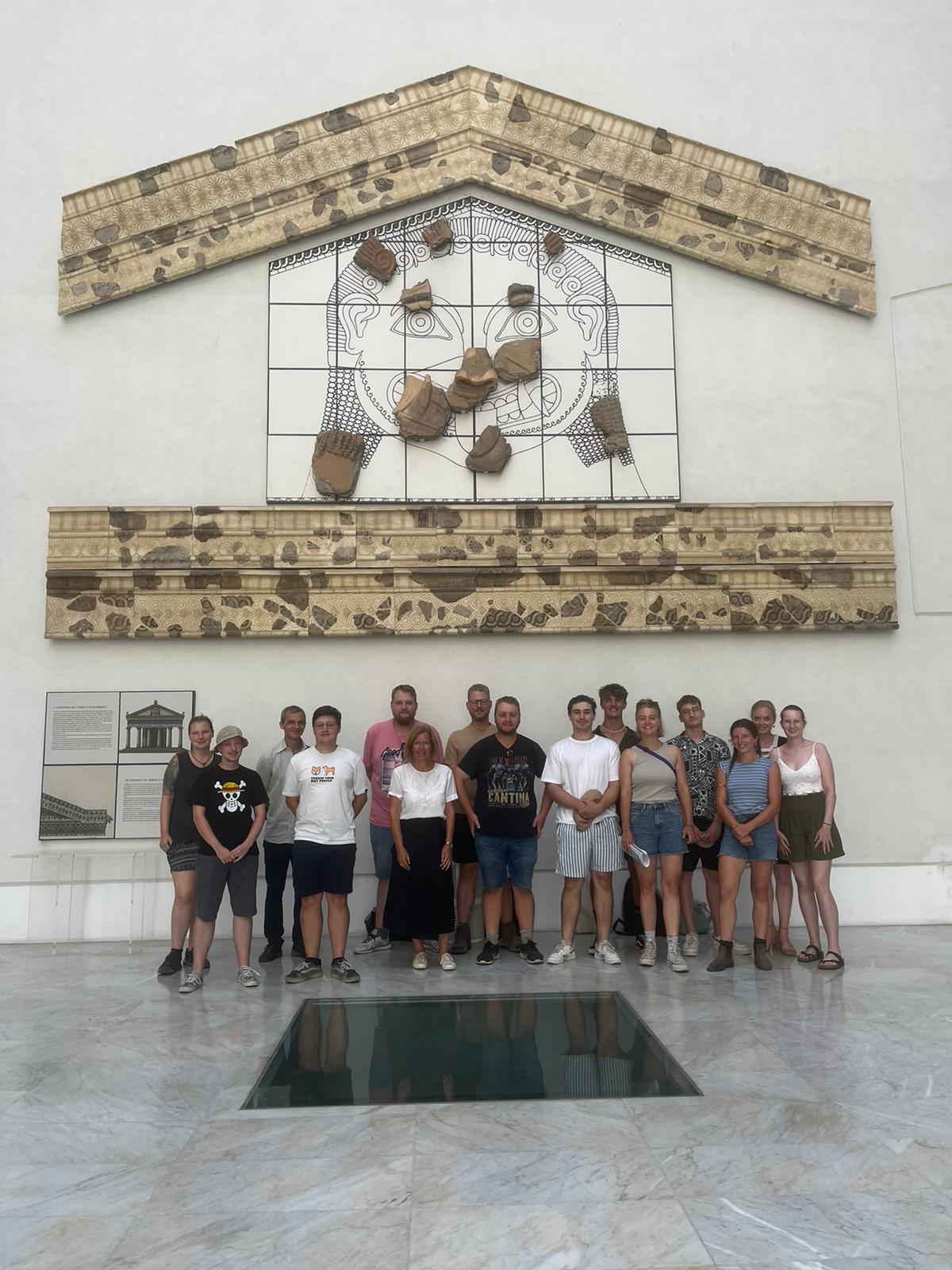
Through chronological and comparative classifications, we increasingly gained an overview of the settlement of Sicily in antiquity and its extensive history over the ten days. Thank you for a successful and eventful field trip!
From November 7 to 9, 2019, the Classical Archaeology working group went on a museum excursion to Munich under the direction of Dr. Anne Sieverling.
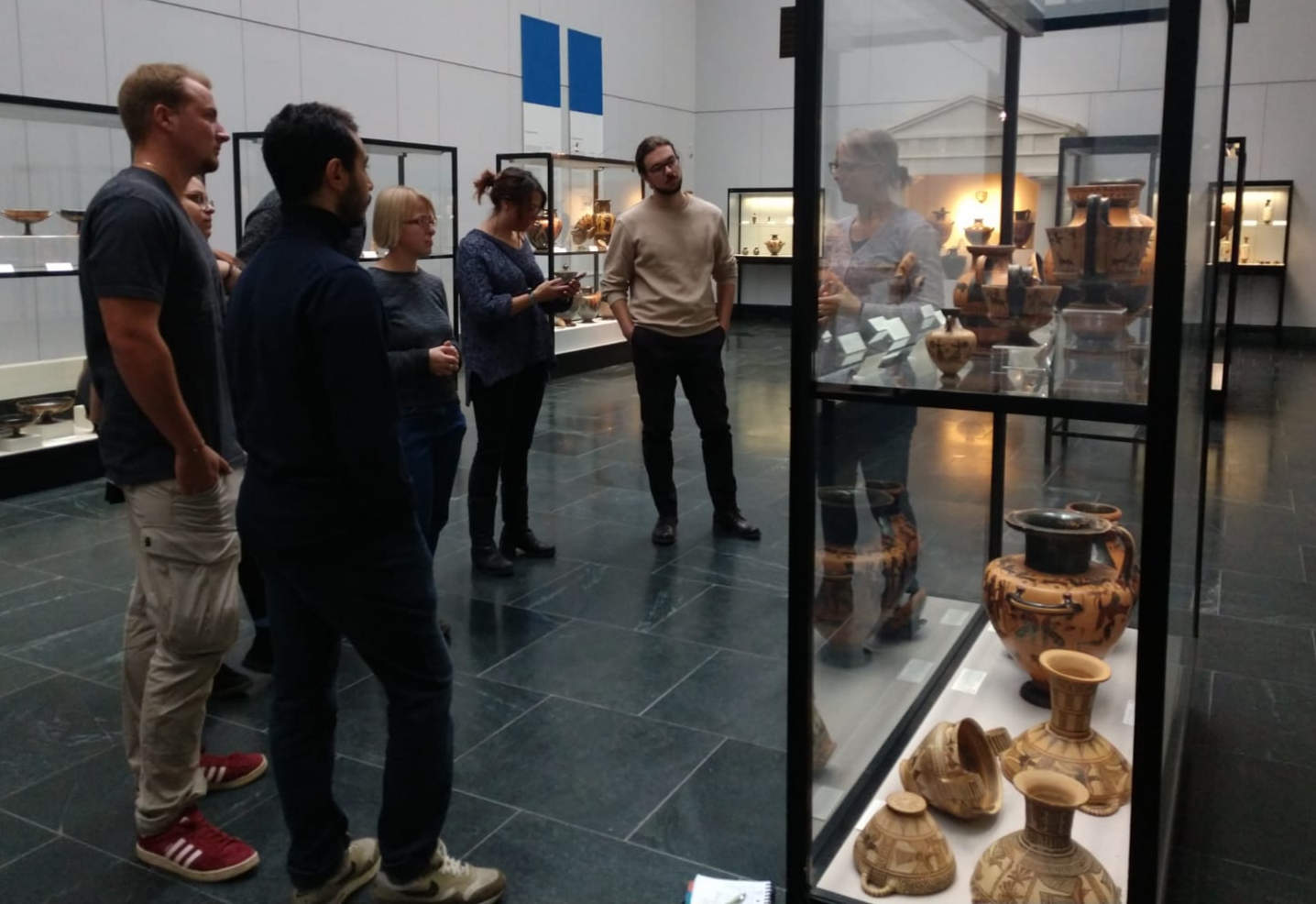
We first visited the extensive Museum for Casts of Classical Sculptures, where the museum director Dr. Nele Schröder-Griebel kindly gave us a guided tour of the new exhibition “Living Plaster” and presented many interesting details about museum education, plaster casting techniques and the history of the museum. We then discussed the archaic sculptures from Samos and Athens and their respective contexts, as well as other masterpieces of antiquity such as the Athena Marsyas group and the Tyrannicides.
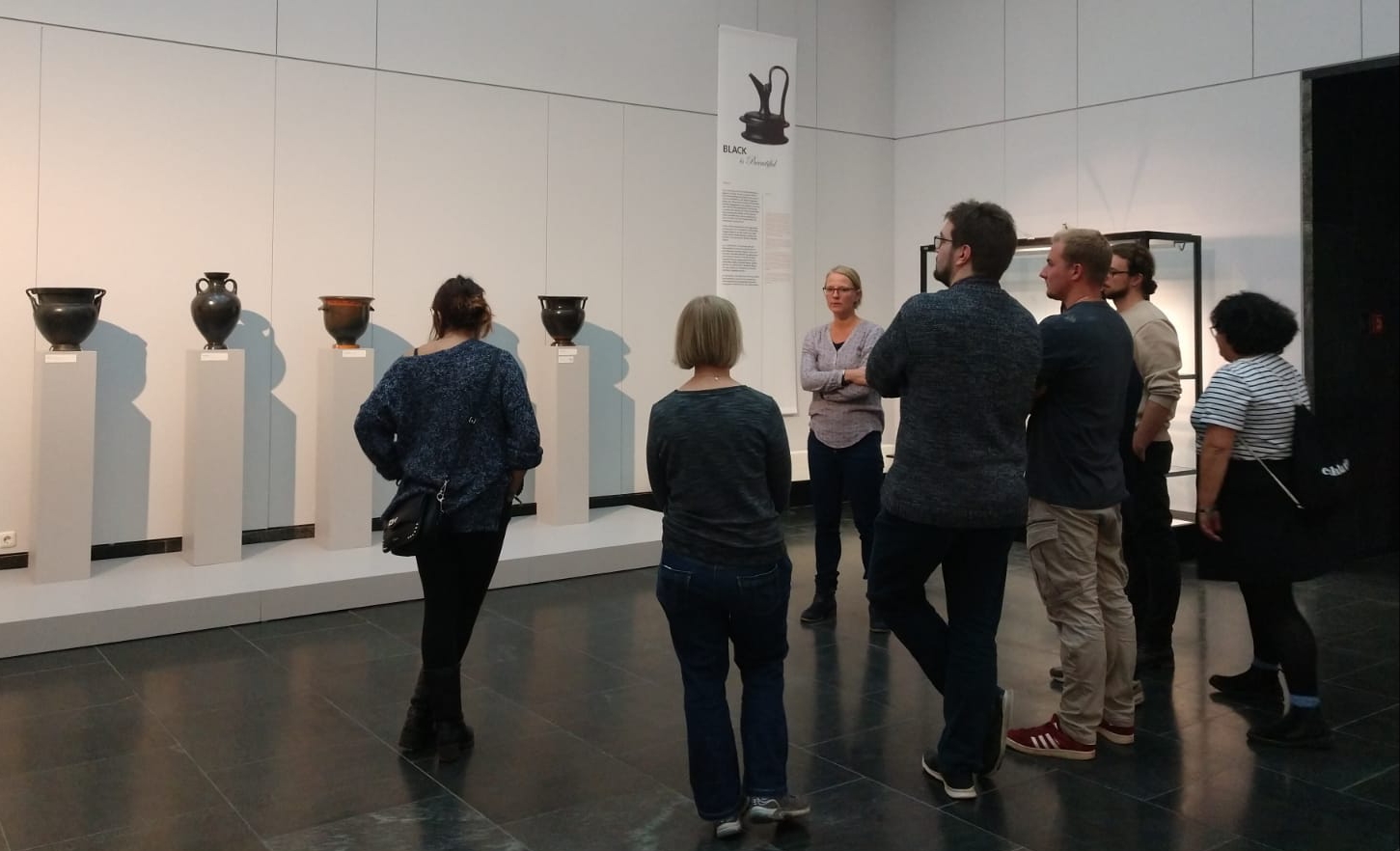
We spent the following two days in the Collection of Classical Antiquities on Königsplatz, looking at the pictorial vases in contrast to the glossy clay vessels in the current exhibition “Black is Beautiful“. Side notes on other find genres such as terracottas, gems, gold jewelry and bronzes showed that these are also linked to each other in terms of pictorial themes or morphology, which rounded off the discussion of material antique diplomas well.

At the beginning of October, the Classical Archaeology working group went on a week-long field trip to Delphi. Every day, 15 students joined lecturers Heide Frielinghaus and Anne Sieverling to visit the oracle site of Apollo and the Delphi Museum.
Following the preparatory seminar in the summer semester, the knowledge was deepened on site, among other things through intensive discussions and identification exercises directly on the archaeological objects, such as the charioteer, the metopes of the Athenian treasury, the bronze tripods …
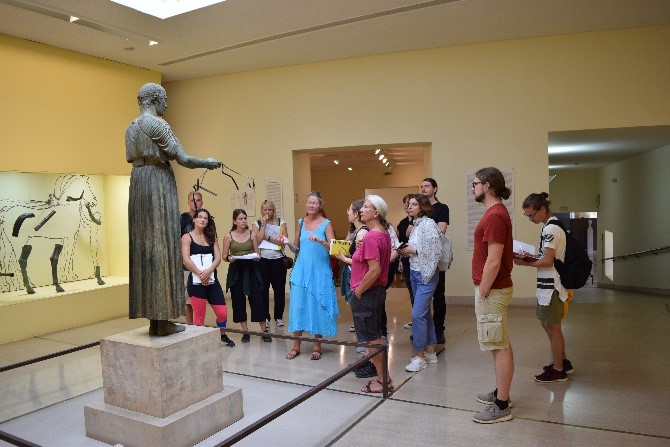
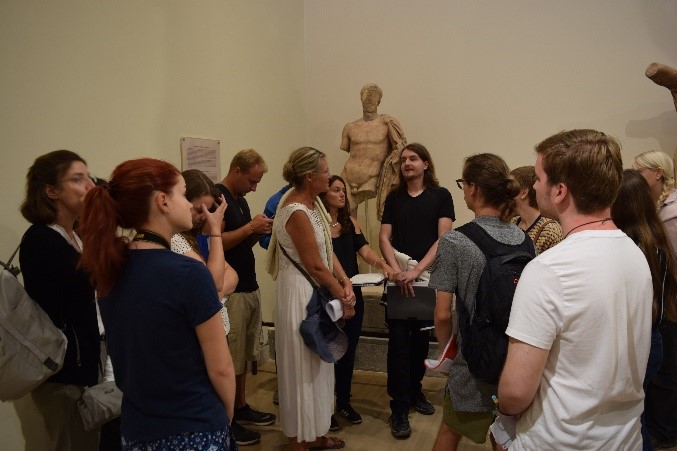
… and the architectural structures, such as the foundations of the Sikyonian Treasury and the Temple of Apollo, as well as the bases of the multi-figure statue dedications.
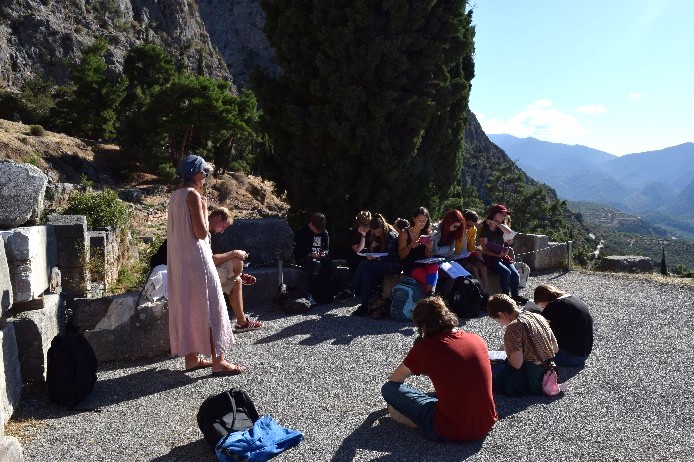
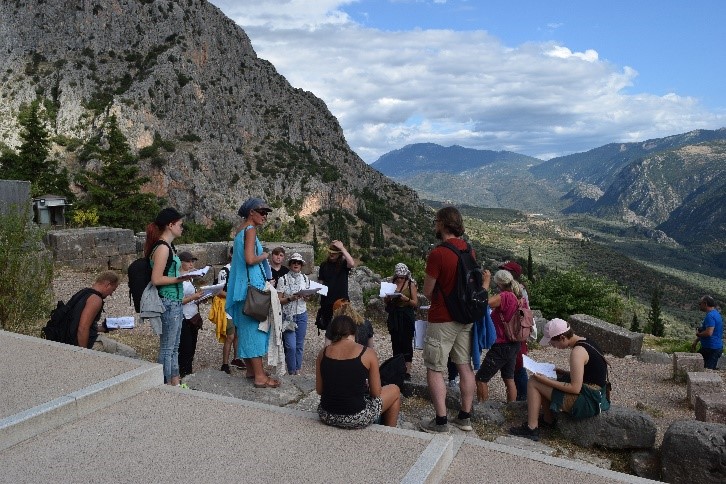
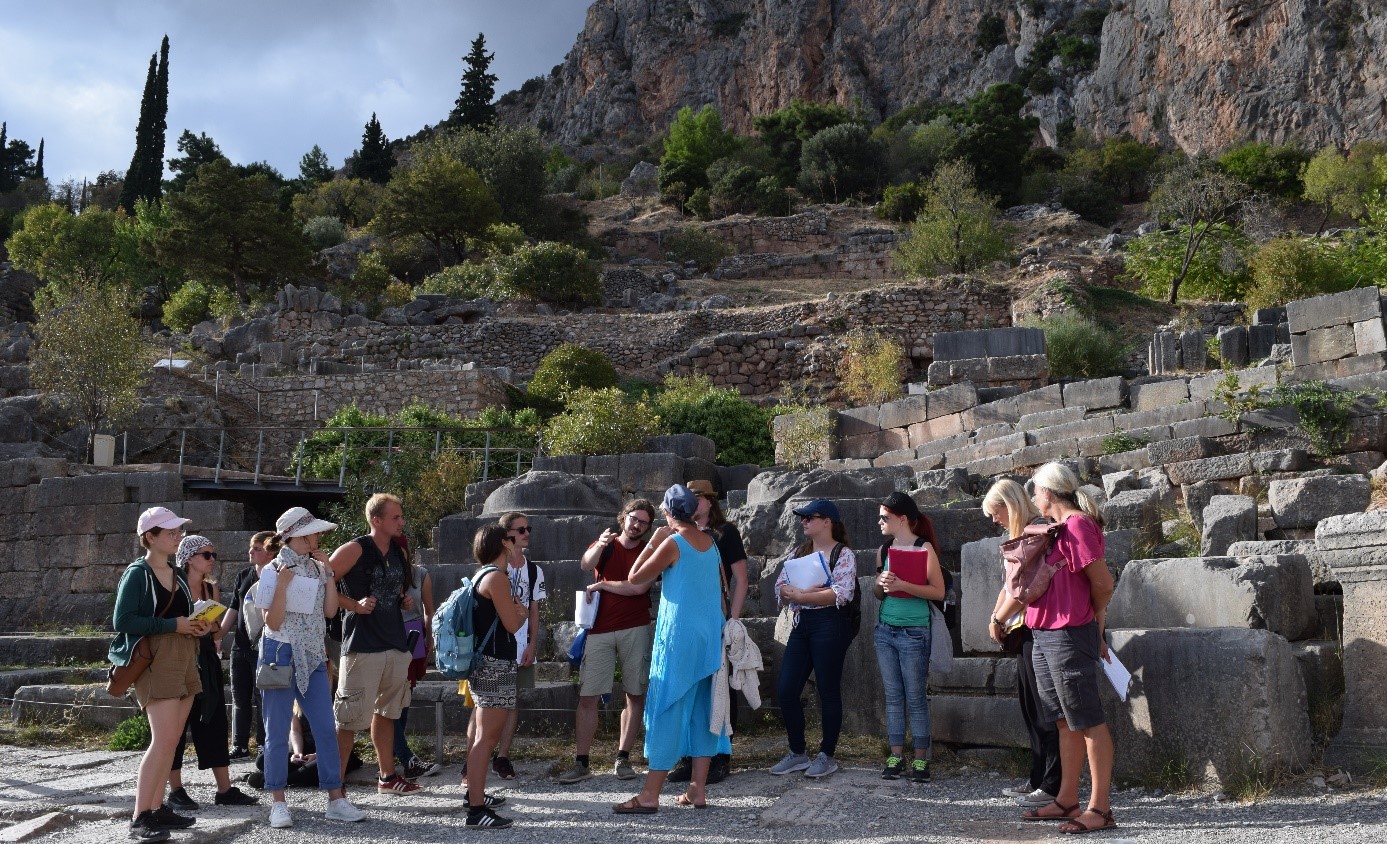
The field trip also included a guided tour of the sanctuary prepared by the students, a reading by Pausanias on the paintings of Polygnot in the Lesche of the Knidians, a guided tour of the finds of the settlement and the necropolis by Dr. Nikolaos Petrochilos (Ephoria Delphi) and a visit to the sanctuary of Athena Pronaia and the sports facilities associated with the Pythian Games. We have now returned from this intensive pilgrimage with a great deal of new knowledge, insights and new interesting questions.
We would like to thank the archaeological employees of the Ephorate of Delphi, especially Mr. Petrochilos, and the guardians of the site and the museum for their hospitality and helpful support.
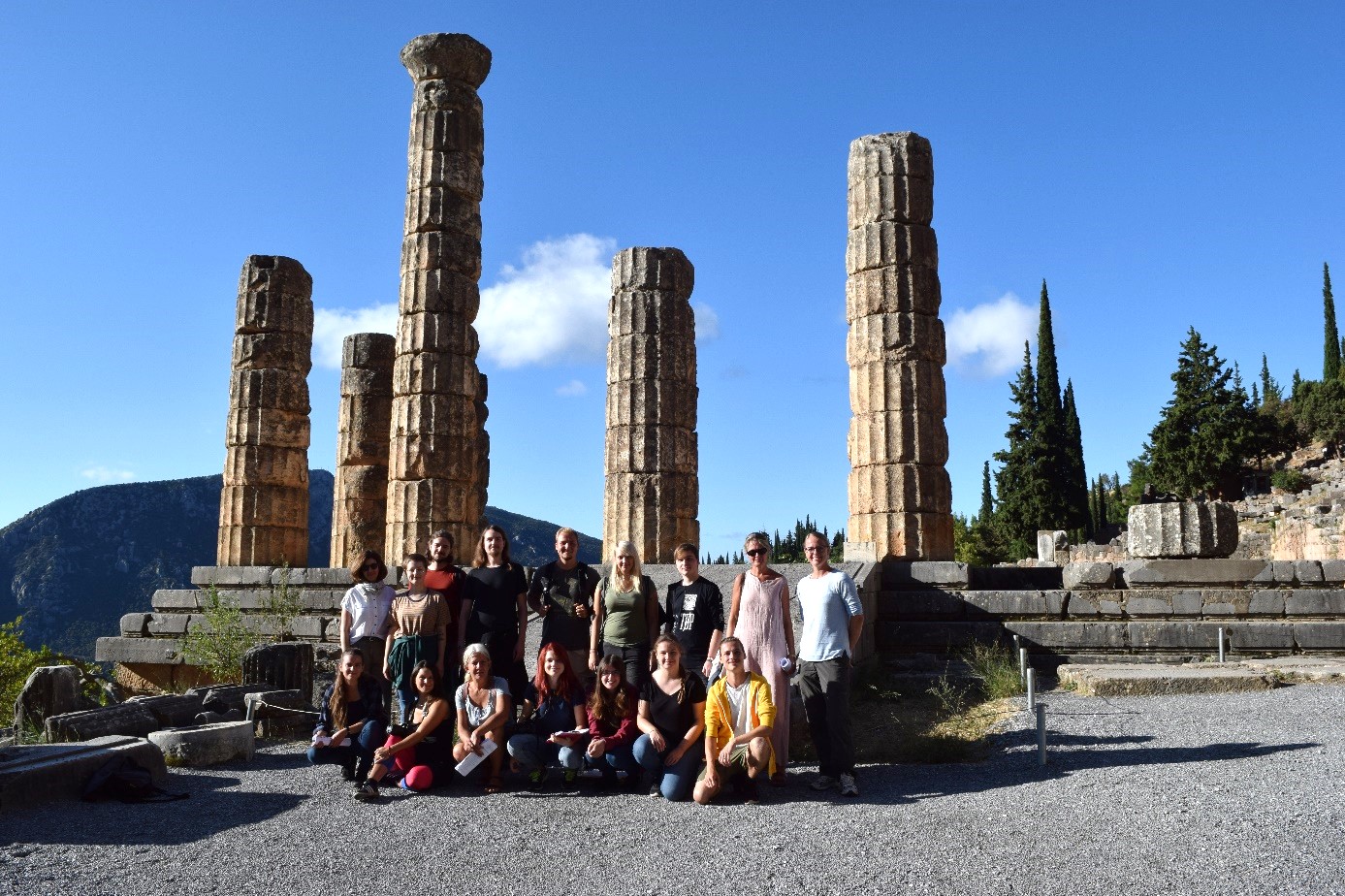
Bottom from left Melina Angermeier, Kristina Wörzler, Emese-Eva Huber, Janina Noack, Pia Kusche,
Sina-Marie Hahn
Top from left Elke Baum-Hofmann, Bianca Protiwa, Stefan Wetherington, Adrian Schulze, Philipp Schug,
Sarah Merk, Yannic Heilmann, Heide Frielinghaus, Anne Sieverling
On Saturday 29 June 2019, our field trip to the Palatinate organized by the student council took place with a colourful Roman Villa-Terra Sigillata-Cannibal-Celtic Wall-Stone Quarry program.
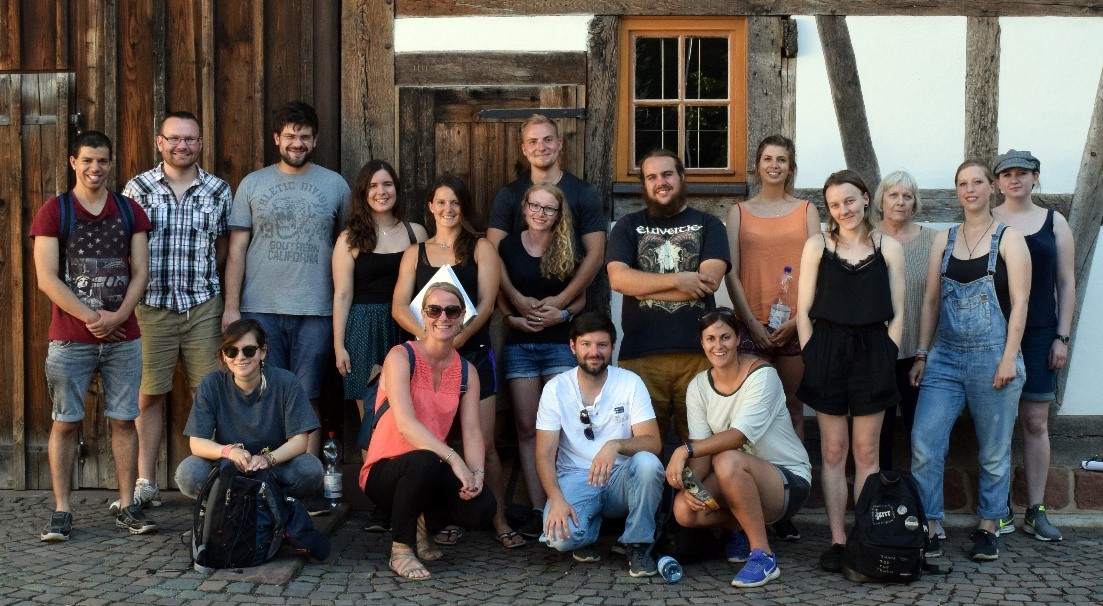
Our first stop was the Villa Rustica “Weilberg” in Ungstein near Bad Dürkheim, where we were kindly given a guided tour of the partially reconstructed complex by Dr. Fritz Schumann. The economic basis of the risalit-style villa, which was decorated with murals and a heated bath, was viticulture, of which the wine press has been preserved. We were able to taste today’s products from a tumblers.
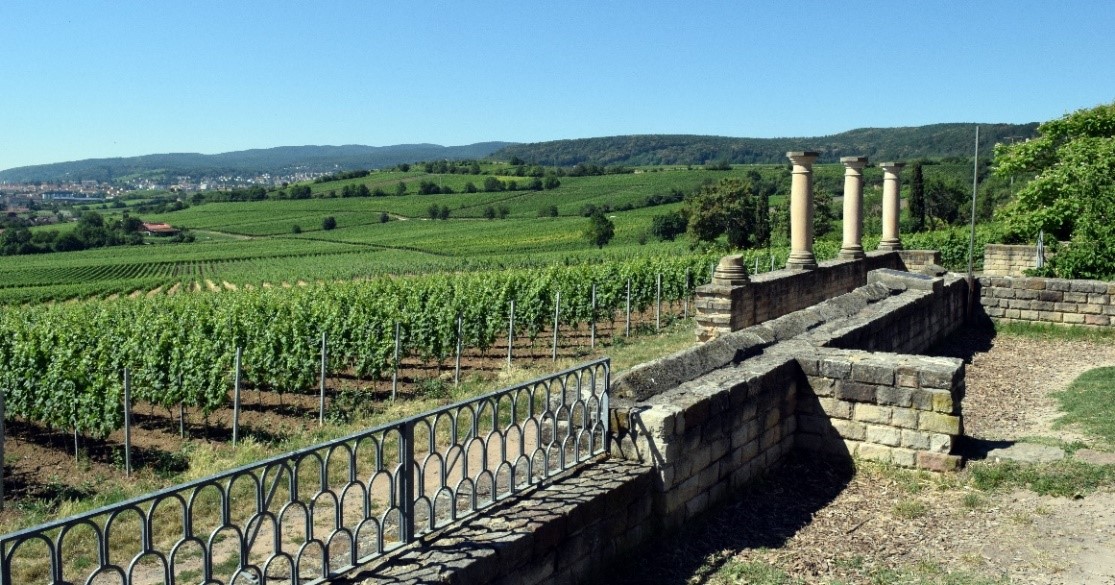
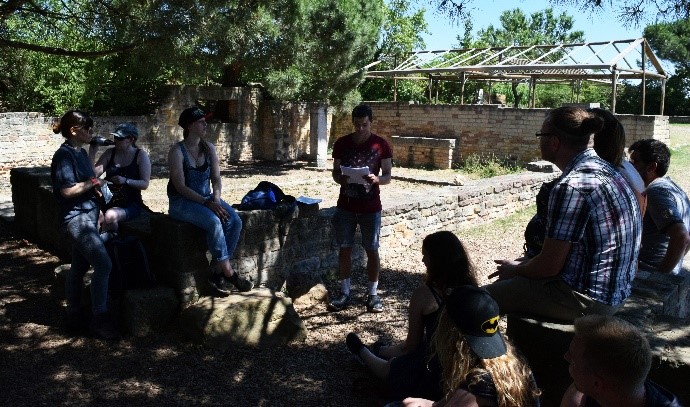
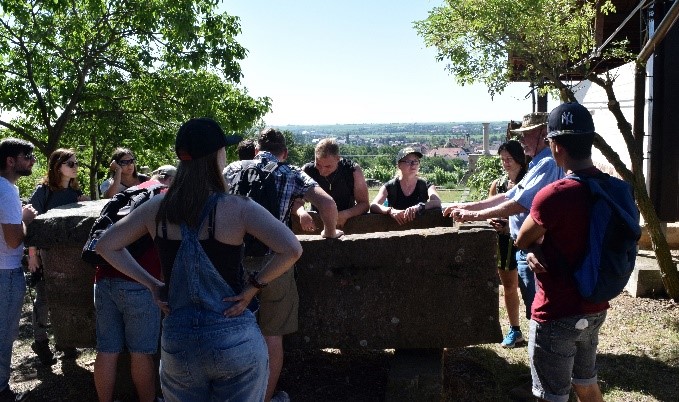
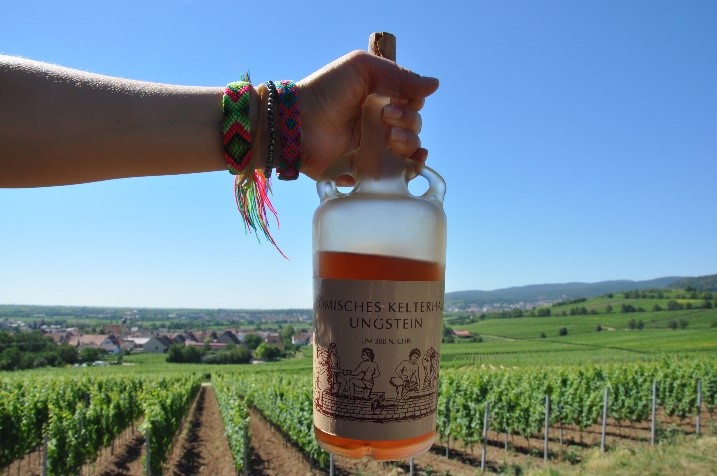
Then we went on to the Terra Sigillata Museum in Rheinzabern, where Dr. Fridolin Reutti was waiting for us to tell us about his wealth of excavation and research knowledge and guide us through the exhibition. We learned about a tomb relief from the Vicus Tabernae, the extensive range of products made there, such as bricks, Terra Nigra and, of course, the famous Terra Sigillata from Rinzabern. The highlight was the various production techniques of the red-coated pottery and the firing process in the many kilns that were found here.
After a short breather in the museum courtyard, where it was now 36 degrees, we continued on to the Herxheim Museum, where we looked at the exhibition on the Neolithic cult site in Herxheim and discussed the very unusual findings in depth. Around 7000 years ago, remarkable funerary rituals were carried out here, in which hundreds of human bodies were dismembered, their skullcaps cut off, the bones smashed and the human remains buried with intentionally destroyed vessels and other grave goods.
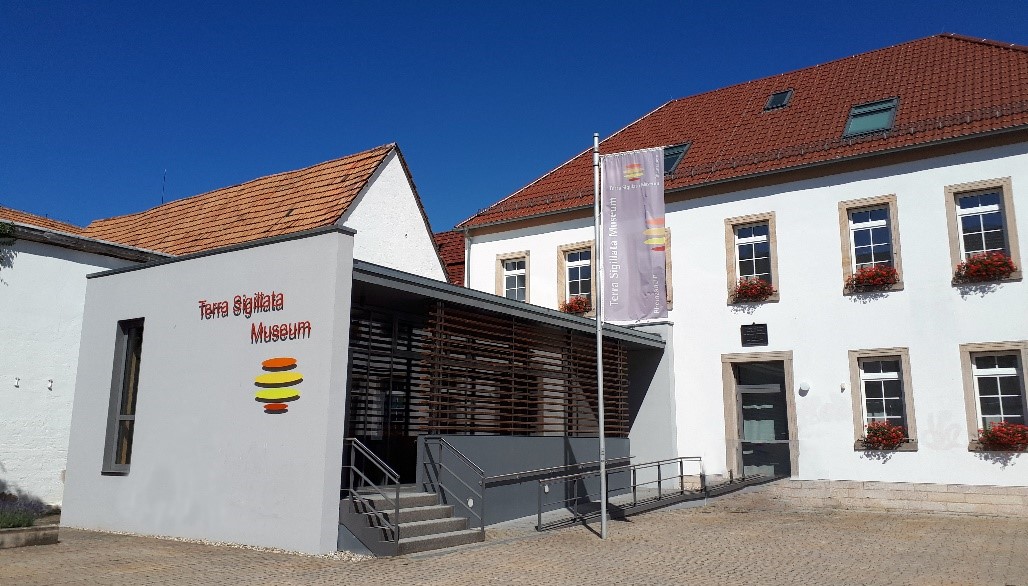
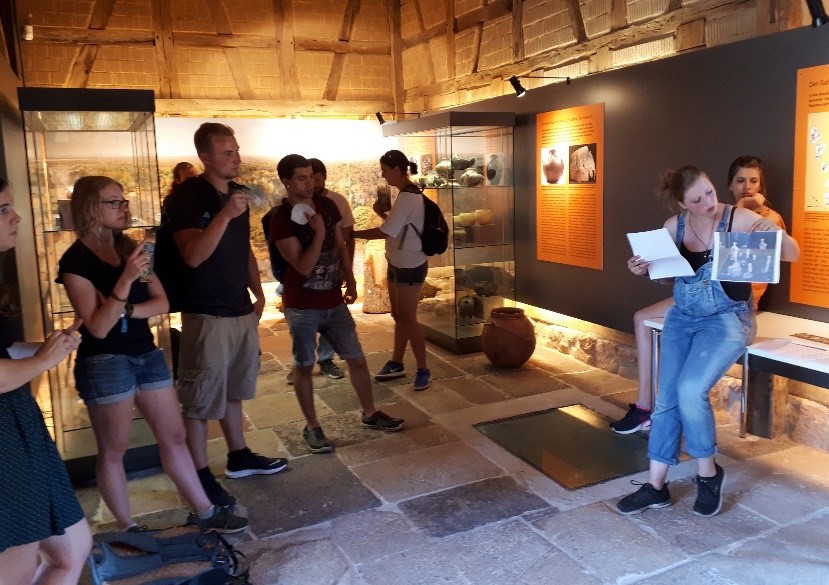
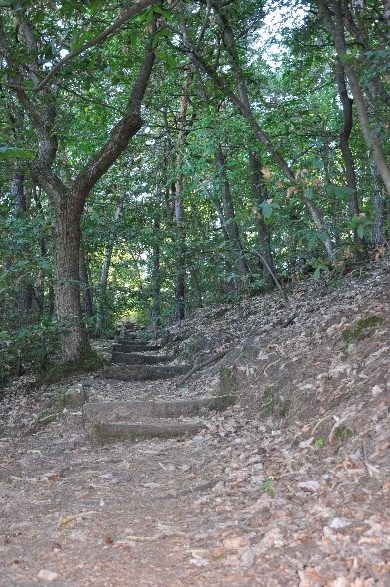
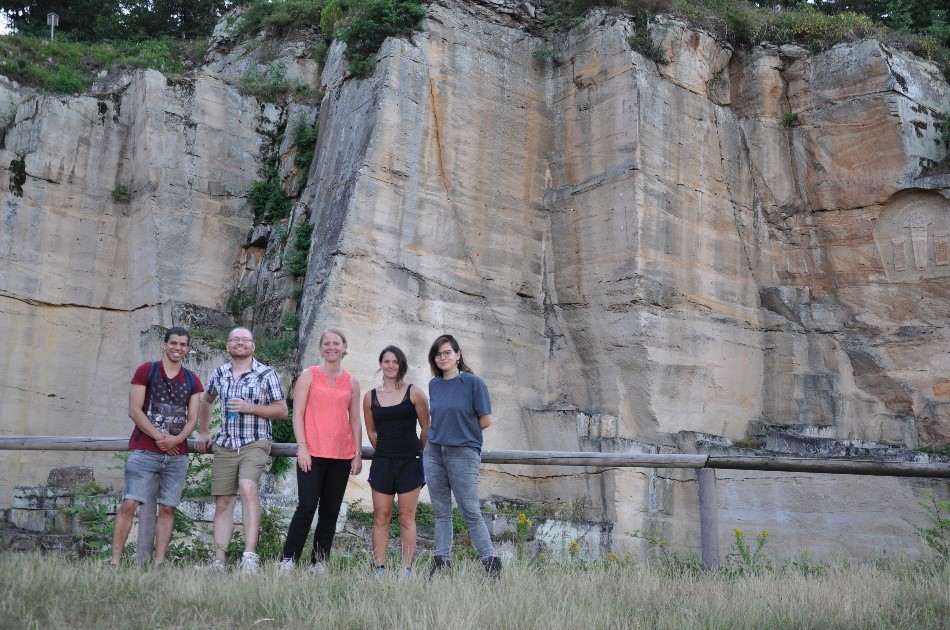
The last part of the field trip then took place in a smaller group on the Kästenberg in Bad Dürkheim, where we hiked to the “Heidenmauer” hilltop settlement, a 2 km long Celtic ring wall from the late Hallstatt period, and its exposed Zangentor gate. Finally, we climbed up to the Roman quarry, the so-called Kriemhildenstuhl. There we enjoyed an after-work drink with a fantastic view of the Wine Route and the Rhine plain before heading back to Mainz after a long and very interesting day.
A special focus of the practical training in the archaeology degree programs at Mainz University is on museums and exhibitions. Thanks to the Classical Archaeology department’s own collections, it is possible to regularly offer practical museological seminars for students in preparation for special exhibitions.
An “Introduction to Museum Work” is also regularly offered, in which the basics of all public-facing areas of museum work such as exhibition planning, museum education, etc. are taught. In addition, students can complete three to six-week internships in the Classical Archaeology collections during the semester breaks.
The colloquium offers a first insight into possible career fields after completing a program of study in the field of ancient studies. The disciplines of Egyptology, Ancient Oriental Studies, Byzantine Archaeology, Classical Archaeology, Classical Philology, Pre- and Protohistoric Archaeology and Ancient Near Eastern Archaeology present concrete perspectives that show participants career opportunities within and outside academia. Graduates, lecturers, alumni and other guests report on their own career paths and enable students to talk to them and ask their questions.
Close cooperation with LEIZA and the GDKE as well as project-related cooperation with partner institutions in the region and beyond gives our students the opportunity to get to know a wide range of (larger) fields of activity. We would like to expressly encourage our students to make use of the passing networks and are happy to assist with placement.
- Archaeology Data Service University of Southampton (digital archive for Roman amphorae)
- Archaeopress Publications (Archaeological specialist literature)
- ARTEX (research association for archaeological textile research with specialist publication)
- American School of Classical Studies at Athens (editor of the series Athenian Agora and Corinth; Hesperia)
- Cambridge University Press (Archaeological specialist literature)
- Central and Eastern European Online Library (Online Library)
- Center Jean Bérard (miscellaneous literature)
- De Gruyter Verlag (miscellaneous literature)
- Digital library of the Regional Archaeological Service of BrittanyExcavation reports)
- DOABooks – Directory of Open Access Books (diverse literature)
- Dyabola (literature research)
- Edipuglia-Verlag (various literature)
- Edition Topoi Verlag (diverse literature)
- Edizioni Ca’ Foscari Digital Publishing (miscellaneous literature)
- JSTOR (scientific platform)
- Internet Archive (digital copies of historical printed works)
- L’Édition électronique ouverte (miscellaneous literature)
- Leuven University Press (miscellaneous literature)
- L.I.S.A. Science Portal of the Gerda Henkel Foundation (scientific films and interviews)
- Oriental Institute University of Chicago Catalog of Publications (various series)
- Persée Portal (scientific platform)
- Perseus digital library (library for ancient texts)
- Propylaeum-eBOOKS (publication platform)
- SAIA – Scuola Archeologica Italiana di Atene (publisher of Annuario magazine)
- Sidestone Press publishing house (miscellaneous literature)
- Heidelberg University Archaeological collections (digital copies of historical printed works)
- University of Oxford Beazley archives (ceramics database)
- Publishing house of the Austrian Academy of Sciences (diverse literature)
For many years, the members of the Classical Archaeology research unit have been characterized by their broad commitment to interdisciplinary collaborative projects. These currently include the management of the core research area 40,000 Years of Human Challenges, which was founded in 2019, and the long-term academic project Disiecta Membra. Stone architecture and urbanism in Roman Germany. We are also involved in the Collaborative Research Center 1391 Other Aesthetics, the Research Training Group 2304 Byzantium and the Euromediterranean War Cultures, the EU Research Training Group TheSPIS: Theatre, Sanctuary, Performance: Interaction and Sustainability and a Minigraduate Research Training Group Urban Differences, as well as the Leibniz ScienceCampus Byzantium between Orient and Occident and the Leibniz Excellence Cooperative on Resilience Factors in Diachronic and Intercultural Perspective.
The research colloquium provides an opportunity for presenting and discussing research in depth within a small group of academics. The format is aimed at external guests who wish to present their ongoing work, as well as employees and advanced students within the department. Participation is mandatory for Master’s students, with a focus on thier thesis. This aims is to present the project or topic of work to teaching staff and students. Students present an outline of their planned master’s thesis with the research question to be addressed and the range of methods to be used. A basic compilation of the most important literature is submitted with the presentation.
The series, edited jointly by Heide Frielinghaus (JGU) and Jutta Stroszeck (German Department of Archaeology, Athens Division), has been publishing individual research and conference proceedings on various archaeological topics on ancient Greece in regular intervals since 2010.
- H. Frielinghaus – J. Stroszeck (Hrsg.), Neue Forschungen zu griechischen Städten und Heiligtümern. Beiträge zur Archäologie Griechenlands 1 (2010)
- O. Pilz, Frühe matrizengeformte Terrakotten auf Kreta. Votivpraxis und Gesellschaftsstruktur in spätgeometrischer und früharchaischer Zeit, Beiträge zur Archäologie Griechenlands 2 (2011)
- J. Stroszeck – H. Frielinghaus (Hrsg.), Vorbild Griechenland. Zum Einfluß antiker griechischer Skulptur auf Grabdenkmäler der Neuzeit. Beiträge zur Archäologie Griechenlands 3 (2012)
- H. Frielinghaus – J. Stroszeck (Hrsg.), Kulte und Heiligtümer in Griechenland – Neue Funde und Forschungen. Beiträge zur Archäologie Griechenlands 4 (2017)
- H. Frielinghaus – J. Stroszeck – P. Valavanis (Hrsg.), Griechische Nekropolen: Neue Forschungen und Funde. Beiträge zur Archäologie Griechenlands 5 (2019)
- B. Wesenberg, Qualis peplus fuerit: Zum panathenäischen Peplos. Beiträge zur Archäologie Griechenlands 6 (2020)
- M. Streicher, Panathenäische Preisamphoren hellenistischer Zeit. Kontinuität und Wandel einer athenischen Vasengattung, Beiträge zur Archäologie Griechenlands 7 (2022)
- H. Frielinghaus – J. Stroszeck – A. Sieverling (Hrsg.), Textilien im antiken Griechenland, Beiträge zur Archäologie Griechenlands 8 (2023)
- H. Frielinghaus – J. Stroszeck (eds.), Appointment and Cult, Contributions to the Archaeology of Greece 9 (2025)
Supplement volumes
- H. Frielinghaus – Th. Schattner (eds.), ad summum templum architecturae – Forschungen zur antiken Architektur im Spannungsfeld der Fragestellungen und Methoden (2018)
Series jointly edited since 2019 by Heide Frielinghaus, Sebastian Graetz, Heike Grieser, Ludger Körntgen, Johannes Pahlitzsch and Doris Prechel.
- L. Körntgen – H. Frielinghaus – S. Grätz – H. Grieser – J. Pahlitzsch – D. Prechel (Hrsg.), Dominant, verführend, ewig schuld. Frauen im Umfeld des Herrschers, KpH Bd. 2 (2022)
- H. Grieser – H. Frielinghaus – S. Grätz – L. Körntgen – J. Pahlitzsch – D. Prechel (Hrsg.), Der Herrscher als Versager?! KpH Vol. 1 (2019)
Series jointly published by Heide Frielinghaus and Christine Walde since 2025
- H. Frielinghaus/C. Walde (eds.), Beyond Entertainment. Programs of Study on the Theatre of the Roman Imperial Period I (2025)
The key aim of the new MAPA series (Material Appropriation Processes in Antiquity) is to promote a focus on human and social agency in the way in which material culture, such as artefacts, art and architecture are created, used, and perceived, and thus become crucial factors in processes of cultural transfer and appropriation. This is a deliberately broad understanding of materiality, which does not rely on the wholesale adoption of currently fashionable concepts like “hybridity”, “object agency” etc., whilst at the same time providing a conceptual framework in which such theoretical approaches can easily find a place. Last but not least, the emphasis on processes of material appropriation, driven by human agents in a particular social setting, seems particularly suitable for all sorts of research into aspects of Graeco-Roman antiquity, e.g. in what have usually been conceived as the “core zones” of the Mediterranean, but equally in diverse geographical settings where various form of cultural contact and exchange would have taken place.
Within MAPA, both monographs and edited volumes (e.g. conference proceedings) in German, English, Italian, and French will be published.
Each manuscript will be assessed by members of the MAPA editorial board, in line with their respective expertise, in a double-blind review. For the series a “hybrid” strategy of dissemination is pursued: from the
moment of publication, each volume shall be available both as an e-book and in print, and there is also the option of an Open Access version.
Volumes:
- J. Lipps – M. Dorka Moreno – J. Griesbach (Hrsg.), Appropriation Processes of Statue Schemata in the Roman Provinces, MAPA 1 (Wiesbaden 2021) ISBN 9783954904495
- D. Maschek – F. Diosono (eds.), Living in a World of Change: New Perspectives on Cultural Exchange and Transfer in the Hellenistic Mediterranean, MAPA 2 (Wiesbaden 2025) ISBN 9783752007855
- J. Lipps – D. Kreikenbom – J. Osnabrügge (eds.), Die Mainzer Salus. Gesellschaft und Stadtkultur im Norden der Germania Superior, MAPA 3 (Wiesbaden 2023) ISBN 9783752007954
- J. Lipps – M. Grawehr (eds.), Colour Schemes in Roman Architecture. Aesthetics, Semantics, and Regional Appropriation , MAPA 4 (Wiesbaden 2024) ISBN 9783752008548
This small annual series publicizes objects from the JGU Classical Archaeology Collection.
- K. Gaßmann, Ein Hellenistischer Reliefbecher erzählt von den Anfängen einer neuen Keramikgattung, Mainzer Winckelmann-Blätter 8 (Mainz 2025)
- P. Schollmeyer, Modell eines Töpferofens. Roland Hampes und Adam Winters Forschungen zu antiken Brenntechniken, Mainzer Winckelmann-Blätter 7 (Mainz 2024)
- M. Grawehr, Die Mainzer Augenolpe, Mainzer Winckelmann-Blätter 6 (Mainz 2023)
- P. Pasieka, Tanz und Kampf – zwei Seiten einer Amphora. Die schwarzfigurige Halsamphora Mainz 222, Mainzer Winckelmann-Blätter 5 (Mainz 2022)
- K. Junker, Conspicuous destruction. Die Mainzer Kratere aus früharchaischer Zeit, Mainzer Winckelmann-Blätter 4 (Mainz 2021)
- P. Schollmeyer, Votivgabe für eine Gottheit oder einen Heros? Ein tönerner Miniaturschild aus der Universitätssammlung Mainz, Mainzer Winckelmann-Blätter 3 (Mainz 2020)
- P. Schollmeyer, Fliehende Mädchen. Zwei Tonplaketten aus der Universitätssammlung Mainz, Mainzer Winckelmann-Blätter 2 (Mainz 2019)
- A. Sieverling, Protogeometrische Grabbeigaben aus Westgriechenland. Ein Grabfund aus der Universitätssammlung Mainz, Mainzer Winckelmann-Blätter 1 (Mainz 2018)
| Name | Topic | Thesis Supervision |
| Heide, Thomas | Römische Steinwirtschaft in der Provinz Germania Superior: Archäologische und petrografische Untersuchungen zu Gewinnung, Herstellung und Transport von Bau- und Werksteinen aus lokalem Naturstein | Lipps |
| Pasieka, Paul | Zwischen Resistenz und Resilienz: Sepulkralkultur lokaler Eliten im hellenistischen Etrurien | Lipps |
| Scarci, Azzurra | Ein neuer Blick auf das “multikausale” Phänomen der Fragmentierung – Olympia, andere Heiligtümer und Horte Alteuropas | Frielinghaus |
| Sieverling-Pantelidis, Anne | Versorgungsnetzwerke römerzeitlicher Städte | Frielinghaus |
- Pilz, Dr. Oliver: Kulte und Heiligtümer in Elis und Triphylien (2017)
- Flecker, Dr. Manuel: Kreative Kollaboration(en). Zum Beginn römischer Steinarchitektur in den Nordwestprovinzen (2026)
| Name | Topic | Thesis Supervision |
| Adam, Max Georg | Mercy in war. Submissio representations in the context of Roman victoriousness. (GRK 2304) | Frielinghaus |
| Bockius, Sabrina | Transfer und Transformation römischer Wirtschaftsarchitekturen am Beispiel von Platzanlagen in den Nordwestprovinzen (SFB 1391 in Tübingen) | Lipps |
| Colucci (née Schulz), Nadja | Untersuchungen zu Kulturkontakten in Unteritalien am Beispiel Timpone della Mottas Rekonstruktion lokaler, regionaler und überregionaler Vernetzung anhand archäologischer Funde und Befunde | Frielinghaus |
| Gómez Blanco, Francisco José | The Arena at Home: Concepts of Body and Violence in Mosaic Depictions of Amphitheater Events of the Roman Imperial Period (GRK 1876) | Frielinghaus |
| Hack, Charleen | Buntes Mainz. Zur Polychromie römischer Steindenkmäler im Norden der Provinz Germania superior (SFB 1391 in Tübingen) | Lipps |
| Nagy, Goldie Gloria | Investigations into the significance of equids in the Roman military context (GRK 2304) | Frielinghaus |
| Rinaldi, Adele | Da Vespasiano a Domiziano. Le fasi edilizie e stratigrafiche di un tratto della Cloaca Maxima | Lipps |
| Rodriguez de Guzman, Nathalie Julia | Konzepte vom toten Körper in der römischen Bildkunst von der späten Republik bis zur mittleren Kaiserzeit (GRK 1876) | Frielinghaus |
| Ruhland, Anna-Sophie | Ästhetische Potenziale frühkaiserzeitlicher Architektur am Beispiel Korinths und weiterer ausgewählter urbaner Zentren Griechenlands (SFB 1391 in Tübingen) | Lipps |
| Skolik, Annika | Roman geisa and architectural ornamentation in the north-western provinces | Lipps |
| Suquet, Andrea | From settlements to cities: birth, development and changes of Apulian populations settlements between the Archaic period and the Roman Republican age (MGRK Urban Differences) | Lipps |
- De Luca, Sabina: L’ordine ionico a Roma. Tipologia, contesti, semantica (2025)
- Deppe, Konstantin: Die römischen Panzerstatuen des griechischen Ostens. Produktionsprozesse, Typen und Kontexte kaiserzeitlicher Thorakophoroi (2025)
- Graml, Constanze: Das sog. Hekateion im Kerameikos von Athen (2014)
- Hanelt, Julia Sophia: Geprägte Gelübde – Untersuchungen zu den Votaprägungen anlässlich der Regierungsjubiläen der römischen Kaiser von Augustus bis Iustinianus I. (2024)
- Hanelt, Philipp Jakob Nicolai: Untersuchungen zur Entwicklung der Darstellung der römischen Kavallerie auf Bildträgern der östlichen Hälfte des Imperium Romanum (2024)
- Jäger, Florine: Marmoranstückungen an antiken Skulpturen (2025)
- Kocak, Mustafa: Aphrodite am Pfeiler. Studien zu aufgestützten / angelehnten weiblichen Figuren der griechischen Plastik (2010)
- Lehnig, Sina: Foodways through the Desert. A multidisciplinary approach to the settlement history of Arabia and Palaestina (2nd – 7th centuries CE) (2022)
- Martins Berger, Frederik: Inszenierung der Antike. Öffentliche Antikensammlungen im 19. Jh. (2015)
- Pavic, Anton: Illyricum – Griechenland – Rom: Kontaktinduzierter Wandel in den Stadtzentren der Ostadriatischen Antike (2014)
- Prause, Sarah: Konzepte von Blindheit – Ein Krankheitsbild zwischen Darstellung und Heilungsbestrebung im 8.-1. Jh. v. Chr. (2018)
- Richter, Daniel: Vetera Castra und die frühkaiserzeitliche Architektur und Bauornamentik des Rheinlands (2025)
- Schimpf, Florian: Mensch. Landschaft. Religion: Eine Untersuchung zur Genese, Gestaltung und Wahrnehmung von heiligen Naturräumen in Kleinasien (2017)
- Shala, Elvis, Dresnik: Late Roman Settlement and its Place within the Roman Empire (2025)
- Stoeßel, Linda:‚Andere‘ Ästhetik antiker Wirtschaftsräume im Rom der späten Republik und frühen Kaiserzeit (SFB 1391 in Tübingen) (2026)
- Theis, Frederic: Römische Schiffsdarstellungen in Italien und dem westlichen Mittelmeer. Studien zu Ikonographie und Kontext (2016)
- Tietz, Julia: The crouching Aphrodite (2021)
- Wolf, Christina: Der Satyr aus Mazara del Vallo (2010)
- Adam, Max Georg: Postumus’ other side – a quantitative analysis of Roman coin depositions in Britain in the 3rd century AD (2025)
- Angermeier, Melina: Die etruskisch-geometrische Keramik der Grabungskampagnen 2021 und 2022 am Tempio Nuovo in Vulci (2023)
- Ahfeldt, Lukas: Mit anderen Augen – Eine Analyse der Visualisierungsverfahren und -geschichte in der Archäologie am Beispiel architektonischer Funde in Pergamon (2021)
- Bandlow, Elisa-Marie: Heracles in Apulian vase painting (2015)
- Beck, Samantha: The Choironisi site and its significance in the region. An evaluation based on the finds of the Plaghiá Peninsula Survey (2023)
- Bockius, Sabrina: Die bauliche Ausstattung römischer Platzanlagen in Germanien (2022)
- Colucci (geb. Schulz), Nadja: Ritual Destruction and Accidental Damage of Votive Gifts in the Archaic Sanctuary of Timpone della Motta (2023)
- Deppe, Konstantin: Die römischen Panzerstatuen des griechischen Festlands (2018)
- Dörr, Sabrina: Zur Darstellung alter Menschen in der attischen Keramik klassischer Zeit (2014)
- Engel, Julian: Concordia im Imperium Romanum – Studien zur Identifizierung und Lokalisation des Concordia-Kults (2021)
- Hafner, Lucas: Die Exomis in klassischer und hellenistischer Zeit (2016)
- Holweg, Johanna: Erstpublikation archäologischer Funde aus Israel (Akko, Ossure) (2018)
- Kapfer, Lisa: Mykenische Vasen mit figürlichen Darstellungen (2020)
- Kazior, Franziska: Totenkult in Nahost mit speziellem Blick auf die Turmgräber in Palmyra. Vergleich und Austausch mit anderen Kulturen (2022)
- Kress, Bianca: Die Akropoliskore 682. Möglichkeiten und Grenzen der Polychromieforschung (2018)
- Kühnreich, Daniela: Bildprogramme römischer Ehrenbögen in den Nordwestprovinzen (2019)
- Kyewski, Sandra: Gladiatorenmosaik von Bad Kreuznach und die Ikonographie der Venatio (2014)
- Jäger, Florine: Statuette einer sitzenden Nymphe – Typus einer Muse (Dresden-Zagreb) (2018)
- Mangelsen, Friederike: Die Wirkung des (Original-) Objekts bei der Vermittlung im archäologischen Museum. Besucherstudie am RGZM (2015)
- Nappert, Nicola: Untersuchungen zur Votivpraxis in ausgewählten boiotischen Heiligtümern (2014)
- Nicodemus, Julia: Die Bedeutung von Ixous auf der westgriechischen Plaghiá-Halbinsel (2025)
- Ockert, Anna: Römische Brücken – Darstellungen und Bildschmuck (2019)
- Pachen, Katharina: Die Stadtreliefs von Avezzano (2014)
- Rausch, Laura Magdalena: Unter Dach und Fach: Untersuchungen zu den Dachterrakotten der Ausgrabungen 2021-2023 am Tempio Nuovo in Vulci (2025)
- Richter, Fabienne: Die Taten des Herakles auf einem Fries im Theater in Delphi (2015)
- Rodriguez de Guzman, Nathalie: Terrakotten aus dem Besitz der REM Mannheim unter besonderer Berücksichtigung des Typus der Manteltänzerin (2019)
- Schilling, Mario: Sarkophag-Fragmente aus Patara (2016)
- Schug, Philipp: Neues Licht auf römische Lampen in Etrurien: Die Lampenfunde der Kampagne 2021 des Projektes Vulci Cityscape (2023)
- Skalecki, Ralf: Ionische Tempel und Bauornamentik in der Magna Graecia (2016)
- Ahfeldt, Lukas: Die Rezeption des Pantheon in der römischen Baukunst (2015)
- Angermeier, Melina: Ein hellenistischer Grabbefund in Akarnanien (2020)
- Beck, Samantha: Gallorömische Heiligtümer – Die Bedeutung der Heiligtümer von Augusta Treverorum für die Herausbildung einer gallorömischen Kultur (2019)
- Becker, Yvonne: Das Templum Gentis Flaviae (2016)
- Bertram, Clemens: Grabmonument in Osterburken. Rekonstruktion und Typologie (2018)
- Bockius, Sabrina: Die Rote Halle von Pergamon (2018)
- Brill, Juliet: Altersdifferenzierung auf attischen Choenkännchen (2023)
- Czepluch (née Oppelland), Katharina: A Venus from Vulci. On the relationship between figuratively decorated everyday objects from the Roman period and their educational background using the example of a bone object from Vulci (2023)
- Deppe, Konstantin: Goldschmuck in der rhodischen Peripherie (2016)
- Engel, Julian: Archäologische Zeugnisse zum Isiskult in Rom (2017)
- Fischer, Maya-Franziska: Heroes at the Altar in Attic Vase Painting (2023)
- Gaßmann, Kai: Ein hellenistischer Reliefbecher aus der antiken Keramiksammlung der Klassischen Archäologie an der Johannes Gutenberg-Universität in Mainz (2024)
- Gebhardt, Laura: „filiae dulcissimae? Zwei Grabaltäre aus Mogontiacum“ (2025)
- Gerlach, Esther: Erzieher, Lehrer, Unterricht in der attischen Vasenmalerei (2014)
- Hack, Edwin: Das archaische Didymaion (2016)
- Hahn, Sina-Marie: Die Familie des Asklepios (2021)
- Hammen, Moritz: Der ‘arcus novus’. Ein Rekonstruktionsversuch (2025)
- Hasse, Felix: Das Amphiaraion von Oropos (2017)
- Heinz, Lisa: Die attischen Phylenheroen. Das Monument auf der Agora (2014)
- Höhr, Vincent: Das Römische Theater von Mainz: Deutung der spätantiken Datierung (2025)
- Huber, Eva-Emese: Läuferdarstellungen auf Panathenäischen Preisamphoren des 6. und 5. Jahrhunderts v. Chr. (2022)
- Jäger, Florine: Frauen im dionysischen Umfeld in der apulischen Vasenmalerei (2015)
- Jürgens, Fabian: Bewaffnung und Bewaffnungsrealität. Zur Darstellung der Bewaffnung auf attischen Vasen anhand der Siana-Schale Inventarnummer 89 der Mainzer Universitätssammlung (2022)
- Kapfer, Lisa: Das Schiffsfresko von Akrotiri (2017)
- Kehl, Dehlia Ciara: Medea’s characterization on the volute krater (3296) in the Munich Collection of Classical Antiquities and her role as a murderess in Apulian vase painting (2025)
- Koblenz, Yasmin: Materialität und Medialität des Larenkultes im Wandel des augusteischen Rom am Beispiel des Compitum Acili (2024)
- Korbach, Lisa: Selten Sichtbar. Arbeitende Frauen auf attischen Vasen des 6. und 5. Jahrhunderts. v. Chr. (2018)
- Kühnreich, Daniela: Die Attikareliefs des Trajansbogens von Benevent (2017)
- Kress, Bianca: Die sog. Geschwisterstele im Metropolitan Museum of Arts in New York (2014)
- Laabdallaoui, Houda: Handwerksdarstellungen auf dem sog. Forumsfries der Julia Felix (2025)
- Langenberger, Niels-Bjarne: Dienende Gestalten in der Pompejanischen Wandmalerei (2025)
- Lerner, Maya Elisa: Die Münzprägung der römischen Kaiser Balbinus und Pupienus (2022)
- Moll, Kevin: Monster in der apulische Vasenmalerei (2024)
- Münze, Katharina: Die Schale Mainz Inv. Nr. 104 und die Darstellung von Satyrn (2018)
- Muno, Matthias: Der stadtrömische Mithraskult (2014)
- Nicodemus, Julia: Der Krater Mainz Inv. 178: An iconographic study of the griffin depictions on Attic red-figure pottery of the 4th century BC. (2023)
- Nitsch, Christine: Mykenische Schmucktechniken (2024)
- Nowak, Florian: Zeugnisse östlicher Kulte in Mainz (2018)
- Ockert, Anna: Hafendarstellungen in der antiken Bildkunst (2017)
- Oehmig, Saskia: Das Palestrina-Mosaik (2017)
- Pfeifer, Ann-Kristin: Augustus und Pietas. Wandel eines Tugend- und Wertebegriffes unter Octavian – Augustus (2019)
- Protiwa, Bianca: Mythische Königinnen in der attischen Vasenmalerei (2021)
- Rausch, Laura: Die erste Monumentalisierung der griechisch-geometrischen Dreifüße (2020)
- Rodriguez de Guzman, Nathalie: The Hildesheim silver find (2016)
- Rogall, Dominik: Analyse und Kontextualisierung einiger Bucchero-Gefäße im RGZM (2017)
- Schiffer, Hubert: Römische Bäder in Mainz und Umgebung (2025)
- Schlimm, Pascal: Klassizistische Tendenzen in der Spätantike (2015)
- Schmitt, Michael: Der attisch-rotfigurige Skyphos Mainz Universität Inv. 113 (2017)
- Schug, Philipp: Das Grab des sog. Greifen-Kriegers in Pylos (2020)
- Stridde, Kimberley: Odysseus in Apulien – zu einer Oinochoe mit Phlyakenszene (2025)
- Termin, Nina: Zur Palastarchitektur Herodes des Großen (2017)
- Thüring, Hannah: Das Monument des Lysikrates in Athen (2017)
- Weber, Julia: Ein Grab in Kalami (Akarnanien). Die chronologische Einordnung eines Grabbefundes (2024)
- Wetherington, Stefan: Akrobatendarstellungen in der unteritalischen Vasenmalerei (2021)
- Zander, Kurt: Ikonographie der Barbaren am Großen Ludovisischen Schlachtsarkophag (2014)
The Classical Archaeology research unit has three extensive collections: Original small works of ancient art, plaster casts of Greek and Roman sculptures and original photographs of ancient works of art, buildings and sites. They are used as part of the practical modules of the bachelor’s and master’s degree programs for the practical training of students. These efforts were and are reflected in special teaching projects, thematic special exhibitions and special tours for an interested external and internal university public. Objects from the classical archaeology collections are regularly on display in the School of Seeingthe showcase of science and arts at Johannes Gutenberg University Mainz, as part of special exhibitions.
A special focus of the public outreach is on events for pupils and lecturers as part of the Mainz Ancient Studies Network University School (MANUS). Corresponding offers for exploring the collection are individually tailored to the curriculum requirements of the individual schools and can be requested at any time from the responsible collection curator by telephone or e-mail.
Both collections are located in Philosophicum I, Jakob-Welder-Weg 18, and are open to the public on request.
The original collection of Classical Archaeology mainly contains figuratively and ornamentally decorated Greek ceramics from the 8th to 4th centuries BC as well as a few terracottas, bronzes and stone works. The objects on display provide a wide range of insights into the realities of life in antiquity, religious concepts, burial customs and forms of self-presentation of the ancient elites.
The history of the collection
The collection includes some particularly prominent exhibits, including an early Attic grave find: a bowl from the Amasis Painter and a bronze handle attatchment from the 6th century BC, which have already been shown at special international exhibitions.
The pieces in the original collection come almost exclusively from Greek sanctuaries and tombs. In addition to mythical figures, they also depict scenes from everyday life. For example, there are scenes from the areas of weddings, sport, religious rituals, war, hunting and caring for the dead.
With a few exceptions, the exhibits were purchased by the first chair holder, Roland Hampe, who acquired a total of three older private collections (Grancy, Massow and Preuss).
The majority of the collection has been published. In addition to specialist publications, since the 1950s the working group’s researchers have also endeavored to make the collection accessible to a wider circle of interested parties in the form of popular science books, guided tours, lectures and special exhibitions. Since 2018, an annual issue of the Mainzer Winckelmann-Blätter is being published annually, in which an object or a group of objects from the collection is presented.
Exhibitions in the original collection
The special student exhibition is based on the results of Kai Gaßmann’s bachelor’s thesis, which was the first scientific examination of relief beaker 212 from the original Classical Archaeology collection. The investigation was recognized by Faculty 07 as an outstanding final thesis and the interesting results are now presented in this hybrid exhibition.
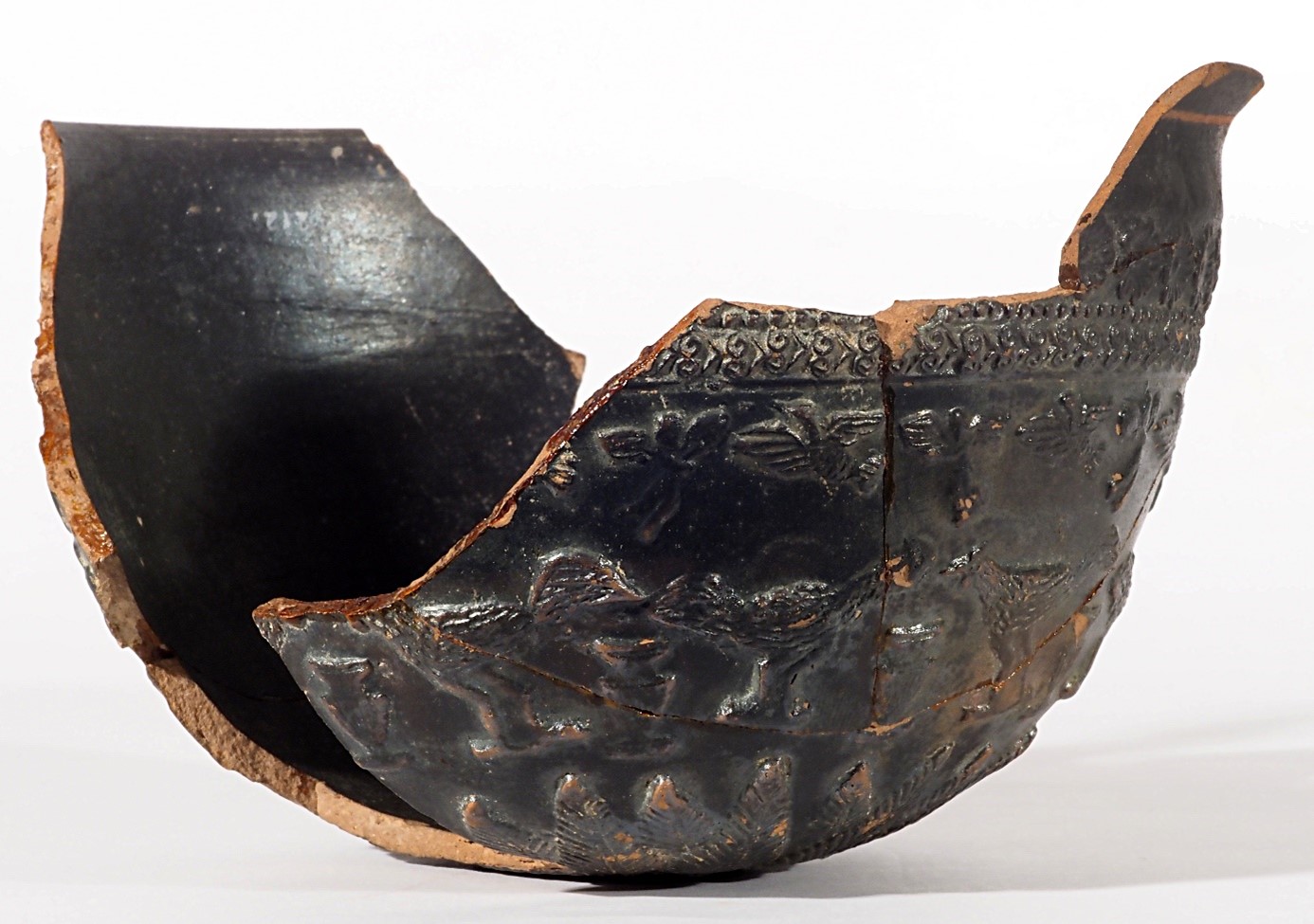
Sculptural decoration on the outside of relief pitcher 212 Photo by A. Schurzig
Distribution
Vessel 212 belongs to the ceramic genre of Hellenistic relief cups. These were popular drinking vessels for wine in the Hellenistic period and were widespread throughout the Mediterranean. 
Revised map by P. G. Bilde, Mouldmade bowls, centres and peripheries in the Hellenistic world, in: P. Bilde et al. (eds.), Centre and periphery in the Hellenistic world, Studies in Hellenistic civilization 4 (Aarhaus 1993) Fig. 1
After a ling tradition of mostly slip painted tableware, the new ceramic genre stands out with its sculptural decoration.
How were Hellenistic relief beaker made?
Hellenistic relief beakers were formed using moulds – a new manufacturing process at the time. These moulds were decorated with hallmarks and incisions and could then be used to produce their specific Hellenistic relief beaker in series.
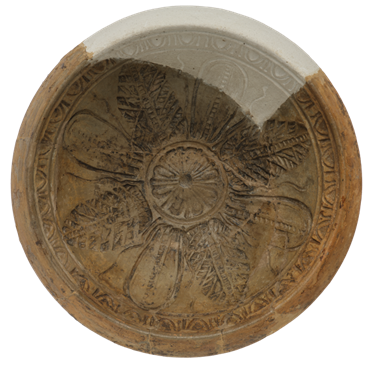
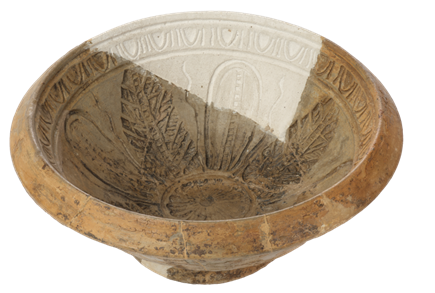
Interior and side view of a beaker-mould
Photo by Leibniz Center for Archaeology (LEIZA) / R. Müller

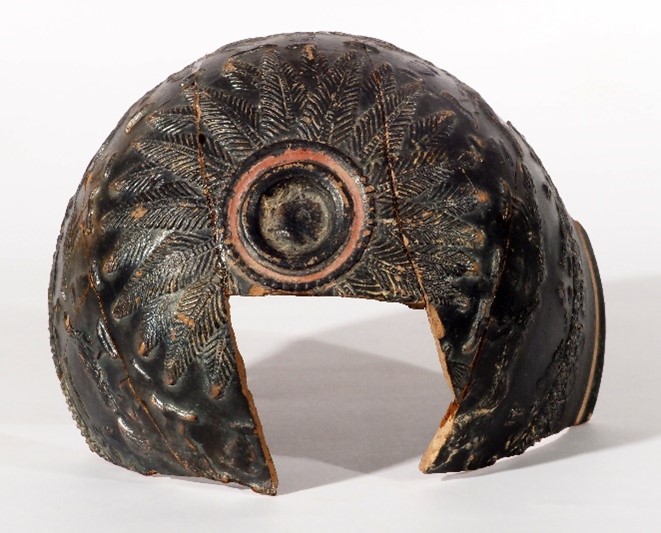
Interior and exterior view of relief beaker 212, Photos by A. Schurzig
The first moulds for the production of the new type of pottery were likely made by imprinting Ptolemaic or pseudo-Ptolemaic metal vessels.
How does the vessel date and where does it come from?
The vessel can be placed in the context of the emergence and establishment of the ceramic genre of Hellenistic relief beakers. It was produced between ca. 220-175 BC and thus dates to the early period of the new ceramic genre.

View of relief beaker 212 Photo by A. Schurzig

View of relief beaker 212 from below Photo by A. Schurzig
The origin of the Hellenistic relief beaker can be traced back to Athens, which is considered the oldest production center of the new ceramic genre, by means of typological comparisons.
The black, metallic coating and two grooves filled with ‘miltos’ (a red color) are characteristic of Hellenistic relief beakers from Athens. These are located below the rim of the vessel on the one hand and between the curves of the ring-shaped base on the other.
Which workshop did the vessel come from?
Stylistic comparisons allow the vessel to be attributed to the Athenian workshop of Bion. Diagnostic features include the flying birds, the rim ornament, the rows of beads, craters and roosters. According to Susan Rotroff, Bion’s workshop is credited with the invention of the new ceramic genre of Hellenistic relief beakers. However, the theory is still incomplete.

Relief cup inv. no. 212, M 1:1 Drawing by Kai Alec Gaßmann
However, it is easy to see that Bion’s workshop made a decisive contribution to the spread of Hellenistic relief cups in the Greek Mediterranean. Athenian pottery expanded first to Argos, then to Corinth and later to the island of Lemnos. This testifies to the mobility of the potters and businessmen, who thus built up a new economic network and spread the technical knowledge for producing the new type of pottery. 
Dissemination of the Bion workshop Drawing based on a design by Kai Alec Gaßmann
What does the decoration of the vessel say?
The decoration of vessel 212 self-references its context of use: for drinking wine during the symposium. The depicted vessels can be interpreted as craters: Vessels for mixing wine and water. The antithetically arranged roosters and erotes can be linked to the cockfight associated with the Dionysian world. Despite the development from painting to relief technique, the pictorial formula is based on the pictorial traditions of vase painting, which testifies to a visual vocabulary that has been passed on since archaic times.

Detail of the relief cup
Drawing by Kai Alec Gaßmann

Detailed view of the winged figure on the relief beaker 212
Photo by A. Schurzig
The central motif of a winged figure, of which only the head and the wing have survived, is particularly striking.
How can the representation be reconstructed?
Fragmentary depictions can be reconstructed by comparison with well preserved vessels bearing the same decoration. A relief beaker formed with the same matrix from the Athenian Agora, also attributed to the workshop of Bion, shows the winged figure completely preserved: depicted in profile and holding a branch.
The figure probably represents Nike or Eros, both of whom are depicted in similar iconography on coins and vase paintings (see vessel 128 in the original collection).
Bachelor’s thesis by Kai Gaßmann (2024)
recognized by Faculty 07 as an outstanding student thesis in the BA final thesis category
Creation of an exhibition concept – internship report by Kai Gaßmann
As part of my bachelor’s thesis, I examined a Hellenistic relief beaker from the original collection with regard to its provenance and dating. In doing so, I was able to highlight its previously unknown and outstanding significance and noted in my conclusion that the object should receive more attention in the original collection. Following this suggestion, my supervisor Anne Sieverling proposed creating a small permanent exhibition for the Hellenistic relief beaker in the original collection in order to draw attention to the previously unknown object. I was able to complete the planning and implementation during an internship. I also had the opportunity to present the results of my BA, which has since been awarded by the faculty, in the Mainzer Winckelmann-Blättern at the end of 2025 and thus present my first publication.
A lot of preparation was necessary for the exhibition. First, I summarized the results of my BA as short exhibition texts and expanded my research in order to create a coherent concept. It was surprisingly challenging to rethink some of the content from my BA to make it visuably presentable. However, planning the exhibition and condensing my writing gave a deep insight into what it takes to present an object both concisely, yet in detail. The redrawing of the Hellenistic relief cup, which was part of the BA, also had to be adapted. It was also a new experience to create and revise maps, for which I familiarized myself with previously unknown image editing programs such as IrfanView. Finding good photos that could be shown publicly for the exhibition also proved to be a challenge. Thanks to Anne Sieverling, making inquiries to the Ministry of Culture for Antiquities of Athens, the American School of Classical Studies and the Leibniz Center for Archaeology (LEIZA), high-quality comparison photos could be obtained and are now presented. Finally, the images and texts were finalized and the printing was commissioned to the university print shop. Meanwhile, repeated trial exhibits in the original collection helped to finalise, how the object could be arranged for display in conjuction with the information presented. The object was also supplemented with other finds from the collection to ensure its informative value.
When planning the exhibition, I particularly liked the flexible and largely unconstrained mode of operation, which allowed for the individual steps in preparation to be spread out over the semester, making adjustments in the process possible. Overall, I would like to recommend to more students to work with objects from the original collection as part of their final theses and then take the opportunity to present their own results there.
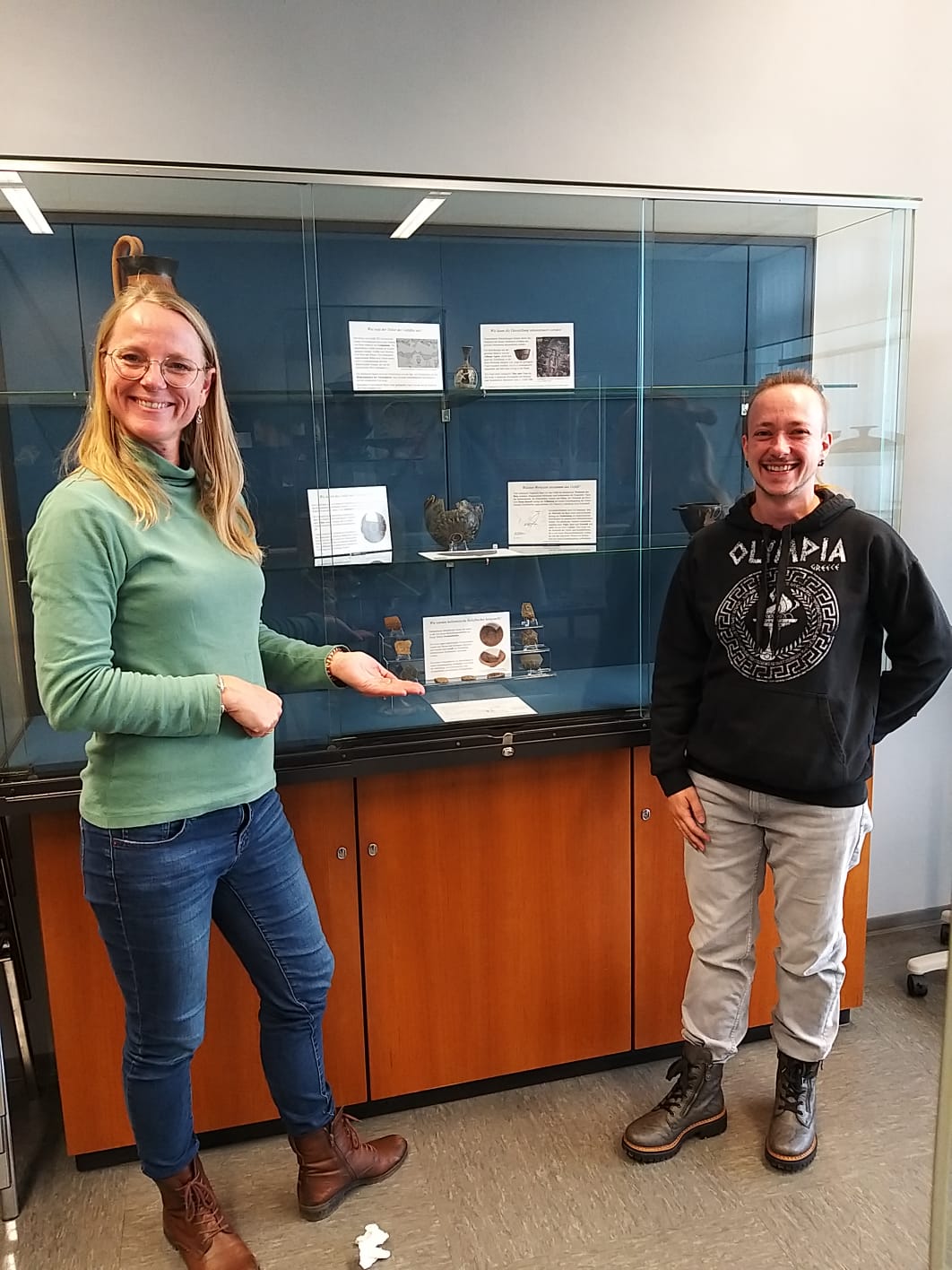

Photos by J. Weber
Presentation of the special student exhibition on November 4, 2024 in the original collection of Classical Archaeology:
In addition to a respectable gallery of Roman imperial portraits, visitors to the cast collection will find an extensive array of prominent masterpieces of ancient sculpture from the world’s most important museums of antiquity. These include the Parthenon sculptures as well as the Venus de Milo, the Vatican Apollo from the Belvedere or the famous slab with Zeus and Athena from the Pergamon Altar in Berlin. Particularly noteworthy is a series of casts taken from part of the Parthenon metopes that Frank Brommer had made especially for the Mainz collection in the 1960s for research purposes. As the original relief slabs suffered greatly from the Athenian air pollution in the years that followed, the Mainz casts are of great documentary value.
The history of the collection
While the original collection was established in the years following the Second World War, the history of the cast collection dates back to the 19th century. The core collection consists of plaster casts, which the Mainz Citizens’ Association for Sculptural Arts had successively acquired since its foundation in 1871. This collection was exhibited in the ‘Kurfürstliches Schloss’ until 1907, from 1912 in the ‘Mainzer Stadtbibliothek’ and finally in the late 1930s in the so-called Haus am Dom, the former Prussian main guardhouse on Liebfrauenplatz. Severely damaged in the bombing, the remaining remnants of the collection came into the possession of the Archaeological Institute and the Art History Institute of the reopened University of Mainz after 1948. The department for Classical Archaeology subsequently endeavored to steadily expand this part of its collection through additional purchases.
The photo library of Classical Archaeology was largely built up during the time of Frank Brommer. Photographs of all areas of ancient arts and architecture as well as topography are archived in more than 1,000 DIN A4 photo boxes. Some of the photographs already have historical value today. Recently, the ‘Ancient Sculpture’ section has experienced a significant increase through the partial acquisition of the original photographs for Peter C. Bol’s History of Ancient Sculpture. Another 380 photo boxes in DIN A5 format, in which the photographs of Frank Brommer’s famous ‘Vase Lists’ are stored, are also worthy of special mention. The photo library is housed in its own room, where seminars and practice classes also take place, and is open to all interested users
The image database of reproduction photographs created for teaching purposes can be accessed via the Gutenberg Images archive system of the university library.
The image database can be used to download high-quality images for presentations and qualification work. Similar to ArkuBiD, the data is provided with metadata that provides information on the origin and dating of the antique objects depicted.
Non-JGU members can also use the database. For first-time access, please contact Dr. Anne Sieverling
Instruction

Before you can use the database, you must log in with your JGU account in the top right-hand corner. Information on logging in and all other functions of the database can be found by clicking on the book symbol.
As part of the Philosophicum departmental library, the Classical Archaeology Library is supervised by the co-workers at Mainz University Library. The entire collection can be searched via the University Library’s online catalog. As a reference library with a sufficient number of workspaces at the location, it is open to all users. The Books may be borrowed to a limited extent.
Two corinthian alabastra
Inv. 66 and 67 (1951 acquired from the Preyß Collection; provenance unknown)
Height: 21,2 cm (Inv. 66); 23,7 cm (Inv. 67)
Preservation: no cracks, some firing defects
Categorisation: Corinthian, black-figure, first quarter of the 6th century BC
Ungewöhnlich mag die Form des griechischen Alabastrons (Plural Alabastra) erscheinen, doch ist nicht nur die Funktion des Gefäßes, sondern auch die äußere Gestalt noch heute bei Parfümflakons greifbar. Seinen Ursprung hat die Gefäßform in Ägypten und im Vorderen Orient. Im ägyptischen Bereich, wo die Alabastra nur aus Alabaster gefertigt wurden, tauchen die frühesten Exemplare im 3. Jahrtausend v.Chr. auf. In Griechenland erscheint die Gefäßform im 7. Jahrhundert v.Chr. Zunächst greifen korinthische Töpfer die birnenförmiger Variante auf (Abb. 1-3); ab der Mitte des 6. Jahrhunderts produzieren Werkstätten in Attika dann längliche Alabastra (Abb. 4). Die Gefäße werden nun auch aus anderen Materialien wie Ton, Glas und Metall hergestellt.
The meaning of the name ‘alabastron’ however, is not entirely clear. References in the works of Herodotus and Pliny the Elder indicate that the term was already in use in antiquity. The name was most likely derived from alabaster, which in Egypt was used exclusively as the material for the vessel. However, it is also conceivable that the name was derived from the shape, as at least the Attic alabastra had no handles and were thus alabes, i.e. ‘without handles’.
The alabastron has a rather elongated body and features a flat rim with a narrow opening. Among the Corinthian variants of this vessel form, to which the exhibits presented here belong (Figs. 1–3), early examples measuring just 6 cm in height are known. The typical height in the 6th century was around 20 cm, though examples as tall as 40 cm have also been preserved. The shape of the vessel is reminiscent of a bag made of organic material filled with liquid, and may thus suggest leather prototypes. The bulbous body of the vessel, which tapers towards the top, is directly joined by the rim. The Corinthian variant has no stepped neck, but instead features an eyelet handle situated below the rim (Fig. 3). A cord could be threaded through this to hang the vessel.
From the mid-6th century onwards, the Corinthian form of the alabastron was superseded by the elongated variant produced in rival Attic workshops (Fig. 4). Due to its hemispherical base and significantly smaller size averaging between 12 to 14 cm, the Attic alabastron, unlike its Corinthian counterpart, was unable to stand upright. Instead, a cord could be wound around the concave neck of the vessel, allowing it to be hung from its wide rim. In an alternative storage method, the alabastra were kept in small wooden boxes known as alabastrothecae. The Corinthian loop handles had thus become obsolete and were reduced to small decorative knobs (Fig. 4).
The alabastron was used as a container for ointments both in the domestic sphere and in funerary contexts. In both cases, it was exclusively a woman’s possession (cf. aryballos). As a container for ointments, oils and perfume, it was used for skin care and cosmetics. To remove the contents, a long, thin wand was dipped into the opening and the substance applied to the hair or skin. Excess oil was wiped off on the rim, which was often slightly sloped inwards so that the liquid could flow back in. Whether the alabastra were sealed is not attested either in written sources or in depictions. However, lids made of wax, wood or leather are plausible.
In burial contexts, the alabastron served as a funerary object, but kept its function as a vessel for ointments. It contained the fragrant essences used to anoint the deceased. It is noteworthy that around 450 BC, alabastra and lekythoi (cf. lekythos) with white backgrounds began to appear in increasing numbers. Shortly afterwards, the production of figuratively painted Attic alabastra, which had been manufactured in large numbers since the mid-6th century, came to an abrupt halt. The cause of this may have been changes in burial rites, in the course of which the function of the painted clay alabastra was absorbed by the white-ground lekythoi.
The two alabaster vessels, Inv. 66 and Inv. 67, from the Mainz Collection (Figs. 1–3) correspond entirely to the Corinthian form, with their pear-shaped bodies and small loop handles. They are black-figure style pottery made from the cream-coloured clay characteristic of theri Corinthian origin. Apart from flaking of the painted slip and firing defects, both alabastra are well preserved and show no signs of breakage. It is striking that in places, the incised decoration is somewhat carelessly executed. Although no information regarding their provenance is available, it is therefore highly likely that these pieces were used as grave goods. The decoration of the vessels is typical of Corinthian alabastra: horizontal bands, a tongue-shaped band at the transition to the rim plate (on Inv. 66 additionally on top of it), a row of dots on the edge of the rim plate (on Inv. 67 on the plate itself).
Filling motifs such as dots, blob-like rosettes and large, sunflower-like rosettes with incised patterns fill the empty spaces around the respective main motif, which, in the two pieces presented here, fits well within the customary theme of depictions of animals and hybrid creatures. Thus, Inv. 67 depicts a griffin facing right in profile (Fig. 1). The mythical creature sits on its hind legs; its large wings, accented with crimson, extend so far around the vessel that they almost touch at the back. The beak of the eagle’s head is wide open; in front of the large ears sits a pair of nodules, a typical attribute of griffins. The slightly smaller vessel Inv. 66 also depicts winged hybrid creatures with lion’s bodies: two sphinxes sit facing each other (Fig. 2). Between the two female heads with long hair and headbands is a ‘sunflower rosette’. The wings and tails of the two animals overlap on the reverse side. Unlike Inv. 67, no red pigment was used here; the reddish discolouration and the generally poorer condition of the glaze are attributable to a flaw in the kiln firing.
The striking similarity in the depiction of the paws, hind legs and wings of the hybrid creatures on both alabastra (Figs. 1 and 3) suggests that they were decorated by the same painter. Indeed, D. Amyx attributes both vessels to the ‘Laurion Painter’, an artist specialising in aryballoi and alabastra from the Middle and Late Corinthian phases (c. 595–550 BC)
The Mainz Collection also includes an Attic alabastron. This red-figure example displays all the characteristics of this form already described. The vessel depicts standing women dressed in a long, draped chiton and a garment. One of the women holds an alabastron by a cord in her right hand, whilst the other holds what was originally a white wreath in her right hand and a kalathos in her left (Fig. 4). A stool standing between the women indicates that they are inside a house. Such domestic scenes are typical of the painting on red-figure alabastra of this period and fit perfectly within the vessel’s intended environment. Beneath the kalathos is a faded ‘kalos’ inscription. In addition to these inscriptions, which are common on 5th-century alabastra, and the usual potter’s or painter’s marks, so-called ‘perfume inscriptions’ are also known from ointment vessels, which allow conclusions to be drawn about the product’s ingredients, such as cinnamon or iris root.
Literature
Inv. 66: E. Simon – R. Hampe, CVA Mainz (1) Tab. 29, 1-3; D. A. Amyx, Corinthian Vase Painting of the Archaic Period (Berkeley 1988) 181. – Inv. 67: Simon – Hampe loc.cit. . Tab. 28; Amyx loc.cit 181. – About the vessel’s shape: H. E. Angermeyer, Das Alabastron (Gießen 1936); W. Schiering, Die griechischen Tongefäße ² (Berlin 1983) 53. 140; Amyx loc.cit. 437-440. – About the ‘perfume inscriptions’: H. Gericke, Gefäßdarstellungen auf griechischen Vasen (Berlin 1970) 72-75.
Elisa-Marie Bandlow
The Dionysian and the Mourning
Inv. 73. attic black-figure neck amphora (found 1829 in Cavalupo/Latium)
height: 42 cm
preservation: Fully assembled from fragments; some sections reconstructed at the neck
classification: around 500/490 v. Chr., attic black-figure
The amphora is arguably the most well-known type of vessel in Greek fine ceramics. The word ‘amphora’ derives from the Greek word amphoreús, which is a shortened form of amphiphoreús. Literally, it means ‘a jug to be carried on both sides’ (amphí = on both sides and phérein = to carry). This storage vessel, which could be sealed with a lid, was usually made of clay. However, bronze, precious metals, onyx or glass were also occasionally used. In antiquity, the term ‘amphora’ also encompassed the vessel forms now known as stamnos and pelike.
Unpainted amphorae were part of a household’s utilitarian pottery and were used to store wine, oil and other liquids, as well as solid foods such as pulses and salted fish. Painted amphorae, on the other hand, were likely used primarily for ceremonial purposes, such as grave decorations, cinerary urns or grave goods, or as elegant containers for oil or perfume. They were also an important commodity.
The valuable contents of a (utility) amphora could be identified by an attached label, painted markings or an impressed stamp. These would note the substance, origin, vintage, producer and/or dealer. Amphorae preserved with such markings serve as an important source for ancient economic history. Transport amphorae can be traced from the early period through to late antiquity. They usually had a tapered foot. For transport, they were leaned against one another; for storage, they were often placed upright in the ground. As the narrow neck indicates, they were intended primarily for liquid contents.
Two types can be distinguished in the shape of painted amphorae. Both types were used in the same way and served the same purpose. The first type is the neck amphora, which differs from the second type, the belly amphora, in that its neck is clearly set apart from the body. The belly amphora has a smooth transition from the belly to the neck. Both types share the feature that the handles are located on the neck. A variant of the neck amphora is the Panathenaic prize amphora (also known as the Panathenaic-form amphora). It was presented, filled with oil, to the winners of competitions and was decorated with a depiction of the discipline in which the winner had competed. Pointed amphorae (with a stepped neck) appear only very rarely in the repertoire of fine ceramics.
Like the necked amphora, the belly amphora can be classified into several types based on its shape. These are distinguished by specific characteristics. The first type has angular handles and a stepped base The second type, on the other hand, is characterized by cylindrical handles and a uniformly rounded, echinus-shaped base, while the third type can be recognized by its distinctive body and neck contours. In the 6th and 5th centuries, the amphora was produced in Attic potteries primarily for export. The standard black-figure type of the necked amphora was later replaced by the red-figure “Nolan amphora” (Fig. 4) as an export commodity.
The Mainz specimen of an Attic necked amphora (Figs. 1–3) was classified by Beazley as belonging to the standard type he defined, which is widely recognized. It has a slightly oval body and an echinus-shaped foot, and stands 42 cm tall. The handles consist of three ribs. The vessel dates to around 500/490 BCE, that is, to the Late Archaic period.
The amphora originates from the workshop of the Nikoxenos Painter, who employed both the black-figure and, to a somewhat lesser extent, the red-figure painting techniques. To date, no vessels by this artist are known in which both techniques were used. The painter did not specialize in amphorae, as we know from other vase painters; however, 14 other amphorae by his hand have been preserved that are very similar to the Mainz specimen.
The rim is painted black on both the exterior and interior, the three-part handles on the exterior, and the foot is painted black except for a narrow strip directly above the base. Above the narrow strip is a purple-red band and a halo, with a lotus bud ornament above that. The neck is decorated with lotus flower motifs, interrupted by the handles. Additional motifs are located beneath the handles. Tongue patterns are visible both on the shoulder and beneath the neckline, which are in turn interrupted by the handles. On the clay-based underside of the foot, a graffito can be read: EY:A: EV, presumably a trade mark.
Between the decorative elements on the neck and base of the amphora, there are two depictions on either side that are composed in the same way: a figure in the center with an animal in the background, as well as figures to its right and left. At the center of the first image stands a bearded man of mature age (Fig. 2). He is dressed in a chiton and a cloak, the corners of which form loose ‘zigzag folds’. On his head, turned to the side, he wears a broad ivy wreath. Based on his attributes, he is recognizable as the god Dionysus. Among his attributes are the kantharos in his raised left hand—though it is visible only from the handle side—and, in his other hand, a vine tendril that branches out in the background. It winds around the other figures to his right and left. A billy goat with its head bowed and an almost human face, standing behind him and thus half-concealed, is also among his attributes.
The figures on either side of Dionysus are satyrs, who are turning their heads back and appear to be dancing joyfully. Both are also carrying a maenad on their shoulders; like Dionysus, these maenads have ivy wreaths in their hair and are raising their arms as if they were talking animatedly and excitedly to one another. Both are turning their faces toward the god. Both the maenads’ skin and the grapes on the vines stand out clearly in white against the black clay background. Their dresses are also partly white and partly speckled with red. The ivy wreaths in their hair, as well as the goat’s neck, the god’s beard, and the satyrs’ hair, beards, and tails, are also speckled with red.
The second image centers around a warrior (Fig. 3). He wears a helmet, a round shield, greaves, and carries two spears. Standing in front of and behind him are two women, both of whom have pulled their cloaks over their heads like hoods and are raising a hand concealed by the cloak. The woman on the left, whom the warrior is looking at, extends her right, uncovered hand with her fingers spread wide. The woman behind him, on the other hand, clutches her cloak with her free hand. Facing her, behind the warrior’s legs, stands a large dog. As in the other image, there is a vine in the background here as well, branching out between the figures. The women have white skin, and the warrior’s round shield bears a bright white leg as an emblem. The edge of the shield is dotted with red. The band in the warrior’s hair beneath his pushed-back helmet is red, the helmet plume white, as are the dotted
ornaments on the garments.
Since the early 6th century, the two motifs depicted here have been portrayed alongside each other on a vessels. To the modern viewer, unlike to their contemporaries, these scenes may appear to be very contrasting. The amphora was found in a grave and was certainly once a grave offering. It illustrates, in a balanced way, the lifestyle of a wealthy Attic citizen, combining its various facets: on the one hand, the duty to go into battle as a full member of the community to defend the city and one’s own family; on the other hand, the Dionysian enjoyment of life. At the symposium, evoked by the depiction of Dionysus and his retinue, a group of men gathered to experience sensual and intellectual pleasures together.
Literature
R. Hampe – E. Simon, CVA Mainz Universität (1) Tab. 34; A. Trautmann in: K. Junker (Ed.), Aus Mythos und Lebenswelt. Griechische Vasen aus der Sammlung der Universität Mainz (Worms 1999) 52-55 – On typology and use: W. Schiering, Die griechischen Tongefäße ²(Berlin 1983) 25-39 . 140f.; I. Scheibler, Griechische Töpferkunst. Herstellung, Handel und Gebrauch der antiken Tongefäße (München 1983) 16-29. 58-70.
Julia Brandt
Attic late-geometric Hydria
Inv. 46 (from the Grancy collection; Provenance: Vougliagmeni near Athens)
height: 38,5 cm
preservation: intact; small defect infilled at the rim
categorisation: Attika, late-geometric, 720-710 BC
A vessel that was indispensable in every ancient household is the hydria. The very name “hydria” (from *hydor, “water”) suggests its use as a container for water. The name is attested from the 6th century BCE, and its use as a vessel for transporting and storing water is also confirmed by ancient sources. The hydria resembles a jug with a vertical handle, which allowed an easy grip while pouring out its contents. In addition, the hydria also has two horizontal handles for carrying the vessel when filled and heavy.
The oldest preserved vessels of this type date from the Bronze Age. The canonical type at hand, also known as the shoulder hydria, emerged in the 6th century BC (Fig. 1). The shoulder hydria has a strictly structured composition: the body, shoulder and neck of the vessel are clearly distinguished from one another. The height varies between 30 and 50 cm. This type was in use primarily during the period from the last quarter of the 6th to the second quarter of the 5th century.
In parallel, there was another variant, now known as a kalpís, which was produced from the late 6th to the 4th century. The kalpis (plural: kalpides) has a spherical body and a shoulder that rises more gently (Fig. 2). The neck, shoulder and body transition smoothly into one another. Kalpides are usually slightly smaller than shoulder hydriae and generally measure around 25 to 40 cm in height. Whilst the vertical handle on shoulder hydriae usually extends from the shoulder to the rim, on kalpides it is attached to the shoulder and neck.
There are numerous vase paintings depicting hydriae in use, which provide insight into how they were handled. Most of these depict scenes at water houses, showing girls or women filling the vessels from spouts, as fetching water was one of the daily tasks of women (Fig. 1). The empty hydria could be held by its vertical handles and was carried on the head or shoulder. The heavy, water-filled hydria was placed on the head by first lifting it by the horizontal handles and setting it on one knee, so as to grasp the handles from below. In this way, it could be lifted above and placed on the head. A kind of cushion or cloth ring (tyle) served as a support. Hydriae were certainly also used for storing water in the home. Most of these vessels would have been simple, undecorated vessels. However, there were also precious metal hydriae. Painted clay hydriae (Figs. 1–3, 5) were certainly not used for fetching water from the well, as they are too fragile for that purpose.
In their function as water vessels, hydriae were also used in religious rituals, as water was required for many ritual acts. Given its purifying properties, water was an essential component of purification rites. For example, prior to an animal sacrifice, the altar, the sacrificial animal and the participants were sprinkled with water. Furthermore, the sacrificial animals had to be watered. Many rituals therefore began with a procession in which water was carried from a spring to the altar. Water, and thus the hydria, played an important role in both public and private funerary rites. Water was used for washing the corpse, but also for libations at the grave. In addition, hydriae were placed in the grave with the deceased as containers for drinking water, for, as in other ancient cultures, it was customary in Athens to provide the deceased with goods, food and drink for their journey to the underworld. In some cases, hydriae also served as vessels for the cremation of the body.
The Late Geometric hydria in the University Collection was also found in a grave not far from Athens (Fig. 3). It is therefore in very good condition, with only a small hole on the reverse side. A small chip at the rim has been repaired with plaster. As it is an early example of its kind, the hydria in our collection differs slightly in its shape from the variants described above. The vessel has an egg-shaped body resting on a low foot. The tall neck is clearly set apart from the shoulder. The horizontal handles are situated at the widest point of the vessel’s body. The vertical handle attaches at the shoulder and extends only slightly beyond the middle of the neck. The glaze with which the decoration is painted onto the ochre-coloured clay has partially flaked off, yet the geometric ornaments are for the most part still very clearly discernible. A decorative scheme consisting of geometric elements such as meanders is typical of pottery produced from around 900 to 700 BC. Hence, this period is also referred to as the Geometric period. The vessel is decorated with several encircling bands, zigzag lines and diamond-patterned bands. Between the horizontal handles, there is a large diamond-patterned motif on both the front and back of the vessel, each framed by vertical decorative bands.
Thirteen stylised female figures wearing long skirts are depicted on a continuous frieze around the neck of the hydria (Fig. 4). The women’s upper bodies are rendered in the shape of a triangle, and their hair is merely hinted at. This stylisation of human figures is typical of the Geometric style. The women’s clothing is decorated with lattice patterns. They clasp hands to form a circle dance, holding stylised branches that hang down to the ground. Circle dances were performed by young men and women at festivals in honour of the gods or during funeral rites. Numerous depictions from the Late Geometric period show circle dances in connection with scenes of the display of the deceased (prothesis) and funeral processions (ekphora).
An additional decorative element, black-painted plastic snakes are depicted around the rim, at the base of the neck and on the vertical handle (Fig. 5). These too are stylised; the heads and tails are not fully rendered. Such sculpted snakes are found on many Attic amphorae and hydriae discovered in graves dating from the second half of the 8th century BC. As creatures associated with the earth, snakes in antiquity served as intermediaries between the underworld and the world of the living and therefore often appear in scenes from the cult of the dead. Initially, the snakes are still rendered in detail; on later vessels, however, they resemble more of a circumferential bead. Whilst the depiction of a round dance on the neck does not yet directly indicate use in funerary rites, the applied snakes make it clear that the hydria in the Mainz collection was not intended for everyday use in the house, but was produced as a grave offering specifically.
Literature
R. Hampe – E. Simon, CVA Mainz
(1) Tab. 5 ; Chr. Schmitt in: K. Junker (Ed.), Aus Mythos und Lebenswelt. Griechische Vasen aus der Sammlung der Universität Mainz (Worms 1999) 23-27 Tab. 2. 6. – On the Typology: E. Diehl, Die Hydria. Formgeschichte und Verwendung im Kult des Altertums (Mainz 1964); T. Schreiber, Athenian Vase Construction: A Potter’s Analysis (Malibu 1999) 117-123; E. Trinkl, Sacrifical and Profane Use of Greek Hydrai, in: A. Tsingarida (Ed.), Shapes and Uses of Greek Vases (7th – 4th Centuries B.C.) Proceedings of the Symposium held at the Université libre de Bruxelles, 27-29 April 2006 (Brüssel 2009) 153-171. – On the sculpted snakes: E. Grabow, Schlangenbilder in der griechischen schwarzfigurigen Vasenkunst (Münster 1998) 7-15.
Swetlana Pirch
Two Attic jugs
Oinochoe, Inv. Nr. 115 (1951 acquired from the Preyß collection)
total height: 24,2 cm; maximum diameter: 15,6 cm
preservation: reassembled from numerous fragments; reconstructions on the reverse and next to the female figure; antique repairs to the handle
classification: Attic red-figure, c. 440 BC, ‘Zwergmaler’
Olpe, Inv. 87 (acquired from the Grancy collection, provenance unknown)
total height: 31,6 cm; maximum diameter: 11,5 cm
preservation: reassembled from numerous fragments; The upper handle attachment and minor chips have been repaired
classification: Attic black-figure, around 530 BC, in style of the Amasis painter
When examining Greek vase forms, two distinct types of jug stand out: the oinochoe (Fig. 1) and its sub-type, the olpe (Fig. 4). The name ‘oinochoe’ immediately explains its function: ‘oinos’ meaning ‘wine’ and ‘cheo’ meaning ‘to pour’, makes it clear that this vessel was intended for pouring wine. These jugs were used at symposia, where wine was ladled out using oinochoes from krateres, in which wine and water were mixed. Occasionally, they are also found as grave goods or were used in sacrificial rites for pouring libations. The olpe served the same function; its name corresponds to the Greek term for ‘jug’.
Today, the two types of jug are distinguished solely by their shape. The oinochoe is a bulbous jug with a stepped neck (Fig. 1). Much like modern jugs, it has a large handle, making it easy to pour out its contents. The spout can take various forms: there are round spouts as well as so-called beaked jugs, the spout of which indeed resembles a beak. The earliest type of jug attested since the Geometric period is the trefoil jug, whose rim is shaped like a three-leaf clover. Today, the term ‘olpe’ refers to slender jugs in which the body tapers smoothly into the neck without a step (Fig. 4). Furthermore, the handle extends beyond the rim. Olpes also feature various spouts; these may be round, trumpet-shaped or cloverleaf-shaped, for example.
Oinochoe
The oinochoe Inv. 115 (Figs. 1–3) in the vase collection corresponds exactly to the form described above. Its foot is initially slightly convex outwards, then curves inwards. A clay-coloured groove clearly sets the otherwise black foot apart from the body of the vase. The belly is broadly curved and the shoulder is flattened towards the neck. The neck is stepped, a feature emphasised by a circumferential decorative band. It curves slightly inwards and ends in a flared lip. The handle attaches to the shoulder and rises vertically in a gentle curve, where it joins the rim of the vessel in an arc. Two grooves divide the handle into three ribs of irregular size.
An interesting feature of this jug is that the handle appears to have broken off and repaired in antiquity. Three lead clamps were originally attached to the rim, two of which have survived (Fig. 2). Another break in the curve of the handle also appears to have been clamped, as there are still four holes for clamps here. The connection to the body of the vessel was repaired with a large clamp. However, as all the clamps are broken, the repair does not seem to have held up. Although such repairs usually rendered the vessels no longer functional, a number of ancient repairs can nevertheless be identified. Pottery was not particularly expensive, and if a vessel broke, it could easily have been replaced with a new one. It is therefore assumed that in some cases the vessels had sentimental value for the owner. Perhaps they were gifts or similar items that the owner did not wish to part with.
The decoration on the oinochoe in the Mainz collection is uniformly black; in some places, however, the coating is not entirely opaque, allowing the clay body to show through. The figurative scene on the front of the vessel (Fig. 1.3) is executed in red-figure painting. In the lower part of the belly, one can make out a decorative band that does not quite run all the way round, a so-called egg-and-dart frieze, which also forms the base for the two figures. Above the figurative scene, as already mentioned, is a broad tongue-and-dart frieze.
On the left is a naked male figure (Fig. 1). The tail, the rendering of the face and the bald head indicate him as a satyr. These creatures were closely associated with Dionysus, the god of wine, and were known for their sexual appetite. The satyr on the oinochoe wears a wreath of leaves in his hair, which was once highlighted in red paint and is now barely discernible. Running swiftly to the right, the satyr approaches a female figure. She (Fig. 3) is dressed in a long robe and a cloak and wears red ribbons in her hair. She too is in the act of running to the right, away from the satyr, yet turns towards him and extends her right hand towards him. In her left hand she holds a rod-like object, the tip of which is missing. This rod is likely a thyrsus, identifying the woman as a maenad – a being who, within the circle of Dionysus, represents, as it were, the female counterpart to the satyr. The theme of the vase painting can thus be clearly attributed to the Dionysian realm: it depicts a satyr pursuing a maenad. Such a theme is entirely appropriate on a wine jug used at a symposium. The oinochoe is attributed to the dwarf painter active in the High Classical period, who mainly painted amphorae, hydriae and pelikes.
Olpe
The second jug (Inv. 87) in the collection is an olpe (Fig. 4.5). The vessel has an echinus-shaped foot; the body is not as strongly curved as that of the oinochoe and merges seamlessly into the neck. The spout is shaped like a trefoil. The clay-based handle, decorated with black lines, attaches to the upper part of the body and curves towards the inside of the rim. It features a groove, dividing it into two ridges.
The painting on the vessel is uneven and appears more brown than black, suggesting a firing defect. The pictorial field itself is carved out against a clay background and is framed at the top by a garland of lotus buds. The figurative scene is executed in the black-figure technique. It is interesting to note that the pictorial field is slightly offset from the axis of the handle. When viewed from the front, it is not fully visible. It is possible that the jug was hung on the wall when not in use. In this position, the depicted scene would indeed be best viewed.
Traces of red paint are still visible on some of the figures, for example on their robes and the horse’s mane. A total of four figures are depicted. On the far left stands a naked young man holding a spear. As his animated gestures suggest, he appears to be engrossed in conversation with the horseman standing next to him, who is shown in full-face view. To his right, one can see another naked youth who also appears to be participating in the conversation. A fourth male figure appears at the right edge of the picture field. This figure stands out from the others due to his long robe and is apparently not involved in their conversation. Such seemingly uninvolved figures are referred to as “spectator figures.” Also worth noting is a dog at the rider’s feet. The hunting dog and the horse indicate that the figures depicted here are young men of the wealthy upper class; given the left figure’s armament, they may be hunters. The nudity of the two standing youths evokes the ideal of a youthful, athletic physique.
Translated with DeepL.com (free version)
On the reverse side of the Olpe, there is another decoration (Fig. 5): Two triangular indentations with rounded bases, forming a black oval between them. Some researchers believe this depicts a stylized eye. Whether this is accurate remains uncertain, as it could also be a purely ornamental decoration.
Literature
Inv. 87: R. Hampe – E. Simon, CVA Mainz (1) Tab. 38, 1-3; B. Lowis in: K. Junker (Ed.), Aus Mythos und Lebenswelt. Griechische Vasen aus der Sammlung der Universität Mainz (Worms 1999) 39-42. – Inv. 115: E. Böhr, CVA Mainz (2) Tab. 12, 7; 13. – On the typology: W. Schiering, Die griechischen Tongefäße ²(Berlin 1983)152 f. – On the ancient repairs carried out on Inv. 115: A. Nießner in: Junker ibid. 105 f.
Sandra Kyewski
Chalice-Krater
An Attic red-figure Chalice-Krater in the “Kerch style”
Inv. 178 (1951 acquired form the Preyß collection; provenance unbekannt).
height: 29,6 cm; rim diameter: 24,7 cm
conservation: near complete reassembly from sherds; some missing pieces reconstructed; small hole at the round object on revers (possibly an air pocket, burst in firing); white topcoat on griffon wings and maenad intact; yellow topcoat for internal layout rudimentarily preserved
classification: Athens, red-figure, around 350 BC.
The krater was a popular and highly versatile type of vessel in antiquity. Krater of various shapes existed from the Proto-Geometric period to the late Red-Figure period, that is, from around the 11th to the 4th century BC. Due to their primary function as vessels for mixing wine and water, they formed a central part of daily life for their users and are mainly associated with the symposium, the ancient banquet.
The name of the vessel is derived from the Greek word kerannymi, meaning ‘to mix’, and appears in written sources such as the Odyssey in connection with the mixing of wine and water – at symposia, wine was always drunk diluted. Furthermore, many depictions in vase painting show krateroi as wine-mixing vessels alongside the psykter, a spherical vessel with a cylindrical opening which was filled with ice or snow to cool the wine and placed inside the krater. Other uses, such as their function as grave goods or grave ornaments in funerary rites, as prestigious art objects in private settings, or as votive offerings in sanctuaries, can be deduced from the respective context in which they were found.
A characteristic feature of the krater is its design as a bulbous vessel with handles, lacking a shoulder and neck, resting on a foot, forming a deep and wide body and ending in a wide-spreading rim (Figs. 1 and 2). From the 6th century onwards, distinctive forms emerged in various regions of Greece. These new creations can be distinguished by the shape of their handles and can be attributed to specific areas where they were particularly popular. These include the volute krater (Sparta) with its large spiral volutes, which spring from the handles and attach to the rim. Also worth mentioning is the colonnette krater (Corinth), which is characterised by rod-shaped handles in the rim area. The name of the bell krater (Attica) refers to the characteristic shape of its body. Particularly noteworthy is the chalice krater, a new development in late Attic black-figure pottery, which reached its formal perfection in Attic red-figure painting and underwent significant stylistic changes over time.
The so-called Kerch vases, to which the cup krater presented here is attributed on the basis of its style, take their name from their main site of discovery, the town of Kerch on the Crimean Peninsula in the northern Black Sea, and represent a sub-group of late red-figure Attic vessels dating from around 370 to 320 BC. In the 4th century, the Greek colonies in this region were Athens’ main suppliers of grain and trading partners, and, alongside Boeotia, the main buyers of vase production. It can therefore be assumed from the outset that this type of vase was conceived as a mass-produced and export commodity. Furthermore, hydriae and pelikes formed part of the diverse range of vessel forms characteristic of the Kerch style.
The oldest attested chalice krater is thought to be the work of the great painter and potter Exekias or someone from his immediate circle, and dates from around 525 BC (Fig. 1). Its formal models may be found in Ionic pottery, such as the chalices from Chios, but also in cup-shaped vessels from Attica. The Exekias krater is characterised by a broad, calyx-shaped body, curved convexly upwards, with a wide rim, and by the handles attached to the sides at the lower part of the vessel’s body. One might also say that, in the broadest sense, it is reminiscent of a woman’s skirt.
In terms of form and proportion, a marked tendency towards elongation of the vessel can be observed in red-figure painting. This is clearly illustrated by our example, which, in terms of its development, represents the final stage of this transformation in vessel type (Fig. 2). The elaborate formal structure begins with the two-part foot-and-base zone: formerly executed as a relatively simple, low base plate, the foot now rises diagonally upwards in a slight convex curve, resembling a goblet, forming a sculptural ring (torus), whereupon, in sharp contrast, the upper foot zone curves concavely into the body of the vessel. The boundary is again marked by a subtle ring. The body of the vase is once more divided into two parts. Note the lower, convexly curved handle zone, at the upper end of which the handles attach, running diagonally upwards and forming a loop-like curve inwards. Above this, a cup-shaped, slightly concave wall begins. Whilst in the black-figure phase this wall still rose convexly or almost straight upwards, in the red-figure phase a tendency towards a concave curve—sometimes more, sometimes less pronounced—began to emerge. Sometimes, as with the Mainz vessel, the wall is set apart from the handle zone by a small step.
Furthermore, the division between the two zones is visually defined by a wide ornamental band that runs around the handles. The ornamental band and the handles thus serve as a backdrop for the main pictorial fields featuring the figurative decoration. The design of the vessel’s body structure in an ‘S-curve’, together with the placement of the handles in the lower part of the body, is such that, on the one hand, it allows for painting to run all the way round the vessel, whilst on the other hand, the handles create a division that splits the vessel into a main and a secondary viewing side. A distinctive feature of cup-shaped krater is the almost seamless transition of the wall into the rim zone, which forms the vessel’s widest diameter. In later periods, this rim projects further and further out and sometimes folds downwards. In the case of our krater, the rim runs almost horizontally and is stepped at the lower rim edge. In early vessels, the wide rim is almost in the same proportion to the height of the vessel.
In terms of figurative decoration, chalice krater follow the trend typical of the period towards a reduction in the number of figures and a clear distinction between the front and back. On the face of the krater, the viewer is presented with a scene that appears somewhat strange at first glance, in which a young, beardless man with short hair rides towards the viewer on a griffin from the left (Fig. 2). This figure is framed by stylised clusters of grapes. He is bare-chested, but is almost completely obscured by the griffin’s white, widely outstretched right wing. In his raised right hand, the man holds the hem of a thin cloak, which could also serve as a saddlecloth or bridle, as he has draped it around the neck of his mount. His gaze is fixed on a young woman with her hair tied back, clad in a long white chiton, who appears to be running away from him. As she runs, she looks back at him and holds out a tympanon (frame drum) towards him. In her left hand, not visible in the picture, she holds a black-spotted torch; in front of her, above the right handle, lies an overturned kalathos (wool basket). To the right of the woman’s head, a further decorative motif is depicted as a clay-coloured triangle. Above the left handle rises an altar with a volute finial (Fig. 3).
The figuratively painted panel on the reverse (Fig. 4), on the other hand, depicts a motif that was very popular from the 5th century BC onwards: three youths in cloaks engaged in conversation. Their attributes point to the sporting realm: the central figure holds a discus with cross and dot decoration in his raised right hand, whilst the figure on the right holds a spherical object that could represent an aryballos.
The image on the obverse (Fig. 2) likely depicts a nocturnal ritual in honour of Dionysos, the god of wine, who is presented here in the form of the youthful, beardless god that emerged from the 5th century BC onwards. Alongside this, the older depiction of the elderly, bearded man in a long cloak continues to exist. The grapes mentioned earlier suggest this identification. Confusion may arise from the depiction of Dionysus in combination with the hybrid creature, the griffin. This was already incorporated into Greek iconography from the Near East during the Geometric period and, in this instance, rendered in the archaic form of the ‘eagle type’ with a winged lion’s body and an eagle’s head. The griffin is the usual animal companion of Apollo, whilst Dionysus is generally associated with the panther. In mythology, however, Dionysus, like his half-brother Apollo, is rooted in the cult of Delphi and assumes the role of guardian deity of the sanctuary during the winter months, only to be relieved in spring by Apollo, who rides back on the griffin from Hyperborea (a mythical land in the north).
In this respect, it is not only the depiction of the griffin that is explained. The hurrying woman, too, can be clearly identified as a Maenad – that is, a follower of the Dionysian retinue (thiasos) – by her attributes: the tympanon, the torch and the kalathos; she is surrendering herself to the ecstatic frenzy of the Dionysian cult. The orgiastic revelry, with its exuberant, unrestrained dancing and animal sacrifices, is depicted in a greatly toned-down form on this vase painting, reflecting a trend in vase painting of the late Classical period:
As mentioned at the outset, kraters were primarily used in the context of the symposium. However, given its small size, this function is hardly conceivable for our specimen. It is far more likely to have served as a funerary object in the sepulchral context, especially as most Kertch vessels were found in burial contexts. The pictorial depictions do not contradict this: the combination of a Dionysian motif with a sporting one could symbolise a happy and fulfilled earthly existence for the deceased, which one did not wish to deny him in the afterlife.
Literature
E. Böhr, CVA Mainz, Universität (2) Tab. 9; S. Buchmann, Orgiasmus und Liebeswerden, in: K. Junker (Ed.), Aus Mythos und Lebenswelt. Griechische Vasen aus der Sammlung der Universität Mainz (Worms 1999) 91-95 (including older literature). – On the typology: M. G. Kanowski, Conatainers of Classical Greece. A Handbook of Shapes (St. Lucia 1984) 60-70; S. Frank, Attische Kelchkratere. Eine Untersuchung zum Zusammenspiel von Gefäßform und Bemalung (Frankfurt 1990). – On style and motif: K. Schefold, Kertscher Vasen (Berlin 1930).
Matthias Muno
Lid of a lekanis
Inv. 118 (1951 acquired from the Preyß collection; provenance unknown)
diameter: 22,6-23,2 cm; heigth of the knob: 3,8 cm
preservation: near complete reassembly from numerous fragments
classification: Athens, red-figure, c. 410-400 BC.
Hardly any other form of Greek fine pottery seems as familiar to the modern observer as the lekanis. In shape and dimensions, it resembles an elegant bowl of the kind still used in households today. Bowl-shaped vessels for storing food existed in various forms and sizes even in prehistoric cultures. However, the version under review here was first created in the late 7th century. Athenian potters initially produced lidless vessels, known today as lekáne (plural lekanai). As early as 600, the variant with a lid was introduced, the so-called lekanís (pl. lekanides), which soon became the dominant form. Although the number of surviving lekanai and lekanides is relatively small compared, for example, to bowls or amphorae, they were produced throughout the entire period up to the late 4th century. As early as the 6th century, workshops outside Attica were also producing vessels of this type; in the 4th century, they were then produced primarily by workshops in Greek Southern Italy.
The shape of the lekanis has changed very little over time. The vessel has a wide, slightly flared foot that supports the bowl, which is initially flat and then rises steeply. The handles are strikingly shaped, extending on both sides to form a ‘spike’, a distinctive protrusion (also known as an ‘omega handle’). Resting on the bowl is the lid, which is usually flat, with a knob in the centre in the form of a disc resting on a short stem. As with many other vessel forms, there are significant variations in dimensions. The basin can have a diameter of up to 40 cm, though there are also numerous smaller examples, including miniature formats – the lekanis featured here, which was produced in a Greek city in Campania (Italy), has a bowl diameter of just 10 cm. In addition to the figuratively painted bowls, there is also a large number of vessels that are coated only with a glossy slip.
The functions and the correct ancient terms can only be determined approximately. Lekanis, lekane and some related terms appear frequently in ancient written sources, where they refer – in the general sense of ‘basin, bowl’ – to vessels made of various materials with a wide range of uses, from serving food to washing feet. If, within the types of painted pottery, the closed form is referred to as a lekanis and the open form as a lekane, this does not strictly correspond to ancient usage, but rather serves the purposes of modern scholarly communication. To narrow down the function of the painted clay vessels, one must instead rely primarily on the find context and the depictions on the lekanai and lekanides themselves. In any case, the basic practical use – as household bowls – was probably the exception for the elaborately decorated examples, despite their suitability in principle for this purpose. The context of the finds suggests that their use in funerary contexts provided the initial impetus for the creation of such vessels. Later, however, the other two traditional uses for fine pottery also emerged: as votive offerings in sanctuaries and as status symbols in the home. Judging by the depictions on the vessels themselves, some red-figure lekanes clearly served as bridal gifts – as is also likely the case with the Mainz specimen.
Only the lid of this vessel has been preserved. It has only minor areas of damage, but is severely warped. The sections that were once covered in white slip (the textile elements on the female figures) are now visible only as dull patches. With a diameter of approximately 23 cm, this is a medium-sized example. The style of the figure painting, with its very rich, almost nervous interplay of folds, allows it to be dated to the so-called ‘Rich Style’ (late 5th century BC). The vase painter belongs to the circle of one of the great masters of this artistic movement, the so-called Meidias Painter.
The upper surface of the lid is adorned with a continuous frieze of figures, bordered on both the inner and outer sides by a strip of plain clay. An egg-and-dart motif frames the base of the knob, whilst another adorns the side edge of the lid. The figural frieze appears at first glance to consist of a simple row of female figures, but it possesses a clear internal structure. It is divided into two halves, in the centre of each of which a woman sits on a rock formation suggested by a few rounded lines; two other women, holding objects in their hands, turn towards the seated figure. The division of a frieze into two groups of three, each with a central figure, is also found in a similar form on many other vessels from the late 5th century, such as bowls Inv. 105 and 107 in the Mainz collection.
All the women are wearing a garment which, judging by the way it is belted, can be described as a (woollen) peplos worn over the top, but which, given its light drape and the contours of the body visible beneath, corresponds to a linen chiton. Only their hairstyles and the earrings—which are not always visible—distinguish the women slightly from one another; their hair is of slightly varying lengths and, in the case of three of the women, is draped with scarves.
While the depiction of flowers and stylised rocks suggests the setting to be outdoors, the items depicted move the scene into the domestic sphere: The women in front of the seated figures carry patterned boxes, whilst the women behind them carry so-called exaleiptra. Ribbons, two baskets, further boxes and an alabastron in the hand of one of the seated women complete the abundance of props. The two birds also fit into the deliberate vagueness of the scene: the goose behind one of the seated women and the songbird, probably a nightingale, in her hand. Keeping birds at home was a popular pastime in ancient Greece.
The basic composition is found on numerous Attic vases of the period; elements of it can also be seen, for example, on the pyxis in the Mainz collection. The arrangement of the figures already suggests that the depiction takes us into the sphere of women. Earlier research established the term ‘gynaikon’ (women’s chamber) for this. The arrangement of both halves of the frieze consisting of a seated woman in the centre and two other women holding objects places the scene in the context of wedding scenes, with the bride as the recipient of gifts. However, the image does not claim to be documentary in nature, as is already evident from the duplication of the motif. Moreover, the fact that the figure frieze does not intend to depict a real-life situation is demonstrated quite unequivocally by three name inscriptions, which are now only faintly discernible but which, in their original state, stood out clearly as white letters. The seated woman with her hair tied up is identified as Eunomía (orderly), the woman in front of her as Eukleía (good reputation, high esteem), and the seated figure on the opposite side as Paidiá (playfulness, joyfulness). These are therefore personifications, i.e. abstract values embodied by human figures (the gender of the Greek words is consistently feminine).
Personifications – the best known being that of Victory, Greek: Nike, Latin: Victoria – are not uncommon in Greek art of the Classical period. Narratively, they dilute a scene, for when personifications are inserted into a depiction, the viewer no longer has a coherent scene before them: it is no longer a homogeneous group of women in their typical setting, but essentially a juxtaposition of abstractions and concrete figures from the real world. The advantage of incorporating personifications, however, lies in focusing the content of an image and, as it were, illustrating it. Based on their typical elements, our image of an Athenian man or woman would indeed be reliably associated with the realm of women’s quarters and weddings, without, however, stating anything specific. The captions, on the other hand, make a precise statement about the values and aspirations associated with women’s lives and marriage. The bride is to gain ‘high esteem’, live in orderly circumstances, and alongside work – which is omitted here – play and pleasure shall also be part of her marriage.
This ideal is frequently depicted and explicitly expressed in vase paintings from this period. By today’s standards, it may seem overly bourgeois or even old-fashioned, but any assessment must take the circumstances of the time into account. The frieze on the lekanis lid dates to a very turbulent period in Athenian history. Dreams of great power and the belief that democracy represented a social model superior to all others led Athens into the Peloponnesian War, which lasted almost thirty years, and ultimately to a disastrous defeat in 404. The experiences and consequences of the war were certainly not the only, but a significant factor in a profound social transformation in Athens, as well as in other parts of the Greek world. A key feature of this change was a yearning for peace and, linked to this, a heightened emphasis on cohesion within the family and the social community. The invocation of eunomia and eukleia—that is, high esteem within a stable social order—found its continuation and intensification a generation later in the decision to establish a separate cult dedicated to Eirene, the goddess of peace, in Athens.
Literature
ARV² 1327, 87. E. Böhr, CVA Mainz (2) Tab. 27. 28; C. Christmann in: K. Junker (Ed.), Aus Mythos und Lebenswelt. Griechische Vasen aus der Sammlung der Universität Mainz (Worms 1999) 87-90 (including older literature); B. E. Borg, Eunomia oder: Vom Eros der Hellenen, in: R. v.d. Hoff – St. Schmidt (Ed.), Konstruktionen von Wirklichkeit. Bilder im Griechenland des 5. und 4. Jahrhunderts v. Chr. (Stuttgart 2001) 299-314 Tab. 3.
On the Typology: A. Lioutas, Attisch-schwarzfigurige Lekanai und Lekanides (Würzburg 1987); D. E. Breitfeld-v. Eickstedt, Die Lekanis vom 6.-4. Jh. v. Chr. Beobachtungen zur Form und Entwicklung einer Vasengattung, in: J. H. Oakley u.a. (Ed.), Athenian Potters and Painters (Oxford 1987) 55-61.
PD Dr. Klaus Junker
An Attic pelike
Inv. 114 (1951 acquired from the Preyß collection; provenance unknown)
height: 15,9 cm; rim diameter 9,5 cm
preservation: intact
classification: Athens, red-figure , around 440/430 BC.
The most well-known type of vessel from ancient Greece is the amphora; of which the pelike (Fig. 1) is one of its many variants. The pelike first emerged from Attic pottery workshops around 520 BC and was produced until the end of the red-figure vase-painting tradition in the late 4th century BC. The term ‘pelike’ is not of ancient origin, as the Greeks referred to this vessel form as ‘stamnos’ or ‘stamnion’. However, as this name is already in use in modern scholarship to denote a different type of vessel, the variant of the amphora under discussion here was given the name ‘pelike’.
The pelike is characterised by a bulbous, stocky, sack-like basic shape and features a smooth transition from the body of the vessel to the neck. It also has a wide, stepped base. The vessel’s two vertical handles extend from the neck down to the shoulders. The pelike has a wide opening that is not covered by a lid. The height of the vessels ranges from approximately 15 to 40 cm. Over the course of its history, the vessel’s form has undergone only minor changes. The so-called necked pelike is the only variant to have emerged, characterised by a longer neck.
Like the amphora, the pelike was also used for storing wine, oil or water. Its low centre of gravity gives the pelike great stability, which, as vase paintings show, made it a vessel particularly suited for use in the marketplace. However, pelikes were also used in domestic settings for storing liquids. As grave goods, however, pelikes appear only rarely, and their decorative motifs scarcely ever refer to funerary contexts.
The pelike from the Mainz Collection (Inv. 114) is an Attic red-figure vase. The reddish-brown clay body is covered with a glossy black slip, which has been applied rather unevenly. An egg-and-dart moulding is visible where the shoulder meets the neck. The vase features a figure on each of its two main sides. On side B, a standing youth facing left can be seen. He is clad in a long cloak, wears a red band in his hair and leans on a knotted staff. The opposite side shows another cloaked youth, who is also leaning on a knotted staff (Fig. 1). In his hands he holds a formerly red fringed tania. The youth is bending down towards a stele, which bears an illegible inscription. His posture suggests that he intends to embellish the stele standing before him with the tasselled cord. Even in the redrawing, it is not possible to determine whether the inscription on the stele is a name or a nonsense inscription, i.e. an inscription without meaning.
The cloak and knotted staff clearly indicate the two young men are Attic citizens. The interpretation of the stele on side A, which is embellished with a band by the young man in the cloak (Fig. 1), is not without its problems. Other vase paintings show that funerary steles were decorated with taniae, yet the stele on our pelike is probably too small to be a funerary monument. Stelae on which laws or proclamations were inscribed were located in public places such as the Agora or along major roads, so that everyone could see them. The stele on the Mainz pelike, however, probably does not represent such an inscribed stele, but rather a finish post in a sports ground. Such finish posts could, much like funerary stelae, also be decorated with taniae. Physical exercise was an important part of the education of young men from wealthy families in Athens. Given the two youths on our pelike, identified as citizens by their cloaks and staffs, this interpretation does indeed seem the most convincing.
The Mainz pelike (Fig. 1) is attributed to the painter of the Würzburg Camel. This painter is named after a pelike in Würzburg (Fig. 2), which also depicts a solitary youth in a cloak holding a knotted staff on one side, whilst a camel rider appears on the reverse. Both vessels belong to the High Classical period and can be dated to around 440/430 BC.
Literature:
E. Böhr, CVA Mainz (2) Tab. 6. 7, 1. 2. – On the typology: M. G. Kanowski, Containers of Classical Greece: A Handbook of Shapes (St. Lucia, Queensland 1984) 113-115; I. Scheibler, Griechische Töpferkunst. Herstellung, Handel und Gebrauch der antiken Tongefäße 2(München 1995) 16 f. 42. 45.
Stella Berg
Attic red-figure Lekythos
Inv. 35 (acquired fromt the Grancy collection in 1954)
height: 29,2 cm; shoulder diameter: 9,5 cm
preservation: near complete reassembly from numerous fragments.
classification: Athens, red-figure, around 460 BC.
The term ‘lekythos’ (pl. lekythoi) refers to a closed-top vessel for ointments and oils, designed for the controlled pouring of precious liquids.
Our example, a cylindrical lekythos, is characterised by a compact, disc-shaped foot that ensures the vessel’s standing stability. The semicircular lower section of the vessel transitions into a slender, cylindrical body, which is defined by an angularly stepped shoulder. The vessel tapers sharply towards the narrow neck, which in turn is defined by a slightly raised neck ring. This is followed by the cup-shaped rim of the vessel. An upward-curving, loop-like handle extends from the shoulder to the neck (Fig. 2).
Inside the rim there is a slight indentation which, when handled cautiously, allowed the liquid to accumulate in front of the lip before being poured out. This made it easier to pour precise amounts. The shape was therefore designed in such a way that the contents could be poured out in a controlled manner through the narrow neck and the special rim.
The shape of the lekythos, with its foot and handle, dates back to the 6th century. It first appeared in Corinth and then, shortly afterwards, in Athens, though initially it was spherical and somewhat bag-shaped (Deianeira lekythos). Over time, the type became increasingly slender and the body of the vessel taller and more cylindrical, until it took on the common form of the cylindrical lekythos in the 5th century. At the same time, the form of the pot-bellied lekythos also developed. Following the design of the older examples, it has a rather round shape with a broad base that is attached directly to the body of the vessel.
In ancient times, lekythoi were used for a variety of purposes; for example, in the field of cosmetics, as toiletries for women. Men tended to use them for sporting activities. After physical exertion, they would cleanse themselves using the oil contained within and a type of spatula (strigilis). The vessels were also used in funerary rites for anointing or as grave goods (cf. white-ground lekythoi).
The vessel presented depicts a dog and a woman (Fig. 3). The woman stands with her body leaning back, her head tilted backwards and her gaze directed towards the sky. Her right arm is thrown back, whilst her left hangs by her side, holding two spears with their tips pointing downwards. The woman wears boots that reach to the middle of her lower legs and are folded down at the top. She is dressed in a short, sleeveless chiton, which is belted at the hips and beneath which her breasts are visible. She wears a headdress with long flaps at the sides and a kind of fur trim or lining.
To her right is a seated dog. It has a pointed snout, ears pointing backwards and a long tail. A red lead runs from its collar to the woman’s belt. To the left of the pair stands a tree with few branches.
Given her short, sporty clothing and the dog, the woman can be identified as a huntress. In ancient times, a woman depicted in a hunting context is usually interpreted as Artemis, as she was known, amongst other things, as the goddess of the hunt and the forest. In this case, however, the bow typical of the goddess is missing. Whilst this alone is not sufficient evidence to rule out an interpretation as Artemis, this type of depiction is more consistent with the myth of the huntress Procris.
According to myth, Kephalos wanted to test the fidelity of his wife, Prokris. He attempted to seduce her whilst disguised, and when he charmed her with jewellery, Prokris succumbed to his advances. Ashamed of her actions and her husband’s reproaches, she fled, probably to Crete to King Minos. When she wished to return to Cephalus, she was given – either by him or by the goddess Artemis (ancient sources provide conflicting accounts here) – a magical, inescapable spear and the hunting dog Lailaps, which she in turn gave to her husband to appease him. However, their marriage did not proceed peacefully thereafter, as Prokris now also distrusted her husband and spied on him whilst he was hunting. When she gave herself away by making a noise, he mistook her for game and tragically killed his wife with the magical spear she herself had previously given him as a gift.
The spears and the dog, as attributes, point to this myth. The depiction may specifically represent Lailaps and the magical spear, or it may simply be standard equipment intended to emphasise her role as a huntress. Furthermore, the woman’s angry, dynamic posture, as well as the fact that the dog is not depicted in a hunting context but sitting tensely beside his mistress, support this interpretation. His ears are lowered, as if to show attention to his mistress’s pain and anger. Specifically, the scene could depict a moment of eavesdropping. The tree beside which the huntress stands would fit this moment, perhaps as she peers after Kephalos, who is not depicted. Her pose betrays strong emotions. This likely refers to the jealousy that overtakes her at the sight of her husband.
Finally, the question arises as to why a scene depicting betrayal and jealousy was depicted on a vessel. It is hardly conceivable that anyone would have wished to express their resentment by presenting such a vessel as a gift to a woman. Presumably, the tragic end of the lovers—who remained deeply in love despite all the turmoil—made the subject worthy of depiction. It is, however, difficult to draw conclusions on this matter, as no other confirmed depiction of Procris currently exists and there is therefore a lack of reliable comparative material.
Literature
E. Böhr, CVA Mainz Universität (2) Tafel 1b, 1-3 Appendix 7,1 (including older literature). – On the typology: M.G. Kanowsky, Containers of Classical Greece. A Handbook of Shapes (St. Lucia 1984) 95â99; S. Weber, in: K. Junker (Ed.), Aus Mythos und Lebenswelt. Griechische Vasen aus der Sammlung der Universität Mainz (Worms 1999) 47; T. Schreiber, Athenian Vase Construction (Malibu 1999) 171-185. – On the drawing: LIMC VI (1994) 529f. Nr. 1 s.v. Prokris (E. Simantoni-Bournia).
Lisa Heinz
White-ground lekythos
Inv. 132 (acquired from the Preyß collection; provenance unknown)
height: 33,2 cm; shoulder diameter 10,2 cm; diameter of the insert: 2,2 cm preservation: assembled from fragments, shoulder and insert are kept detatchable
classification: Athens, white-ground, c. 440 BC.
The vessel we now refer to as a lekythos belongs to the group of containers used for storing oil. In ancient Greece, however, all such vessels (including, for example, aryballoi and alabastra) were referred to as lekythoi. In general, both black- and red-figure as well as white-ground lekythoi served as oil vessels within the household. The oil was first poured gently onto the rim so that it could be scooped up with a finger – the remainder could simply flow back in. The shape of the white-ground lekythos has changed very little over time. The piece presented below can be regarded as the quintessential example of these vessels. Their size, however, varies greatly. Examples of around 25 cm are known, but they can also reach up to a metre in height.
From as far back as the Geometric period, vessels in various regions of Greece have been coated with a white or light-colored glaze to better highlight the polychrome decoration. It is hypothesised that such white-ground vessels were intended to imitate precious and expensive materials such as marble, alabaster, ostrich eggs, and ivory.
Around 530–525 BCE, the so-called white-ground technique was developed. Initially, however, this must be regarded as a variant of the black-figure technique: the vessel was first coated with a white, caolinite-based clay slip. The figures and objects were then painted on using a dark painting slip. Once the clay had reached a leather-hard state, the incisions for the outlines and details were added. The vessel could then be fired. Starting around 500 BCE, artists began to draw the outlines of the figures and objects. In this way, the white-ground technique evolved into a distinct decorative style.
It should also be noted that from the technique’s inception until around the middle of the 5th century B.C., the background was not pure white, but rather grayish-brown to yellowish (Fig. 1). This allowed the women’s bare skin to be depicted in a bright white, as had already been customary in black-figure painting.
From around 450 B.C. onward, however, it can be observed that the clay background becomes progressively lighter, eventually developing into the white hue also found on the piece discussed later. Concurrent with this change, the color palette on the vessels expanded. In addition to ceramic pigments, vase painters also used shades of blue and green derived from mineral substances. However, these colors were not applied before but only after firing, resulting in poorer adhesion to the clay surface; consequently, very little of them remains today.
Another change from the mid-5th century BCE can be seen in the contour lines. Whereas they had previously been applied only in black,
artists began to apply them in red and matte colors as well.
From 530/20 to around 450 B.C., the white-ground technique was used on various types of pottery, in Athens primarily on smaller vessels such as lekythoi, alabastra, pyxides, and bowls; large vessels were decorated using this technique less frequently. From around the middle of the 5th century, however, this technique was used exclusively on lekythoi.
It is striking that, from this point on, their function as general-purpose oil vessels in everyday life is also abandoned, and white-ground lekythoi are found exclusively in connection with funerary contexts. However, the function of these vessels has not yet been fully established. One possibility is that they were used as grave goods. It is also possible, however, that the vessels retained their original function as oil containers and were used to pour out an offering of oil onto a gravestone or to anoint the deceased.
Motifs associated with graves and death dominate the iconography of white-ground lekythoi, although the range of depictions is limited to a few themes. Mythological scenes—such as those depicting Hypnos (Sleep) and Thanatos (Death) carrying away a deceased person—are very rare. More popular were depictions showing a young woman in her chamber, a warrior’s farewell (Fig. 2), or a visit to a grave (Fig. 4).
The restoration of the lekythos Inv. 132, which will be examined in more detail below, was not carried out very carefully, as the fracture lines are still clearly visible (Fig. 3). Some unrepaired chips remain. The colors have faded significantly, and the black paint has partially flaked off the outer lip, neck, and handle. Measuring 33.2 cm, it is one of the many smaller vessels.
The body of the vase stands on an echinus-shaped foot that features a groove along its upper edge. The body initially extends from the foot in a short cylindrical column, after which the volume expands significantly, but then continues in a cylindrical form from its widest point up to the shoulder. The underside and exterior of the foot are unglazed, showing the natural color of the clay; the top of the foot and the lower part of the vase are slipped black, while the rest of the vase body up to the neck is white. The shoulder is set apart from the belly; the form then tapers to a narrow neck. This is separated from the base of the neck by a step and, like the lower section, is coated in black. At the top, the neck widens into a fairly high echinus-shaped lip. This is thick-walled and has a clay-colored surface, while the interior is again black. The handle runs upward from the step at the base of the neck and, just below the lip, curves outward in a concave curve and then downward, ending in a funnel-shaped opening at the shoulder.
Since the shoulder has been left detachable, it is clear that the vessel contains a cylindrical insert. From around 425 B.C. onward, white-ground lekythoi have been found to feature such inserts. The liquid was therefore not contained directly within the body visible from the outside, but only within this small insert. The question of why this method was used has not yet been reliably answered. Perhaps the intention was to prevent too much of the precious liquid from being used, or the insert may have served as protection to keep the white surface from staining or discoloring from to the oil contained therein.
The obverse of the lekythos depicts a scene featuring two female figures; the reverse is unpainted. The scene is bordered at the bottom by a thin earthen-colored band—though the painter’s execution of this is imprecise—and at the top by a matte-gray meander just below the shoulder line, which is flanked on either side by two encircling brown lines.
At the center of the scene is an elongated, square object standing on a stepped base (Fig. 4). This can be interpreted as a tomb stele. It is flanked by two women, with the one on the left placing her foot on the second step and adorning the tomb stele with colorful ribbons (taniae). The other woman has placed her hand on her chin in a gesture of mourning. Both figures have short hair, which is quite rare in depictions of women. However, it is known that in ancient Greece, women would tear at their hair or cut it off as part of funeral rites to express their grief. In the background, a large hill can be seen towering over the scene in the foreground.
From the Early Classical period onward, scenes depicting preparations for a visit to a grave and the visit itself have emerged, with only two people initially present, while later depictions on lekythoi show up to four or five people. Additionally, grief could be emphasized through gestures.
J. D. Beazley attributes these lekythoi to the so-called ‘Sabouroff Painter’, who operated in Athens from around 460 to 440 B.C.E. The name is a modern one, chosen after a piece from the former Sabouroff Collection. The painter is known for his red-figure vases of various shapes, but above all for his white-ground vessels. He mostly applied the white-ground technique to bowls and lekythoi, employing a rich repertoire of funerary iconography. His most frequent depictions included scenes of prosthesis or visits to the grave, as illustrated by our Mainz example.
Literature
ARV² 847, 207; E. Böhr, CVA Mainz, University (2) Taf. 22; K. Hoffmann in: K. Junker (Ed.), Aus Mythos und Lebenswelt. Griechische Vasen aus der Sammlung der Universität Mainz (Worms 1999) 72-76 (including older literature). – on the white-ground technique: I. Wehgartner, Attisch-weißgrundige Keramik. Maltechniken, Werkstätten, Formen, Verwendung (Mainz 1983); M. Bentz – W. Geominy – J. M. Müller (Ed.), Tonart. Virtuosität antiker Töpfertechnik. Ausstellungskatalog Bonn (Petersberg 2010) 45-50. – On the iconography: J. H. Oakley, Picturing Death in classical Athens (New York 2004) 145-215.
Nicola Nappert
Siana-bowl
Attic blach-figure drinking bowl
Inv. 72 (acquired from a private collection, provenance: Thespiai)
height: 14, 2 cm; diameter: 27 cm, weight: c. 700 g, internal volume c. 2,4 l
preservation: assembled from fragments, handle partially patched, paint partially chipped
classification: Athens, black-figure, c. 560 BC.
Bowls are among the oldest and most popular drinking vessels of antiquity. The Greek name for a bowl, ‘kylix’, was also used as a general term for other two-handled drinking vessels. During the Archaic period, two main types emerged: bowls with a curved sidewall and bowls with a straight sidewall.
The bent-wall bowls discussed here typically rest on a foot that was made increasingly taller over the continuous development of the typology, giving the bowls a more delicate and refined appearance. A wide basin extends from the foot, the lower and larger part of which is always convexly curved; two handles are attached at the widest part of this curve. Above this is a bend that runs around the entire basin, into which the rim joins. This rim usually slopes steeply outward and is sometimes also slightly concave.
What seems unusual to us today was taken for granted back then: as early as the 2nd millennium B.C., drinking vessels, such as bowls, had two handles. However, the tradition of having two handles served little practical purpose, since the bowl was lifted with just one hand when drinking while the second handle served to maintain symmetry and balance.
Although the basic shape of a drinking bowl remained largely unchanged, certain variations in size and proportions are evident. For example, there was a growing tendency to design the handles so that they ran horizontally or curved upward. The diameter of the vessel also varied over time, with the widest point typically measured at the rim and always being greater than the depth of the bowl.
The bent-wall bowl was created in Athens around 740 B.C., but Mycenaean drinking vessels from around 1400 B.C. already featured distinct horizontal segments. Influenced by the Attic bent-wall bowl, a distinct type of bowl emerged in Corinth during the 7th century. Its edges are sharply defined, giving them a metallic appearance. This effect was intended to imitate genuine metal bowls, which were more valuable and thus a symbol of higher status than ceramics. The precise shaping of the Corinthian bowls, in turn, served as a model for the Ionic bowls of the 7th century and the Attic komastos bowls, which were produced beginning in 600.
Initially, Attic komast bowls were painted entirely black, but starting around 590, the bowls began to feature depictions of revelers dancing on the bowl’s surface, known as ‘komastai’. The bowl has a tall foot and straight handles. Above the handles is a slightly concave, narrow, bent rim, which is decorated with ornamentation and may also feature a second frieze of figures.
With the decline of the komast bowls around 560, the Siana-type bowl emerged (Figs. 1–6). These are named after their most common site of discovery, a cemetery near Siana on Rhodes. The foot is even taller and accounts for nearly half the height of the entire vessel. The handle and rim are slightly larger compared to previous types. The lower part of the bowl and the foot are painted with black slip. This shifts the pictorial zone, which also extends over the rim, upward, making it easily legible when the vessel is standing upright. This painting scheme, which can also be seen on the bowl Inv. 89 (Fig. 1), is widespread among Siana bowls, though there are exceptions, as the piece discussed in more detail below demonstrates.
The characteristic tall foot of the Siana bowl (Inv. 72) in the University of Mainz collection has a large base that is very flat and divided by a fine ridge (Fig. 2). The bowl widens sharply from the foot at an almost right angle. It is shaped like a half-ellipse. As with all bowls with a bent wall, the two round handles are attached at the widest point of the bowl and are slightly curved upward. Above them is a narrow strip that curves slightly inward, followed by the bend. The rim of the bowl is about one-third the height of the bowl, rises straight upward, and is concavely curved.
The foot and the lower part of the bowl are slipped black. Several areas left in their natural clay tone visually break up the foot. The painted area is bordered by a narrow unpainted strip and a fine black line. The rim is black, except for the lip. This is rather unusual—depictions on Siana bowls usually extend to the rim—and is reminiscent of a komast bowl. However, because the lower part of the bowl is black and it is dated later than typical komast bowls, it can be identified as a Siana bowl.
In addition to the figures on the front, back, and inside, there are two men in cloaks beneath the black handles (Fig. 3); both are looking in the same direction, thus indicating their connection to this scene. They serve as filler figures and as a link between the front and back, as one of their legs overlaps with one of the legs of the figures on the back. It is possible that they were also intended to represent the actual viewer—a member of the upper class—as so-called spectator figures. A long cloak, a beard, and a walking stick were common attributes of such figures in vase depictions.
The image in the tondo (Fig. 4), on the inside of the bowl, depicts a naked man who, through his crouched posture, conforms to the circular shape of the image. Attributes such as a Boeotian shield, a spear, and a Corinthian helmet form a status-laden hoplite armor. The depiction as a whole likely refers to the hoplite race, a discipline of athletic competitions in which the runners compete wearing armour.
Eight figures are depicted on the obverse (Fig. 5). Two of them are identifiable as women by their formerly white skin. They wear a short, originally red robe and hairbands. Five of the six naked men depicted are bearded. A woman and a man are holding a drinking horn, known as a rhyton, in their hands. This vessel was used during symposia or rituals. The figures are raising their arms and legs: they are performing a komos dance. A komos refers to an exuberant procession within a ritual celebration, often performed in honor of the god Dionysus. A mighty, larger-than-life boar occupies the center of the reverse side (Fig. 6). A spear is lodged in its neck, and it is being attacked by three dogs. From the front, three hunters armed with trident-tipped pikes are running toward the boar. Two others approach from behind with spears. From the group of identically dressed hunters, one stands out as the lead hunter. He stands directly in front of the boar and, unlike the others, wears a small cloak around his chest. Additionally, small dots are painted in front of him. These may be intended to imitate a pictorial inscription and thus identify the hunter. The highlighting of a single hunter suggests that a specific person is meant and implies an explicit interpretation of the entire composition. One of the most popular depictions of the Archaic period was the widespread myth of the so-called Calydonian Hunt. According to this legend, the wealthy King Oineus ruled in Calydon. He is said to have possessed very fertile land and—through Dionysus’ favor—to have been the first viticulturist.
In his worship, he allegedly neglected Artemis, the goddess of the hunt and wild animals. In revenge, she sent a mighty boar that ravaged Oineus’ lands. Oineus summoned hunters from all over the land to hunt the beast. Eventually, his son Meleager succeeded in slaying the boar.
Even though the stylistic conventions vary, there are some consistent elements: the larger-than-life boar in center, surrounded by hunters and dogs attacking it, and inscriptions, usually referring to Meleager. A figure is also frequently depicted, though she is absent from this Siana bowl: the huntress Atalanta. Her absence and the indecipherable inscription speak against interpreting the motif as the Calydonian Hunt. Moreover, it would be highly unusual for several depictions to appear on a vase without any apparent connection. Even if one could draw a tenuous connection between the boar hunt and the komastene scene via Dionysus, the interior would still remain unexplained. So what is the common thread that unites these three images?
Although not immediately apparent from today’s perspective, there is in fact one common thread: all three depictions portray the privileges of the archaic aristocracy. These individuals enjoyed sufficient wealth to avoid having to work manual labour, and had ample free time to exercise their bodies—for example, through the practice of archery. The ideal of beauty for the male population at that time was a youthful, muscular body. This also explains why the male figures are depicted nude—a representation that did not reflect reality but rather glorified the body and signaled the social class to which the vase’s owner belonged, as he identified with and saw himself reflected in these images.
Another prestigious activity displaying one’s athleticism was the hunt. This was viewed as a source of both amusement and courage, as well as a thrill, and served as preparation for battle. The depictions on the bowl can therefore be understood as a visualization of the aristocratic ideal of life. In this context, the prominently featured hunter is not in contradiction to the sport-motif, but rather its logical extension, emphasizing that myth and cult were integral components of aristocratic life at the time.
Literature:
R. Hampe – E. Simon, CVA Universität Mainz (1) Tab. 43; S. Fähndrich, in: K. Junker (Ed.), Aus Mythos und Lebenswelt. Griechische Vasen aus der Sammlung der Universität Mainz, (1999) 28 -33. – On the development of the shape: K. Vierneisel – Bert Kaeser (Ed.), Kunst der Schale. Kultur des Trinkens (1990) 41-49.
Julia Heldt
Two Attic Skyphoi
bowl-shaped skyphos, Inv. 81 (acquired from the Preyß collection; provenance unknown)
height: 11,2-11,4 cm; diameter: 19 cm
preservation: assembled from numerous fragments; few defects filled in
classification: Attic black-figure, 500-450 BC., Haimon-group
skyphos, Inv. 75 (acquired from the Preyß collection; provenance unknown)
height: 15,7 cm; diameter: 23 cm
preservation: assembled from numerous fragments; few defects filled in
classification: Attic black-figure, late 6th c. BC., Ure’s Class of Skyphoi A1
In modern archaeological terminology, the term ‘skyphoi’ (singular: skyphos) refers to a specific type of cup-like drinking vessel. In antiquity, however, the term ‘skyphos’ was probably used to describe a wide range of different drinking vessels. Skyphoi (Figs. 1, 3, 4) feature a low ring foot or conical base, from which the vessel wall rises slightly convex and increasingly steeply towards the lipless rim. Below the rim are two horizontal round handles. A variant of the skyphos, the so-called bowl-shaped skyphos (Fig. 1), differs from the standard design. The foot is more pronounced, the wall rises much less steeply and the slightly concave rim is set apart from the rest of the vessel body. The bowl-shaped skyphos is noticeably more bulbous than the skyphos and, as its name suggests, represents a hybrid form between a skyphos and a bowl.
The origins of this vessel form date back to the Dark Ages. In Corinth, skyphos-like drinking vessels—known in technical terms as kotylos—had been produced as early as the 8th century BC. The skyphos is very common among Attic black- and red-figure painted vessels. This also applies to black-glaze pottery, suggesting that it was a drinking vessel for everyday use. Depictions on various types of paidted pottery depict skyphoi used as drinking vessels for wine at festive banquets (symposia). These depictions show that the vessel was held by the handle with just one hand whilst drinking. Alternatively, one could grasp the base of the vessel with one hand.
From around 530 BC, extremely large skyphoi were produced in Athens, the purpose of which is not entirely comprehensible. Unlike standard-sized skyphoi, which have a capacity of approximately 0.4 litres and from which one could drink comfortably, the oversized skyphoi were likely not suitable for regular use. However, despite their unwieldiness and enormous weight—resulting from their large capacity—they may have been used as drinking vessels at symposia. Particularly large and finely decorated vessels may also have served as gifts or been displayed in homes for decorative purposes. Furthermore, both standard and oversized skyphoi were frequently used as burial gifts.
The skyphos Inv. 81 from the Mainz Collection (Figs. 1, 2) corresponds in shape to the variant of the bowl-shaped skyphi described above. The vessel is quite bulbous, with the slightly concave rim distinctly set apart from the body of the vessel. The lower part of the foot is unpainted, showing natural clay-colour, above which follows an area painted with black slip. The wide handle zone, which also features the black-figure decoration, is coated with a white base coat. In the lower section, a narrow band can be seen, which serves as a base line for the figures. The rim is again slipped black, and the outer sides of the handles are also coated with a glossy slip.
Translated with DeepL.com (free version)
Both sides of the skyphos are decorated with the same figurative scene, each framed by multi-leafed palmettes (Figs. 1 and 2). The scene depicts a beardless, naked man wrestling with a lion. The figure is kneeling and is pinning the lion to the ground with his upper body. The lion tries to fight back by pushing the attacker’s head away with its hind paw. In the background, a highly stylised tree can be seen, its branches extending as far as the palmettes on either side. The black dots are likely the tree’s fruit. Hanging from the tree on the right are a quiver and a bow; on the left, the man’s cloak and club. Based on these attributes, the figure can be identified as Heracles. Depicted is one of the Twelve Labours of Heracles: the slaying of the Nemean Lion.
Roland Hampe has attributed the skyphos to the group named after the Attic black-figure painter Haimon, which dates to the first half of the 5th century BC. The Haimon group comprises several hundred vessels, including many lekythoi, which, like the skyphos discussed here, are frequently decorated using the white-ground technique. It is striking that the vases of the Haimon group, although their painting is mostly of modest quality, were widespread throughout the Mediterranean region.
The skyphos Inv. 75 from the Institute’s collection (Figs. 3, 4) is also an Attic black-figure vessel, though considerably larger than the previously discussed skyphos Inv. 81. Its capacity to the rim is approximately 3.8 litres, and to the handles about 2.3 litres. The wide pictorial frieze is bordered at the top by two and at the bottom by several encircling bands. Beneath the handles, one can make out a naked youth with a spear, hurrying to the right with his head turned back. In contrast to the bowl-shaped skyphos Inv. 81, different figurative scenes are depicted on both sides of the vessel here. Notable is the use of purple pigment on the garments and for the hair bands, as well as white overpainting for the women’s unclothed body parts.
Side A depicts Achilles fighting the Amazon queen Penthesilea (Fig. 3). The battle scene is flanked on the right and left by four and three spearmen respectively. As was customary in the 6th century BC, the Amazon is armed with a shield, helmet and lance, like a hoplite. The depiction makes it clear that the battle has already been decided and the Amazon is defeated.
On side B, another duel is depicted, this time between male opponents (Fig. 4). The two women standing directly behind the advancing hoplites indicate that Achilles and Memnon are fighting here, as their mothers, the goddesses Eos and Thetis, are sometimes named in similar scenes through inscriptions. The outcome of the battle is still undecided, but the ancient viewer naturally knew that Achilles would emerge victorious over Memnon.
A comparison of the figurative style of the two skyphoi makes it clear that Inv. 75 is slightly older than the bowl-shaped skyphos Inv. 81. The vessel was classified by J. D. Beazley as belonging to Ure’s A1 class of skyphoi, which dates to the end of the 6th century BC.
Inv. 81: R. Hampe – E. Simon, CVA Mainz (1) Tab. 40; E. Hatzivassiliou, Athenian Black Figure Iconography between 510 and 475 B.C. (Oxford 2006) 20. – Inv. 75: Hampe – Simon a. O.; J. Stöcker in: K. Junker (Ed.) Aus Mythos und Lebenswelt, Griechische Vasen aus der Sammlung der Universitat Mainz (Worms 1999) 44f.; M. D. Stansbury-O’Donnell, Vase Painting, Gender, and Social Identity in Archaic
Athens (Cambridge 2006) 151. – On the typology: W. Schiering, Die griechischen Tongefäße 2(Berlin 1983) 158.
Katharina Pachen
Office of Prof. Frielinghaus
Address
Klassische Archäologie
Institut für Altertumswissenschaften
FB 07 Geschichts- und Kulturwissenschaften
Johannes Gutenberg-Universität
55099 Mainz
Academic Advisory Office

