The degree program, which has been passing since 2003 and was last revised in 2016, is a combined degree program (180 LP, without minor) that combines all five archaeological subjects represented at JGU
Gaining practical experience is an essential part of archaeology degree programs. The examination regulations of the various degree programs take this into account with the practical module (scope: 24 CP for the B.A. Archaeology, 18 CP for the major subjects, 12 CP for the minor subjects) and the requirement to complete a certain number of excursion days. In the examination regulations, only general specifications were deliberately made for the practical module. You have the option of completing related internships from the JGU offer or from external internship providers (as an orientation value: 2 weeks correspond to 3 CP, 4 weeks to 6 CP) and/or individual practical exercises. The type of internship can and should be chosen by the students themselves according to their own interests and perspectives.
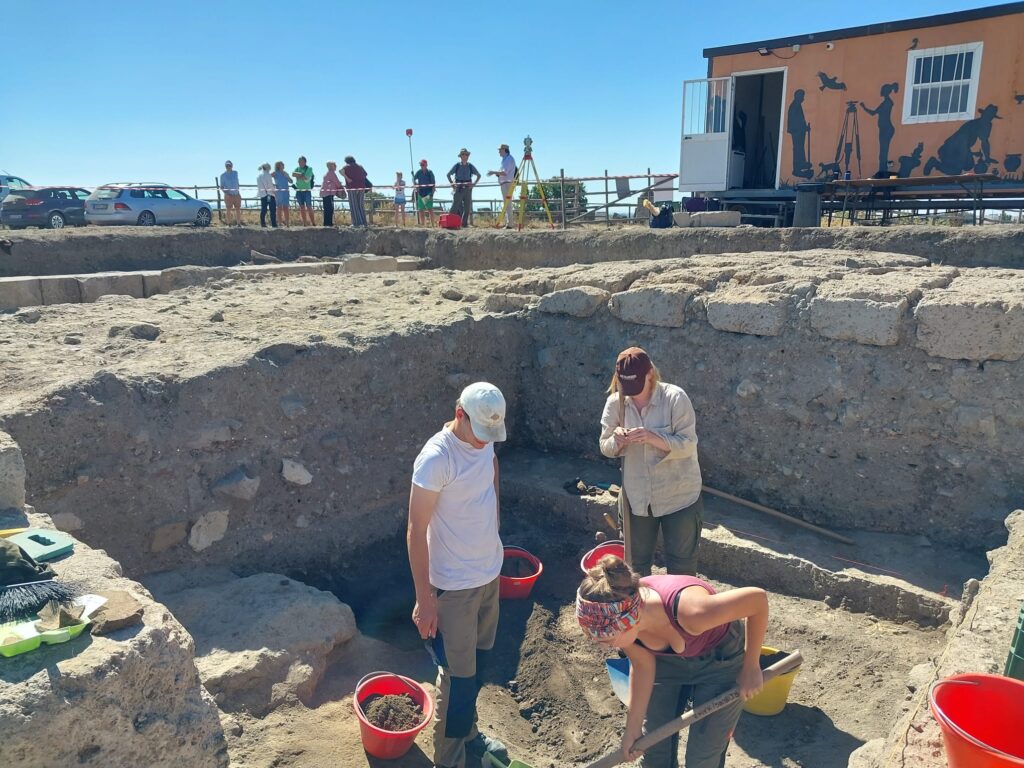
The most popular internships are on excavations and prospecting, for which Mainz is an ideal location thanks to the numerous activities on site and in the region. Important contact points for those interested in excavations are the Pre- and Early Historical Archaeology working group with its “Archaeological Fieldwork” teaching unit and its numerous undertakings in the Mainz area, as well as the Rhineland-Palatinate State Monuments Office in Mainz (see address below). Classical Archaeology also currently offers students opportunities to become employees in field research, for example in Italy. If you would like to work on an excavation in the Mediterranean region or elsewhere abroad, you will generally need to have gained some experience on a domestic excavation. Interested parties for excavations of the German Department of Archaeology(www.dainst.org) should contact the employees of the institutes here in Mainz for further information and placement.
The second focus for internships is employees in museums and at exhibitions. Here, too, there are many opportunities, initially through initiatives by teaching staff in the archaeological subjects themselves, especially in Classical Archaeology, but then also in the region, especially at the Landesmuseum Mainz, whose archaeological department is currently undergoing changes as part of the reorganization of the Mainz archaeological collections. For this area as well as for the items (publishing houses, newspapers, television stations), students should, if possible, seek access on their own initiative with the support of their teaching staff (see the list of potential internship providers below). As the Bachelor’s degree is also designed for an appointment in the field of science communication, it is strongly advisable to also consider institutions from the cultural and scientific sector that are not related to archaeology. In the best case scenario, such practical experience gained during the program of study can lead directly to a subsequent appointment.
Completion of the practical module also includes the submission of an INTERNSHIP REPORT (please use the cover sheets in the download area!). In the examination regulations valid from summer semester 2016, it refers to the entirety of the practical experience, but can highlight individual activities in particular. The report should be about 2 to 3 pages long and – in a form adapted to the respective activities – should address the following points as far as possible: Access to internships, concise description of the activity (if applicable, access to special internships) and, if applicable, the (external) institution where the internship was completed, own experiences, both positive and critical, with a view to own program of study and career goals. Please submit the report to the module leader (P. Schollmeyer; VFG: P. Haupt; Byzt. Arch.: V. Tsamakda).
The field trips (at least 6 field trip days in the B.A. Archaeology and in the major subjects, 2 to 4 days in the minor subjects) can be completed as day trips or in larger units (multi-day or major field trips). If possible, the field trips should be taken in the subject of specialization, but participation in different subjects is also very useful in the joint degree programs. The main purpose is to get to know finds and excavation sites at first hand, thus gaining a more precise view of the archaeological tradition than is possible in the seminar room, to develop a sense of the possibilities and limits of archaeological analysis on excavation sites and to deal with the requirements of modern monument preservation.
The range of field trips on offer is relatively large, albeit unevenly distributed across the individual subject areas, so that demand can be met as far as possible and all students have the opportunity to take part in a major field trip during the course of their program of study. As a rule, participants are required to provide their own work, usually in the form of a guided tour presentation on site. Registration for field trips, especially for major excursions abroad, should be understood as binding, as the organization requires a great deal of preparation on the part of the teaching staff. Due to budget constraints, students unfortunately have to bear a large part of the costs for major field trips themselves.
When submitting an application, especially in the case of institutions not involved in archaeology, it is essential to state that internships are a compulsory part of the study program.
The umbrella organization of archaeological student representations has institutionalized an archaeological internship exchange under the name ArchaeNoah: www.dasv-ev.org/archaeonoah/index.php
State Office for the Preservation of Historical Monuments
Dept. of Archaeological Monument Preservation
Große Langgasse 29; 55116 Mainz
Tel. 06131/201 630-0; Fax 06131/201 6333
e-mail: archaeologie-mainz@t-online.de
Information and requirements for internships at
www.theatrum-mainz.de/index.php/ausgrabung.html
Verlag Philipp von Zabern
For the attention of Ms. Alrun Schößler Tel. 28747-19
Göttelmannstraße 13 A
55130 Mainz
Internships of 8 weeks or more in the publishing house and in the editorial department of the journal “Antike Welt”
Applications are accepted on an ongoing basis
ZDF
Education and Training Department Tel. 70-4364/4763
55100 Mainz
Detailed information on application requirements and modalities
on the ZDF homepage www.unternehmen.zdf.de/index.php?id=225
Römisch-Germanisches Zentralmuseum Mainz
Field of research Palaeolithic
Museum for the Archaeology of the Ice Age, Neuwied
www.rgzm.de
www.museum-monrepos.de
Radio stations and newspapers
generally require the completion of the 4th semester as a prerequisite! An overview can be found on the website http://www.journalistenlinks.de/ under the keyword “Internships and work shadowing”.
Frankfurter Allgemeine Zeitung – FAZ
For the attention of Mr. Hendrik Wieck Tel. 069/75911683
Hellerhofstr. 2-4
60327 Frankfurt
Information on internships: www.faz.net/praktikum
Archaeological Park/Regional Museum Xanten
For the attention of Ms. Andrea Hülsbrink Tel. 02801/712115
Trajanstr. 4
46509 Xanten
“International Summer Academy”, 2 dates in summer, 4 weeks each
Call for proposals from the end of January at www.apx.de/archaeologischerpark/
Südwestrundfunk – SWR
Human Resources Development Tel. 929-2731
for the attention of Ms. Claudia Storch
Am Fort Gonsenheim 139
55122 Mainz
Internships of 6 weeks duration
Applications are accepted on an ongoing basis
The University of Mainz offers an unusually dense range of teaching and research in the field of archaeology among Germany’s higher education institutions. The entire area from the first diplomas of mankind to the advanced civilizations of the Near East and the Mediterranean world, the prehistoric cultures of Europe through to late antiquity and the early Middle Ages are represented by their own disciplines and institutes or departments.
Responsibilities / area of responsibility
Responsibilities / area of responsibility
Responsibilities / area of responsibility
Responsibilities / area of responsibility
Definition
“Bachelor’s examination” refers to the final examination, passing a written paper and an oral examination. There are no preparatory or accompanying courses, unlike in some other subjects or in the Master’s degree in Archaeology. Please inform yourself about all modalities on the basis of the examination regulations applicable to you.
The Bachelor’s examination is not necessarily at the very end of the program of study: registration is possible as soon as 120 credit points have been earned. This regulation has the advantage of allowing you to organize your studies flexibly: you can define the start of the processing time yourself, taking into account your own time budget (during or outside the lecture period). However, avoid the mistake of placing the fulfillment of the requirements in the old languages at the very end of the program of study!
Discuss a provisional date for the oral examination with the examiners in good time!
The examination office of Faculty 07 is responsible for the technical-administrative side. Its website(https://www.geku.uni-mainz.de/zentrales-pruefungsamt/) provides all the necessary information and has the registration form and other documents available for download. You will receive the required proof that you have completed at least 120 LP from Mr. Maisuradze. The processing period for the bachelor’s thesis begins with the submission of the completed registration form. Registration is possible at any time. The oral examination must be logged in separately.
All teaching staff in the respective subject area are eligible to take the examination. The examination regulations stipulate that one of the two examiners of the bachelor’s thesis (does not apply to the oral examination!) must be a university teaching staff member (= university or junior professor) or habilitated (in B.A. Archaeology, one of the two examiners must be a professor).
The topic and examiners are determined on the initiative of the examinees. Bachelor’s theses are generally designed as ‘literature papers’, which demonstrate the ability to systematically describe the subject matter and critically present the state of research. However, the topics can also be developed from employees working on research projects.
The supervisor will help with the exact definition within a topic area. In order to avoid misunderstandings when tailoring the thesis, it is advisable to ensure that the topic is precisely defined and can be easily completed within the deadline.
The processing time is 8 weeks. This can be renewed by two weeks “in special cases”; an informal proposal must be submitted in good time to the chairperson of the examination committee (if necessary via the examination office). Delays caused by illness must be evidenced by a medical certificate.
All questions relating to the bachelor’s thesis should be clarified with the supervisor; interim discussions are expressly permitted under the examination regulations. The scope of the bachelor’s thesis is defined in the examination regulations for the B.A. Archaeology as approx. 30-40 pages of text (excluding bibliography, illustrations, etc.), which also applies as a guideline for the B.A. Classical Archaeology. The information on formalities on the website of the examination office is not binding. Unless otherwise agreed with the supervisors, the following can be used as a standard: Text font Times Roman 12 (or comparable serif font), 1.5 lines, notes Times Roman 10, also 1.5 lines, page margin top 2.0 cm, left 2.5 cm, right 3.0 cm, bottom 2.0 cm; page numbers bottom center or right.
The bachelor’s thesis must be submitted bound in duplicate and in electronic form (PDF).
The evaluation of the bachelor’s thesis should be completed within six weeks. The oral examination should take place within four weeks of the submission of the two evaluators for the bachelor’s thesis.
For the 30-minute oral examination, the regulations stipulate: “The subject of the final examination is the content of the Bachelor’s thesis as well as questions and tasks in the context of the topic chosen for the Bachelor’s thesis and another suitable module of the candidate’s choice, which must be agreed in advance with the examiners (…). The candidate must be given the opportunity to present his or her work during the examination period; the presentation may not exceed five minutes.” The – not obligatory! – presentation of the candidate’s own work should not consist of a summary, but should focus on individual points that can be meaningfully discussed. Everything else can be freely agreed on the initiative of the examinee (free topics or courses of one or both examiners as the subject of the examination). The examiners do not have to be the same as the evaluators of the thesis if, for example, there are scheduling problems.
If the bachelor’s thesis is evaluated as “insufficient” (5.0), it has not been passed. The failed examination can be repeated once, the oral examination twice. You must apply to retake the examination within six weeks of being notified of the examination result. Examinations evaluated as “sufficient” (4.0) or better may not be repeated.

