Letizia Savino is an Assyriologist specialising in the philology and cultural history of the ancient Near East. She is currently a postdoctoral researcher at Johannes Gutenberg University Mainz, where she teaches Akkadian language and cuneiform literature. Her research focuses on Akkadian scholarly and literary traditions, with particular emphasis on medicine, healing practices, and the transmission of specialised knowledge across the ancient Near East.
Her work explores Akkadian medical texts from Ḫattuša, Mesopotamian therapeutic and ritual traditions, the circulation of experts and expertise during the second millennium BCE, and the interaction between Mesopotamian and Anatolian intellectual traditions. More broadly, she is interested in the history of cuneiform scholarship, textual transmission, and the movement of knowledge, people, and practices across linguistic and cultural boundaries.
Her research combines close philological analysis with broader historical perspectives to investigate how cuneiform texts illuminate processes of knowledge production, cultural exchange, and intellectual history in the ancient Near East.
04/2021–12/2025
PhD in Assyriology. The Doctoral thesis project (Title of the disseration: Medicine Across Borders. Circulation of Medical Experts and Expertise in the Second Millennium BCE in the Ancient Near East ) focused on the mobility of specialists in the medical (asûtu) and ritual medical field (ašiputu) in the Second Millennium BCE in the ancient Near East, in particular starting from the data contained in Hittite epistolary documents and medical texts; the research was supervised by Prof. Dr. Doris Prechel (since 2021), by Prof. Dr. Alexander Pruß (2022-2023), and by Dr. habil. Ulrike Steinert (since 2023). The dissertation was defended on 13/04/2026 and received the grade summa cum laude.
11/2018–11/2020
Master’s degree in Archaeology and Ancient History achieved with a grade of 110/110 summa cum laude with a thesis titled Un rituale accadico contro la febbre di montagna (CTH 811) (“An Akkadian ritual against mountain fever (CTH 811)”), supervised by Prof. Dr. Elena Devecchi. The thesis received praise and was deemed worthy of publication. It was also nominated for the Silver Medal for the best thesis of the Department of Ancient Studies for the academic year 2019/2020.
10/2019–03/2020
Erasmus scholarship at the Julius-Maximillians-Universität Würzburg. Passed with a certificate of excellence (ECTS grade A).
09/2014–10/2018
Bachelor’s degree in Beni culturali (Cultural heritage) with main focus on Archaeology at the Università degli Studi di Torino, Italy. Title of the Bachelor’s thesis was Forme di performance nel Vicino Oriente antico: musica, danza e sport in Mesopotamia e Anatolia (“Performative arts in the Ancient Near East: music, dance and sport in Mesopotamia and Anatolia”); supervised by Prof. Dr. Elena Devecchi.
Since 11/2025
Research fellow and teaching assistant for Ancient Near Eastern Studies at the Johannes Gutenberg-Universität Mainz (11/2025-03/2026: 50%; since 04/2026: 80%). The role combines research and teaching activities in Ancient Near Eastern Studies, including counselling for B.A.- and M.A.-level courses, preparation of course materials and examinations, student supervision, coordination of the Erasmus+ programme for the students of Ancient Near Eastern studies, and participation in departmental academic and organisational activities. The post further requires independent research, academic writing, and the use of philological and digital research tools.
11/2023-10/2025
Research assistant (50%) for the three-year DFG-funded project Akkadian and Hittite Emotions in Context (AHEC). The research project pursued a comprehensive study of the semantic domain of emotions in both Akkadian and Hittite to systematically research how emotions in the two languages were differentiated and delimited linguistically and contextually. For my position a good knowledge of the Akkadian language and the corresponding literature, as well as the use of digital writing programmes was required. My primary contribution consisted of an analysis of wisdom literature (dialogues, monologues, fables, …), for which I mapped the lexicon of emotions, both from a semantic perspective, by providing glosses and conducting textual and contextual analyses, and from a diachronic perspective, by investigating how Akkadian terms have been interpreted, translated, and at times even localised in major modern European languages.
02/2022-03/2024
Associated Member of the Research Training Group 1876 “Early Concepts of Man and Nature: Universal, Specific, Interchanged” (Graduiertenkolleg 1876 “Frühe Konzepte von Mensch und Natur: Universalität, Spezifität, Tradierung). The RTG was interested in establishing where and when similar beliefs and concepts originated, whether this happened independently, or whether these concepts were transmitted or even exchanged between ancient cultures, and how and why they changed over time. The time frame of the RTG went from the dawn of history (about 100,000 years BCE) to the Middle Ages in an area that includes the ancient Near East, the Mediterranean, and Europe. During my years as an associate member, I had the opportunity to attend conferences and congresses funded by the RTG, thereby expanding my knowledge and establishing a network of collaborations with other scholars.
01/2021-10/2023
Research assistant (50%) for the three-year DFG-funded project Thesaurus Linguarum Hethaeorum digitalis (TLHdig), in a team composed also by Dr. Fabio Bastici and Prof. Dr. Doris Prechel. The project envisaged the creation, by 2023, of an open content and open access digital archive with a catalogue of Hittite texts in transcription according to HFR standards. For my position a good knowledge of the Hittite and Akkadian languages, and in general of cuneiform languages, as well as the use of digital writing programmes was required. My main contribution was the transliteration of all the Akkadian fragments catalogued under CTH 800-819, as well as of the Akkadian letters sent between the Hittite and foreign courts.
ANA – Associazione Nazionale Archeologi (member)
CuStAA – Consulta universitaria per gli Studi du Asia e Africa (member)
DOG – Deutsche Orient-Gesellschaft (member)
- 2025: “”Se gli occhi di un uomo…” Curare le malattie oftalmiche a Ḫattuša”, in: Stefano de Martino, Francesco Barsacchi, Alessio Palmisano (eds), “Egitto e Vicino Oriente Antichi. Studie e Ricerche sull’Egitto e il Vicino Oriente in Italia”. Eothen 26. Firenze: LoGisma Editore: 195-200.
- 2026: “An Akkadian Ritual Against ‘Mountain Fever’”, in: Tomáš Alušík, Pavla Alušíková Dostalíková, Milena Melfi, Conan T. Doyle, Rupert Breitwieser (eds), “Prehistoric, Ancient and Medieval Medicine: New Perspectives and Challenges for the Twenty-First Century”, Archaeopress: 38–45. DOI: 10.2307/jj.41344826.9
- 2023: “Akkadische Rezepturen gegen Fieber (CTH 811)”: Hethitologie Portal Mainz, online: https://hethport.net/txhet_besrit/intro.php?xst=CTH%20811&prgr=&lg=EN&ed=L.%20Savino
- 2023: “On Akkadian Therapeutic Prescriptions Against Eye-Diseases in Ḫattuša – Part I”, in NABU 2023/3: 135-136.
- 2023: “On Akkadian Therapeutic Prescriptions Against Eye-Diseases in Ḫattuša – Part II”, in NABU 2023/3: 137-138.
- 2024: “Healing Eye-Diseases in Ḫattuša. New studies on content, palaeography, and layout”, poster presented at the 69th Rencontre Assyriologique Internationale, Helsinki 2024. DOI: 10.13140/RG.2.2.15518.40002
- 2025: “Review of Irene Sibbing-Plantholt: The Image of Mesopotamian Divine Healers. Healing Goddesses and the Legitimization of Professional asûs in the Mesopotamian Medical Marketplace. Leiden/Boston: Brill 2022. IX, 410 pp. (Cuneiform Monographs 53.) ISBN 978-90-04-51240-5. € 169,06.”, in ZDMG 175/2: 520-522.
06/2018: Participation in the archaeological excavation in Pietrabianca2, Bioglio (BI), Italy. In addition to field work as an archaeologist, I also took part in the survey and documentation of surface materials emerging in the site area. Supervisors of the excavation were Prof. Dr. Paolo De Vingo and Drs Maurizio Rossi and Anna Gattinga.
17/06/2026
“Verso una riorganizzazione dei testi medici accadici da Hattuša,” Egitto e Vicino Oriente antichi (EVOA2026), 17th-19th June 2026, Florence.
09/07/2025
“Medicine and Magic Across Borders: The Rubricated Akkadian Manuscripts from Ḫattuša,” 70th Rencontre Assyriologique Internationale, 7th-11th July 2025, Prague.
30/10/2024
“‘Schick einen Mann, um Medikamente vorzubereiten! Der Austausch medizinischer Spezialisten im 2. Jahrtausend v. Chr. Im Alten Nahen Osten,” Ringvorlesungen Vielsprachige Antike. Sprachkontakte und Multi-/Plurilingualismus im Mittelmeerraum , Mainz.
09/07/2024
“Healing Eye-Diseases in Ḫattuša” (poster), 69th Rencontre Assyriologique Internationale, 8th-12th July 2024, Helsinki.
19/06/2024
“‘Se gli occhi di un uomo…’ Curare le malattie oftalmiche a Ḫattuša” (“‘If the eyes of a man…’ Healing ophthalmic diseases in Ḫattuša”, Egitto e Vicino Oriente antichi (EVOA2024), 18th-19th June 2024, Turin.
04/06/2024
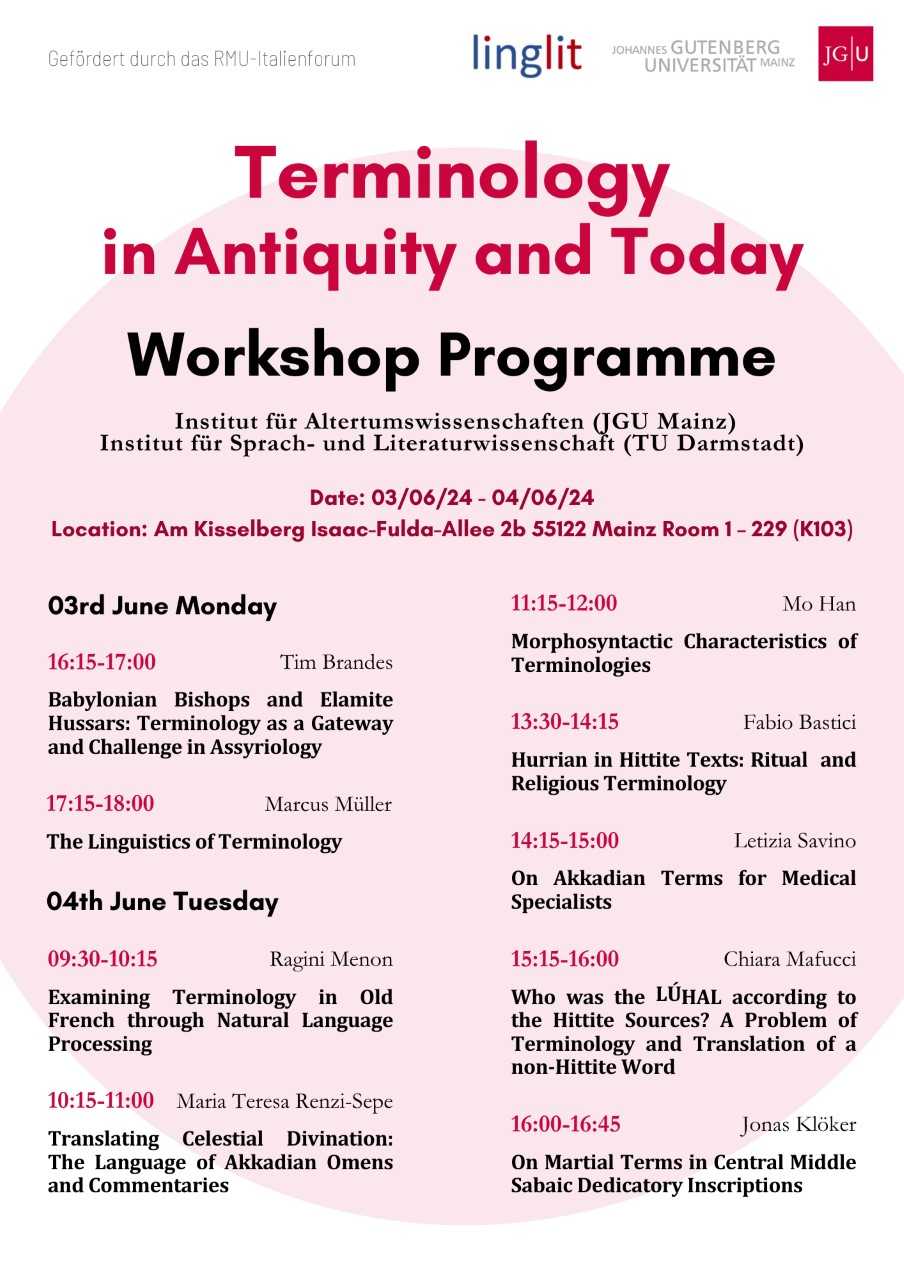
“On Akkadian Terms for Medical Specialists”, Workshop Terminology in Antiquity and Today, 3rd-4th June, Mainz.
07/09/2023
“Healing Ophthalmic Diseases in Ḫattuša. New Translations from CTH 809”, XII. International Hittitology Congress and Ortaköy-Šapinuwa Workshop, 4th-9th and 13th-15th September 2023, Istanbul-Çorum.
02/12/2022
“Medici e medicina all’estero” (“Medicine and physicians abroad”), IV Convegno dei Giovani Ricercatori Italiani di Storia e Filologia del Vicino Oriente Antico (GRISeF-VOA), digital.
22/09/2022
“New Studies on a Mesopotamian Prescription Against ‘Mountain Fever’”, International Symposium Prehistoric, Ancient And Medieval Medicine: New Perspectives And Challenges For The Twenty-First Century. Prague, 21st-23rd September, 2022, Institute for History of Medicine and Foreign Languages, First Faculty of Medicine, Charles University.
31/05/2021
Lectio magistralis at the Università degli Studi di Torino as part of the course Wisdom and Religious Traditions of Ancient Mesopotamia, titled “Ho posto nella sua bocca il giuramento degli dèi. Medicina mesopotamica e āšipūtu nel II e I millennio a.C. ” (“I placed in his mouth the oath of the gods. Mesopotamian medicine and āšipūtu in the 2nd and 1st Millennium BCE”).
SuSe 2026
Johannes Gutenberg-Universität Mainz, Altorientalistik. Akkadian Literature in Translation (S AO Philologie III, 07.848.1430). 2 hours pw. Language: English.
WiSe 2025-2026
Johannes Gutenberg-Universität Mainz, Altorientalistik. Tutorial Akkadian II (T Akkadisch II, 07.848.1345). 2 hours pw. Languages: English, German.
WiSe 2023-2024
Johannes Gutenberg-Universität Mainz, Altorientalistik. Akkadian reading Seminar (S AO Philologie III, 07.848.1430). 2 hours pw. Language: English.
Every SuSe since 2026
Introduction to Ancient Near Eastern Studies and reading cuneiform (“Reading Cuneiform Made Easy!”) as part of the University Open Day. Language: German.
27/03/2026
“La medicina mesopotamica” (“Mesopotamian medicine”): episode of the podcast Riscoprire la Mesopotamia by Thomas Marampon, available on major streaming platforms . Language: Italian.
13/12/2023
Introductory lecture on the decipherment of cuneiform and activity on cuneiform writing on clay. 1B Liceo delle Scienze Umane “Augusto Monti”, Chieri (TO). Language: Italian.
14/04/2023
“In the beginning was the wedge”: introduction to Cuneiform Studies. Stavanger, Universitetet i Stavanger, Faculty of Mathematics and Physics. Sprache: Englisch.
History of Medicine
Akkadian
Wisdom Literature
Second Millennium BCE
Mesopotamian Medicine
Ḫattuša
Transfer of Knowledge
Assyriology