ANCIENT FIELDS FOR FUTURE HARVESTS
Long-term perspectives on sustainable agriculture
Leibniz-Zentrum für Archäologie (LEIZA), Ludwig-Lindenschmit-Forum 1, 55116 Mainz, Germany
8-9th October 2026
Archaeology provides unparalleled long-term insights into the interactions between humans, ecosystems, and subsistence systems, yet its potential to contribute to contemporary debates on sustainable agriculture remains underexploited, constrained by conceptual and disciplinary divides between archaeology, agricultural research, and practice. This workshop seeks to bridge these divides by bringing together scholars from archaeology, archaeobotany, zooarchaeology, geochemistry, palaeoecology, genetics, crop physiology, agroecology, and agricultural anthropology—particularly those working at disciplinary intersections or engaged with the practical challenges of applying knowledge in agroecological contexts and integrating diverse traditions of expertise. Through thematic sessions, the participants will examine how archaeological and historical ecological datasets can inform contemporary approaches to ecological intensification, food sovereignty, and agroecosystem resilience. The workshop will foster the development of shared methodological and conceptual frameworks to enhance the applicability of long-term perspectives to current sustainability challenges.
The event is hybrid, and registration for the workshop is mandatory, via the following link: https://forms.gle/8wJ2W9sYFTHuD6m67
For more information here is the workshop website: https://sites.google.com/view/ancientharvests?usp=sharing
Edited by Eve Derenne, Maria Ivanova-Bieg, Ana Catarina Sousa, Juan Antonio Cámara Serrano and Enrico Giannitrapani
Explores late Chalcolithic Mediterranean networks, highlighting Bell Beaker expansion, cultural exchange, and emerging social complexity.
The late 4th and 3rd millennium BCE saw the development of new long-distance maritime networks around the Mediterranean. During this late Chalcolithic phase, the ‘mental mapping’ of the Mediterranean as a maritime space reached a critical stage; the influx of new people and cultural traits, combined with a boom in seaborne exchange, meant that the western and central Mediterranean became integrated into a large maritime cultural area. Circulation routes seem to have expanded remarkably after 2500 cal BCE, enabling large-scale cultural phenomena such as the Bell Beaker complex to spread across the Mediterranean and integrate a variety of local Chalcolithic groups, both on islands and in coastal or mainland areas. These large-scale networks of interaction foreshadowed the emergence of major Mediterranean civilisations in the next millennium.
Noting that this topic had not been the subject of scholarly discussions in recent years, even though recent archaeological discoveries and analytical developments offered new opportunities to investigate these issues, the co-editors of this volume organised a session at the 2024 international conference of the European Association of Archaeologists in Rome. Their aim was to examine the origins and dynamics of Bell Beaker connections across the Mediterranean, be it in terms of material culture, subsistence strategies, technology, human-environment relationships, absolute chronology, genomic ancestry or isotopic provenance.
This resulting volume is a coherent collection of papers covering the entire western and central Mediterranean, including coastal Maghreb, the Balearic Islands, Sardinia and Sicily. The chapters present a wide variety of scales, methodological approaches and sub-topics ranging from site-based to supra-regional studies, typological and technological approaches, network analyses, computational modelling, but also raw material, isotopic and palaeogenomic data, and touch on themes such as mobility patterns, local integration, power display, exchange networks, luxury and exotic goods consumption, metallurgy and the emergence of social complexity. Some focus solely on Bell Beaker contexts, others discuss the relationships between the traditions of the preceding Chalcolithic societies and the Bell Beaker phenomenon, or the ties the latter shared with the Bronze Age groups that followed it.
Together, these contributions demonstrate the dynamic interplay of cultural, social and technological factors that shaped the Mediterranean during the late 4th–early 2nd millennia BCE. By integrating diverse lines of evidence and a wide array of methodological approaches, this volume not only provides a nuanced understanding of Bell Beaker networks and their integration with local Chalcolithic societies but also sheds light on the precursors to the major Mediterranean civilisations of the Bronze Age. The volume aims to stimulate further research and dialogue on these transformative centuries, bridging gaps in the scholarly discourse and setting a foundation for future interdisciplinary investigations.
Publisher’s homepage: Bell Beakers and the Mediterranean – Oxbow Books
A comprehensive account of the adoption of ironworking in Europe and Western Asia, based on archaeological evidence alongside written sources from the Near East. Southern Europe and the Near East are the focus, but the book also considers early ironworking in Central Europe, the North Pontic steppe and the regions north and south of the Caucasus.
Iron and the Iron Age presents a comprehensive account of the adoption of ironworking in Europe and Western Asia. The study is mainly based on archaeological evidence, but the early introduction of iron in the Near East also takes account of the written sources. After the fundamental innovation of iron production by smelting iron ores, iron use spread at an ever-increasing rate between the 12th and 9th centuries BC – eventually reaching a vast area between the Atlantic coast in the west and the North China Plain in the east.
The book mainly concentrates on the adoption of iron in the Near East and southern Europe, but also includes discussions of early ironworking in Central Europe, the North Pontic steppe and the regions north and south of the Caucasus. The changing conceptualization of bronze and iron is another theme which receives detailed attention.
In the final part of the book, the study turns to the concept of an ‘Iron Age’, and the fundamental culture-historical disjunctions and transformations which can be observed in many regions at the time of the introduction of iron.
now also available in Open Access .
Publisher’s homepage: https://www.archaeopress.com/Archaeopress/Products/9781805830009
Academia.edu: https://www.academia.edu/129359165/Iron_and_the_Iron_Age_The_Introduction_of_Iron_in_Europe_and_Western_Asia
Research Unit Pre– and Early History Archaeology
The Pre- and Early Historical Archaeology research unit of the IAW (formerly the Institute of Pre- and Early History) at Johannes Gutenberg University focuses on cultures from the beginning of human history, the Paleolithic, to the Roman and Medieval periods.
The institution benefits from its geographical proximity and institutionalized cooperation with major archaeological research institutions, museums and heritage offices (LEIZA – Leibnitz Centre for Archaeology and the Romano-Germanic Commission (RGK), Frankfurt am Main. This warrants methodical and practical training and makes Pre- and Protohistoric Archaeology in Mainz an important training location in Germany.
The research unit Pre- and Protohistoric Archaeology at the Institute of Classical Studies at Johannes Gutenberg University Mainz is located at Hegelstraße 59, 55122 Mainz. Here you will find the office, offices and seminar rooms as well as the archaeobotanical laboratory, the laboratory for finds processing and the diverse teaching and research collections of the research unit.
research unitLeibniz AssociationThe Leibniz Center for Archeology (LEIZA) is a globally active research institute for archaeology with headquarters in Mainz and is one of the Leibniz Association’s research museums. As part of a cooperation with LEIZA, the Pre- and Protohistoric Archaeology working group operates an on-site laboratory for the chemical analysis of bioarchaeological remains.
Monrepos
► International research on site. Monrepos Archaeological Research Center and Museum of Human Behavioral Evolution.
The Monrepos Archaeological Research Center and Museum of Human Behavioral Evolution (Monrepos) is a department of the Leibniz Centre for Archaeology, a non-university research institute for archaeology. The Leibniz Center for Archaeology is an institution of the Leibniz Association.
Monrepos explores the longest and most formative epoch in human history: the Palaeolithic and Mesolithic, our hunting history. The decisive biological and social foundations of our present-day existence were formed during this period.
Monrepos pursues a diachronic and perspective-oriented research strategy. Monrepos operates internationally and conducts research in Europe, Asia and Africa.
The research center is based at Monrepos Castle near Neuwied.
► From excavation to exhibition by the shortest route: Project Incarnation: an archaeological exhibition
The direct link between research and museum presentation guarantees topicality. The almost 1000m² permanent exhibition Project Incarnation: an archaeological exhibition at Monrepos Castle illustrates human development from our beginnings 2.5 million years ago to the end of the last Ice Age around 10,000 years ago. World-famous finds impressively illustrate the diversity of long-gone living environments in a vivid way.
Project
The Neumark-Nord project is investigating the survival strategies of Neanderthals during the interglacial period on the basis of a unique site in Saxony-Anhalt. Under the direction of Sabine Gaudzinski-Windheuser and Lutz Kindler, in cooperation with the State Office for the Preservation of Historical Monuments Saxony-Anhalt and the University of Leiden, the project is investigating how early humans shaped their environment. The exceptionally well-preserved interglacial deposits in Neumark-Nord provide high-resolution and precisely datable archives of human activity. By examining these materials, we will explore how Neanderthals actively modified their ecosystems to meet their specific needs. This diachronic “deep history” perspective provides valuable insights into the early stages of human impact on the environment – particularly relevant today, when almost all ecosystems show clear anthropogenic influences.
The team
Prof. Dr. Sabine Gaudzinski-Windheuser (project manager)
Dr. Lutz Kindler (project manager)
Our research examines the fundamental role of hunger as a driver of human behavior in Prehistory. While humans exhibit conservative dietary patterns due to basic biological needs, food procurement and consumption goes far beyond mere energy supply and forms an essential part of social and cultural life. As omnivores, humans show a remarkable adaptability in the use of different plant and animal resources in different habitats. Our research particularly investigates the important role of animal resources in human evolution. Through complementary projects in Melka Kunture, Ethiopia, led by Sabine Gaudzinski-Windheuser and Lutz Kindler in collaboration with international partners, we are investigating early human food selection, procurement, processing and stockpiling, and the associated technologies and land use systems. The project focuses on understanding how early hominins adapted their subsistence strategies to the changing biotopes at the headwaters of the Awash during the Old and Middle Pleistocene. This research contributes to our long-term goal of developing a holistic understanding of the Stone Age diet from the first humans to the last hunter-gatherers and exploring how humans became the dominant species in the food web.
The team
Prof. Dr. Sabine Gaudzinski-Windheuser (project manager)
Dr. Lutz Kindler (project manager)
Our research investigates how rules and sets of rules serve as fundamental building blocks of complex social structures, with the Breitenbach site providing important insights into early human spatial organization. Led by Olaf Jöris, in collaboration with the State Office for the Preservation of Historical Monuments Saxony-Anhalt and the Institute of Geography at Johannes Gutenberg University Mainz, this project explores how early hunter-gatherer societies developed and implemented social rules. Modern human communities are based on complex systems of rules that shape social environments, with internal dynamics being determined more by social rules than by external factors. These systems help to locate individuals in communities and create both individual and group identities. Archaeological evidence shows that the complexity of such rules varied across time and space. Our research at Breitenbach focuses on understanding how spatial and social organization interacted in Aurignacian societies and examines the evolutionary benefits of establishing rule systems and their associated social structures. This provides important insights into how early rules and frameworks extended into all areas of human life.
The team
Dr. Olaf Jöris (project manager)
Project
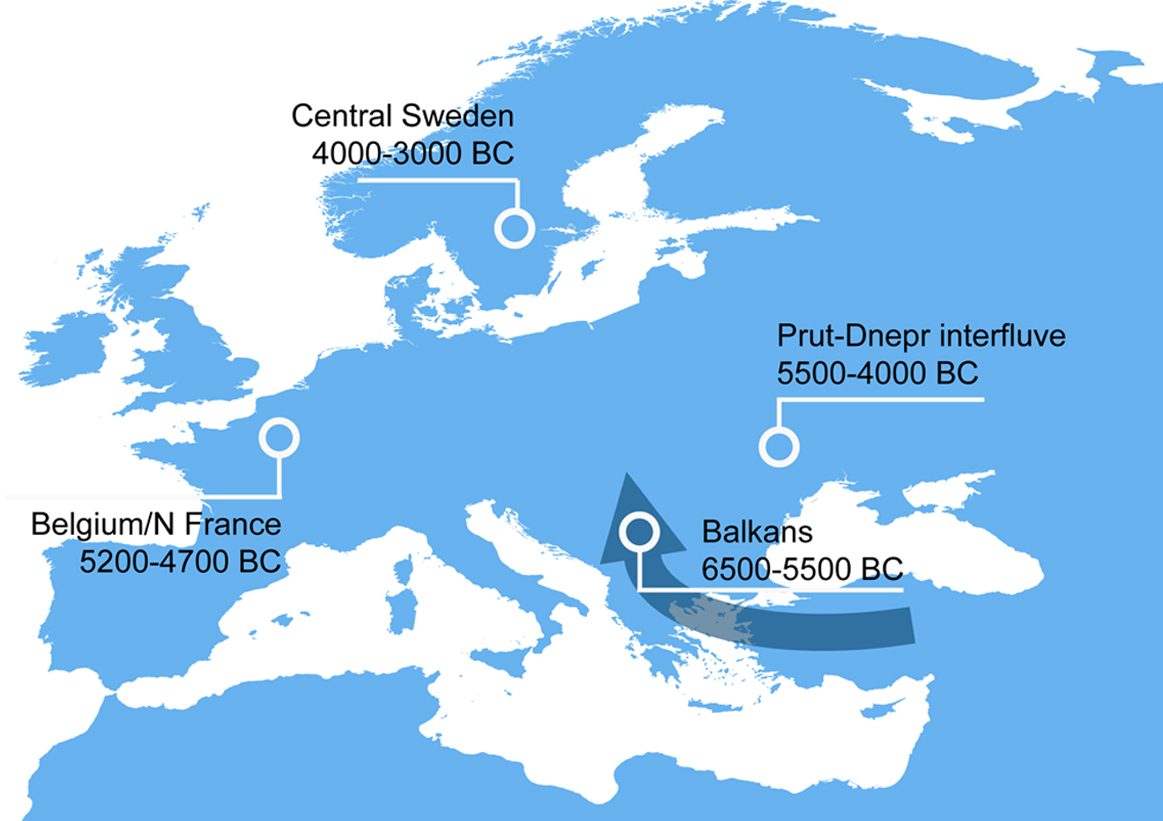
SUSTAIN: Sustainability of Agriculture in Neolithic Europe
SUSTAIN is a five-year research project (2020-2026) funded by the European Research Council. It seeks to understand the sustainability of Early Neolithic agricultural societies in Europe through a combination of climate and biodiversity informatics, bioarchaeology and agent-based modeling. It examines societies that have only recently settled in new environments and started to practice mixed agriculture and pastoralism. This then novel way of interacting with the environment involved a different scale of intervention in the life cycles of plants and animals and was of fundamental importance for later developments in Europe.
Further information: https://sustain-erc.org
The team
- Prof. Maria Ivanova-Bieg (Principal Investigator; Pre- and Protohistoric Archaeology, JGU Mainz)
- Prof. Richard Evershed (University of Bristol, UK)
- Dr. Melanie Roffet-Salque (University of Bristol, UK)
- Prof. Thomas Hickler (Senkenberg Society, Frankfurt, Germany)
- Dr. Wolfgang Traylor (Senkenberg Gesellschaft, Frankfurt, Germany)
- Prof. Mark Thomas (University College London, UK)
- Dr. Sayuri Kochi (Pre- and Protohistoric Archaeology, JGU Mainz)
- Dr. Phoebe Heddell-Stevens (Pre- and Protohistoric Archaeology, JGU Mainz)
cooperations
- Dr. Tina Lüdecke (Max Planck Institute of Chemistry, Mainz, Germany)
- Adrian Timpson (University College London, UK)
- Dr. Marie Balasse (MNHN, Paris, France)
- Dr. Elena Marinova (State Office for Cultural Heritage Baden-Württemberg, Germany)
Financing
European Research Council, CoG, GA 865515
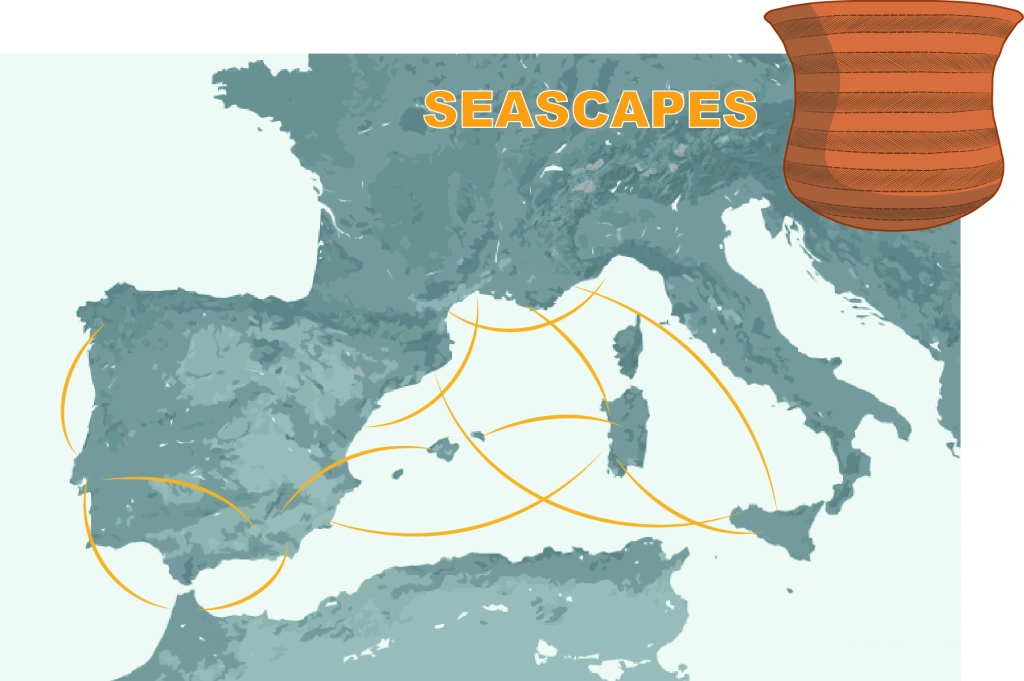
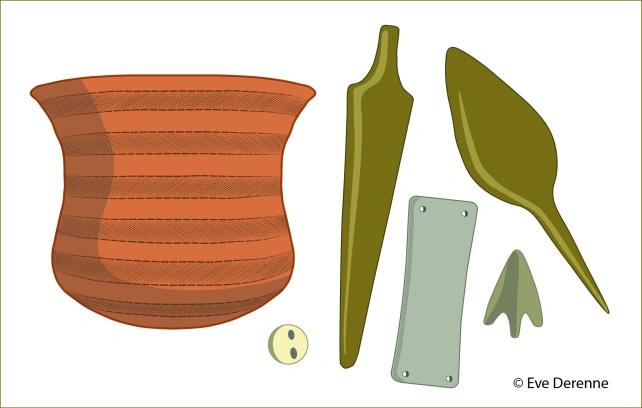
ProjectSEASCAPES: Tracing the emergence and spread of maritime networks in the Mediterranean in the3rd millennium BCE
The Seascapes project (2022-2025) investigates the Bell Beaker phenomenon in the western Mediterranean during the third millennium BC, a period characterized by increased human mobility and the emergence of maritime networks. Radiocarbon dating (including the analysis of specific compounds), the analysis of organic residues in the pottery and spatio-temporal modeling will be used to determine traffic routes, contact points and directions of movement.
Further information: https://seascapesproject.wordpress.com
The team
- Prof. Maria Ivanova-Bieg (project manager; Pre- and Protohistoric Archaeology, Johannes Gutenberg University Mainz, Germany)
- Assoc. Prof. Lucy Cramp (Projektleitung; Department of Anthropology and Archaeology, University of Bristol, UK)
- Dr. Eve Derenne (Pre- and Protohistoric Archaeology, Johannes Gutenberg University Mainz, Germany)
- Dr. Alex Bayliss (Historic England, UK)
- Prof. Mark Thomas (University College London, UK)
- Adrian Timpson (University College London, UK)
- Dr. Elena Marinova (State Office for Cultural Heritage Baden-Württemberg, Germany)
cooperations
- Dr. Michael Kunst (retired from the German Archaeological Institute in Madrid)
- Prof. Ana Catarina Sousa (University of Lisbon, Portugal)
- Prof. Victor Gonçalves† (University of Lisbon, Portugal)
- Prof. Juan Antonio Cámara (University of Granada, Spain)
- Dr. Alberto Dorado Alejos (University of Granada, Spain)
- Prof. Manuel Calvo Trias (University of the Balearic Islands, Spain)
- Dr. Damià Ramis (independent researcher, Spain)
- Dr. Jaume Coll Conesa (Museo Nacional de Cerámica y Artes Suntuarias González Martí, Spain)
- Prof. Olivier Lemercier (University of Montpellier, France)
- Dr. Fabien Convertini (INRAP, France)
- Prof. Riccardo Cicilloni (University of Cagliari, Italy)
- Prof. Carlo Lugliè† (University of Cagliari, Italy)
- Dr. Vitale Sparacello (University of Cagliari, Italy)
- Dr. Gianfranca Salis (Soprintendenza Archeologia, Belle Arti e Paesaggio, Cagliari, Italy)
- Dr. Enrico Giannitrapani (University of Palermo, Italy)
- Dr. Filippo Iannì (Arkeos Sicily, Italy)
- Dr. Salvatore Chilardi (independent researcher, Italy)
- Dr. Emilie Blaise (UMR 5140, Archéologie des Sociétés Méditerranéennes, France)
Financing
- Austrian Science Fund (FWF)
- UK Arts and Humanities Research Council (AHRC)
ProjectA ‘landscape of fear’: The Upper Neolithic fortified hilltop settlement of Kapellenberg near Hofheim am Taunus and its surroundings
Since 2008, the Prehistory and Early History research unit has been involved in a joint project between LEIZA, hessenARCHÄOLOGIE and the city of Hofheim to research the Kapellenberg hilltop settlement near Hofheim with almost annual excavation internships. This is a hilltop settlement of the Michelsberg culture (4300-3500 BCE), surrounded by a rampart that is still very well preserved in parts.
Small sections of the extensive, now wooded, settlement area (40 ha) have been and are being successively investigated. In the first few years, the focus was on the ramparts; since 2013, small sections of the inner settlement area have been excavated, and since 2023, a presumed large burial mound located in the center of the complex.
Since 2024, the investigations have also included the area of the present-day municipality of Hattersheim, where settlement remains from the Michelsberg culture have been repeatedly discovered during construction work since the 1990s. There are increasing instructions that the two sites, which are only about 5 km apart, were connected. Hattersheim also has the advantage that botanical remains and faunal remains are much better preserved here, as are human skeletal remains.
The project is part of the research field “Interactions between humans and environments” at the Leibniz Centre for Archaeology (LEIZA).
https://www.leiza.de/forschung/forschungsfelder/wechselwirkungen-zwischen-menschen-und-umwelten/agglomerationen-und-siedlungsraeume/projekt/der-kapellenberg-ein-pompeji-der-steinzeit-im-rhein-main-gebiet
Excavation internships take place annually in the summer semester, and day excursions to the Kapellenberg and the Hofheim City Museum are also offered every six months.
An archaeological circular trail with information boards has been institutionalized since 2021: https://www.hofheim.de/kultur-sport-und-tourismus/tourismus/aktivitaeten-in-hofheim/ausflugsziele/
The team
Project manager and contact: Prof. Dr. Detlef Gronenborn (LEIZA; JGU)
Excavation management and surveying: Ferenc Kántor M.A. (hessenARCHÄOLOGIE)
GIS and surveying: Dipl.-Ing. Anja Cramer (LEIZA)
Archaeobotanical analyses: Prof. Dr. Maria Ivanova-Bieg (JGU)
Faunal remains: Dr. Stefan Wenzel (LEIZA)
Anthropological investigations: Dr. Jörg Orschiedt (Landesdenkmalamt Sachsen-Anhalt, Halle)
Genetics: Dr. Wolfgang Haak (MPI Leipzig)
Soil Science: Prof. em. Dr. Heinrich Thiemeyer (Goethe University, Frankfurt)
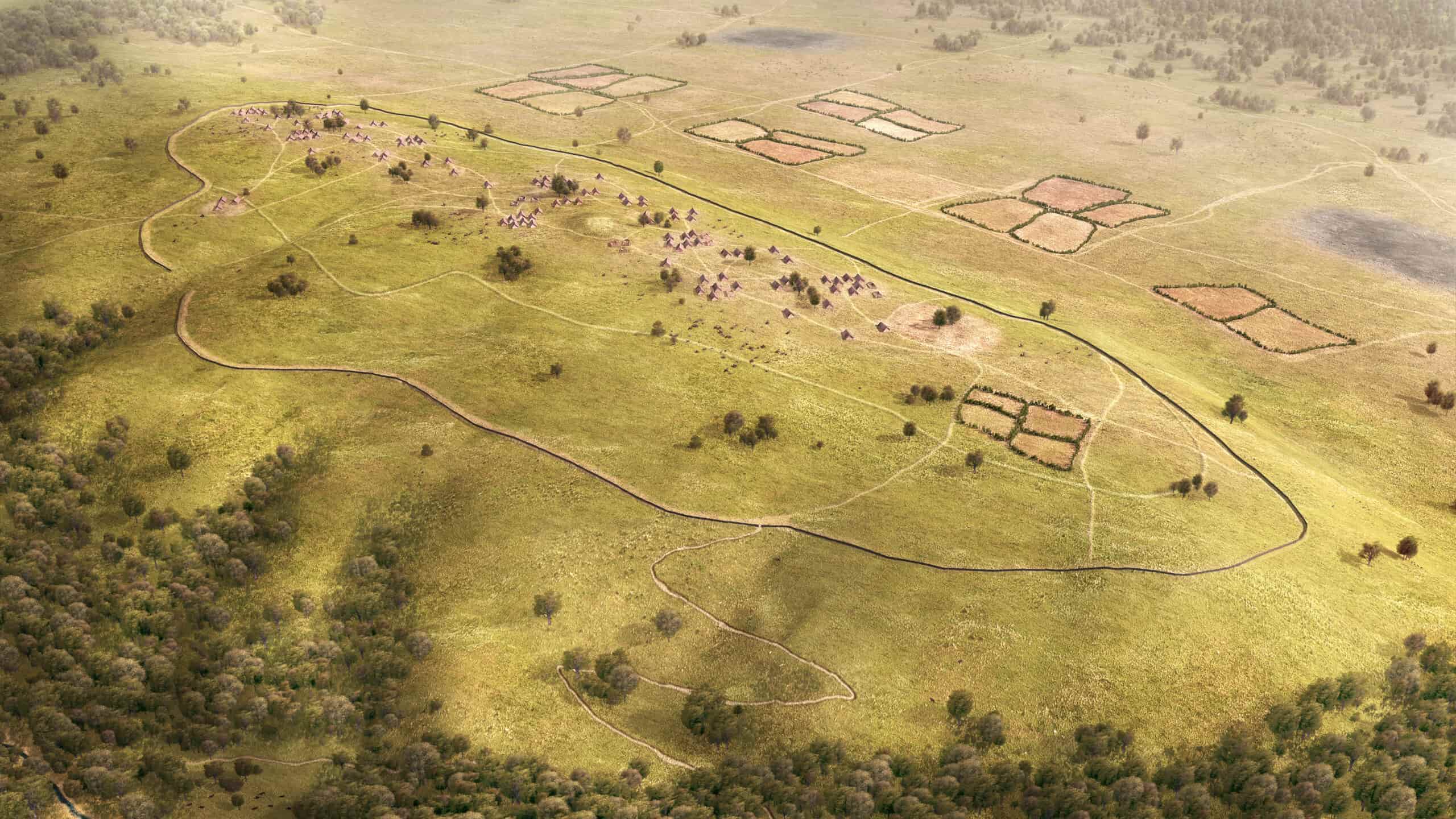
Digital visualization of the Kapellenberg around 3700 BCE (© LEIZA; Magistrat der Stadt Hofheim; Architectura Virtualis)
See English version below
CO-MOVE is a project funded by the German Research Foundation (2021-2026) and carried out in collaboration with the Palaeogenetic Laboratory in Mainz. It investigates how humans and innovations spread around the turn of the 3rd millennium BC, with a focus on the cultural and genetic impact of the “Yamnaya” steppe migrations in Central and Eastern Europe. The project uses data mining and machine learning to refine cultural classifications and examine whether steppe pastoralists and new burial practices spread together. The AI-supported workflow AutArch was developed as part of CO-MOVE. This novel data collection method was recognized as an official use case of the COST Action MAIA (“Managing Artificial Intelligence in Archaeology”).
Article in the Journal of Archaeological Science: https://www.sciencedirect.com/science/article/pii/S0305440325000937
AutArch on Zenodo: https://zenodo.org/records/15369892
GitHub repository: https://github.com/kevin-klein/AutArch
The team
- Dr. Maxime Brami (project manager and contact; Pre- and Protohistoric Archaeology, JGU Mainz)
- Kevin Klein (Software development; JGU Mainz)
- Prof. Dr. Joachim Burger (Paleogenetics; JGU Mainz)
- Professor Dr. Volker Heyd (Archaeology; University of Helsinki)
- Dr. Katie Meheux (University College London)
- Dr. Antoine Muller (Archaeology; University of Bergen)
- Professor Dr. Felix Riede (Archaeology; University of Aarhus)
- Dr. David Shankland (Royal Anthropological Institute)
German Research Foundation (DFG), GA 466680522
CO-MOVE is a project funded by the German Research Foundation (2021-2026) and conducted with the Palaeogenetics Laboratory in Mainz. It explores how people and innovations spread around the turn of the 3rd millennium BC, focusing on the cultural and genetic impact of the “Yamnaya” steppe migrations in Central and Eastern Europe. The project uses data mining and machine learning to refine cultural classifications and test whether steppe pastoralists and new burial practices spread together. As part of CO-MOVE, the AI-assisted workflow AutArch was developed. This new data collection method was recognized as an official use case of the COST Action MAIA (“Managing Artificial Intelligence in Archaeology”).
Journal of Archaeological Science article (2025): https://www.sciencedirect.com/science/article/pii/S0305440325000937
AutArch on Zenodo: https://zenodo.org/records/15369892
GitHub repository: https://github.com/kevin-klein/AutArch
Employees
- (project manager; Pre- and Protohistoric Archaeology, JGU Mainz)
- Kevin Klein (software development; JGU Mainz)
Cooperations
- Prof. Dr. Joachim Burger (palaeogenetics; JGU Mainz)
- Professor Dr. Volker Heyd (archaeology; University of Helsinki)
- Prof. Dr. Ralf Lämmel (informatics; University of Koblenz)
- Dr. Katie Meheux (University College London)
- Dr. Antoine Muller (archaeology; University of Bergen)
- Professor Dr. Felix Riede (archaeology; Aarhus University)
- Dr. David Shankland (Royal Anthropological Institute)
Financing
German Research Foundation, GA 466680522
Project
Communities in peripheral areas of cultural influence in the Bronze Age were very probably less strongly integrated into defining social or political groups from the core area of cultural phenomena. This has an impact on aspects of social life, be it integration into networks or social and economic strategies. In many regions, however, little research has been conducted into these relationships. The project therefore aims to evaluate the settlement and economic practices of supra-regional communities on the fringes of cultural spheres of influence in the Late Bronze Age (ca. 1100 to 730 BC). The aim is to clarify how they were integrated into pan-European transportation routes and trade routes. Important questions are: Are there significant differences in settlement organization between core zones and peripheral areas of archaeologically classified cultural units? How do these differences manifest themselves concretely in features and finds? The north of the state of Brandenburg was chosen as the primary area of investigation, as it is located in the area of tension between two large cultural spheres of influence. At the same time, comparatively little information is available from this area about the transition from the 2nd to the 1st millennium BC. The excavations at the Lanke site in the Barnim district are a central part of the project to answer these research questions. An analysis of the settlement and organizational structure as well as the resource use and administration of this community promises a deep insight into the contact networks of the Late Bronze Age.
Employees
Dr. Bianka Nessel (project manager)
Chiara Mägerlein
cooperations
Brandenburg State Office for the Preservation of Historical Monuments and Archaeological State Museum (BLDAM)
Financing
1. the Ministry of Science, Research and Culture of the State of Brandenburg (MWFK Brandenburg)
2. core research area “40.00 years of human challenges” at JGU
3rd Association for the Promotion of Pre- and Early Historical Archaeology at Johannes Gutenberg University Mainz e.V.
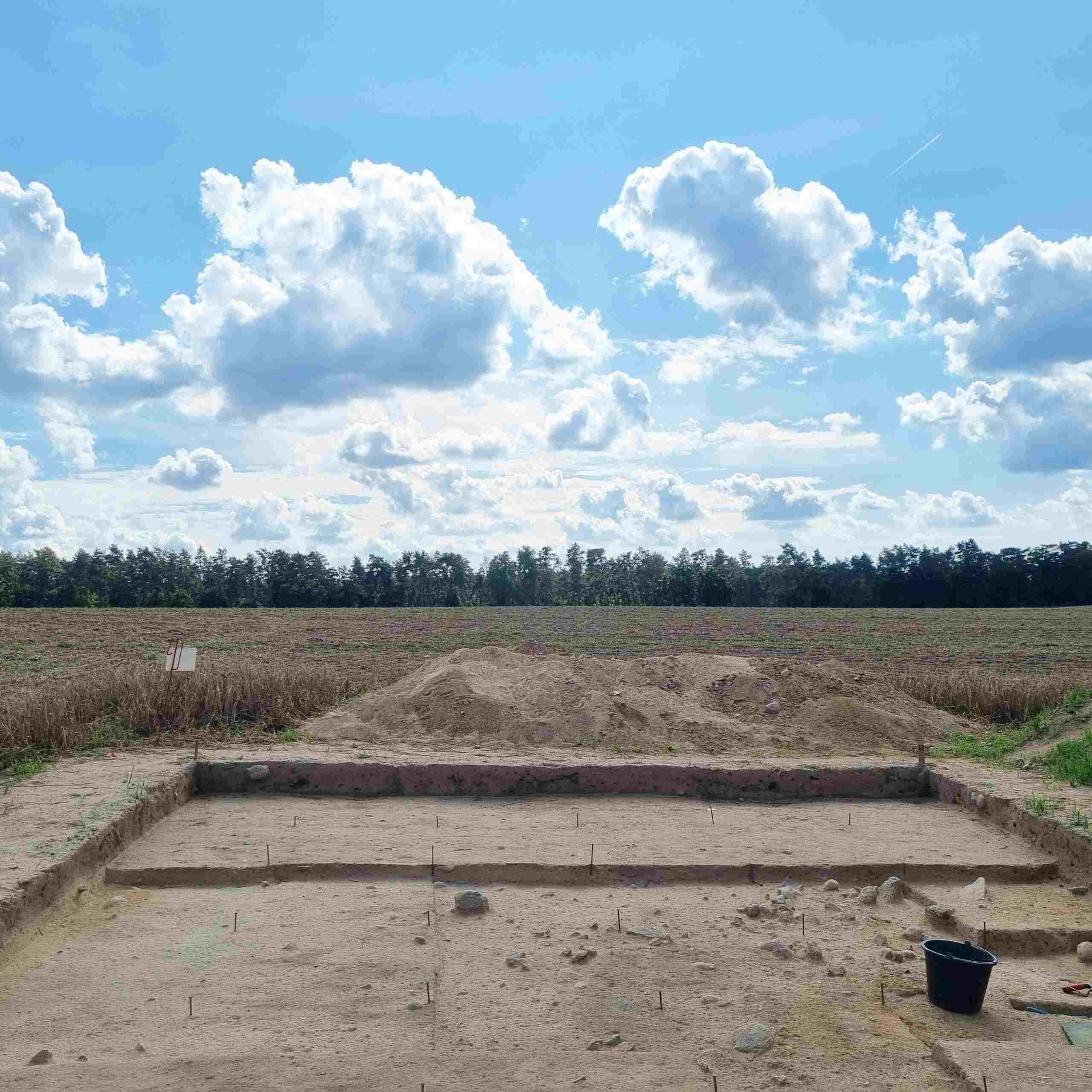
Excavation area 4 in Lanke. Barnim district (Photo: B. Nessel)
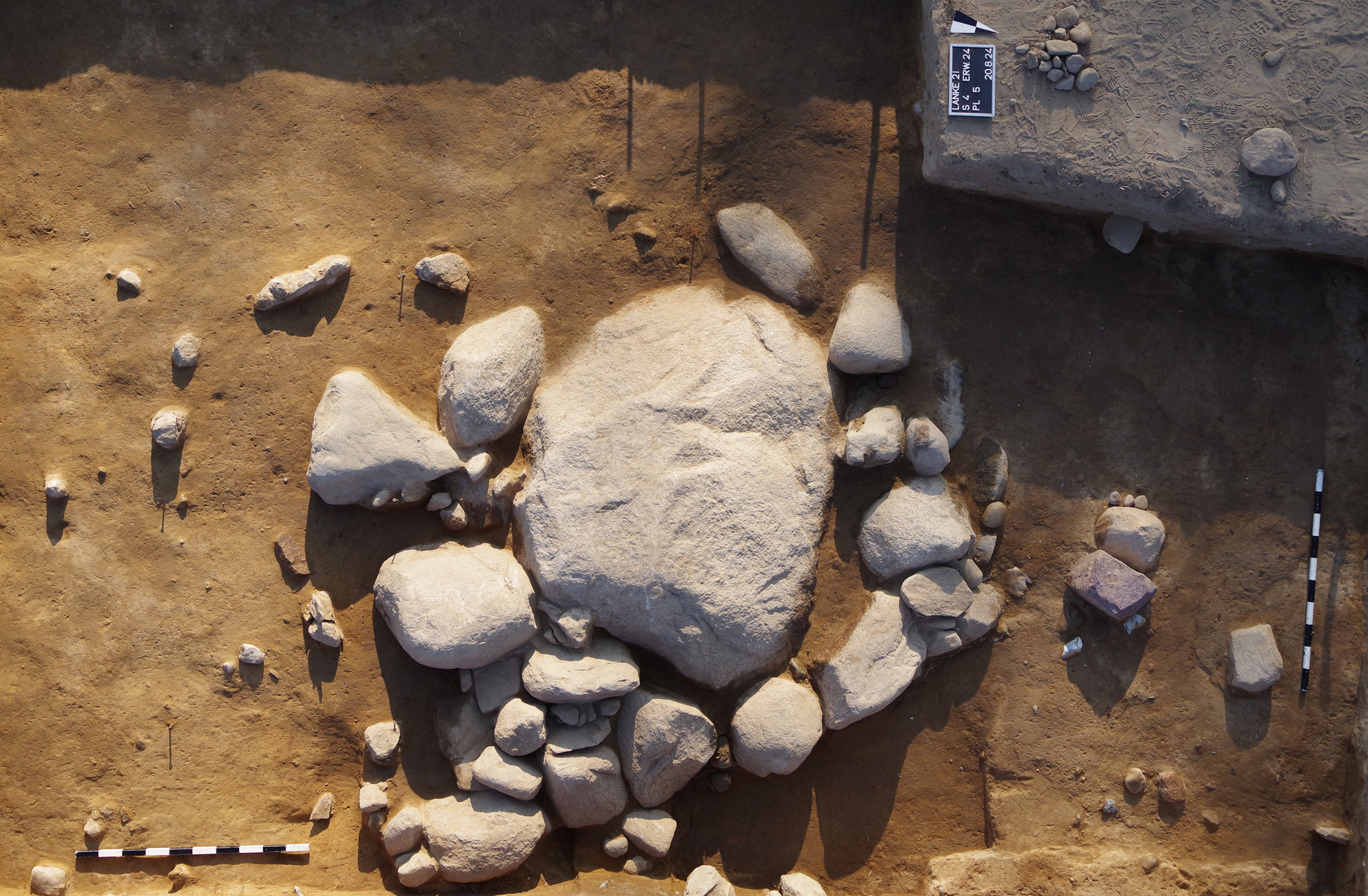
Megalithic complex in the north of the site (Photo: O. Tiel)
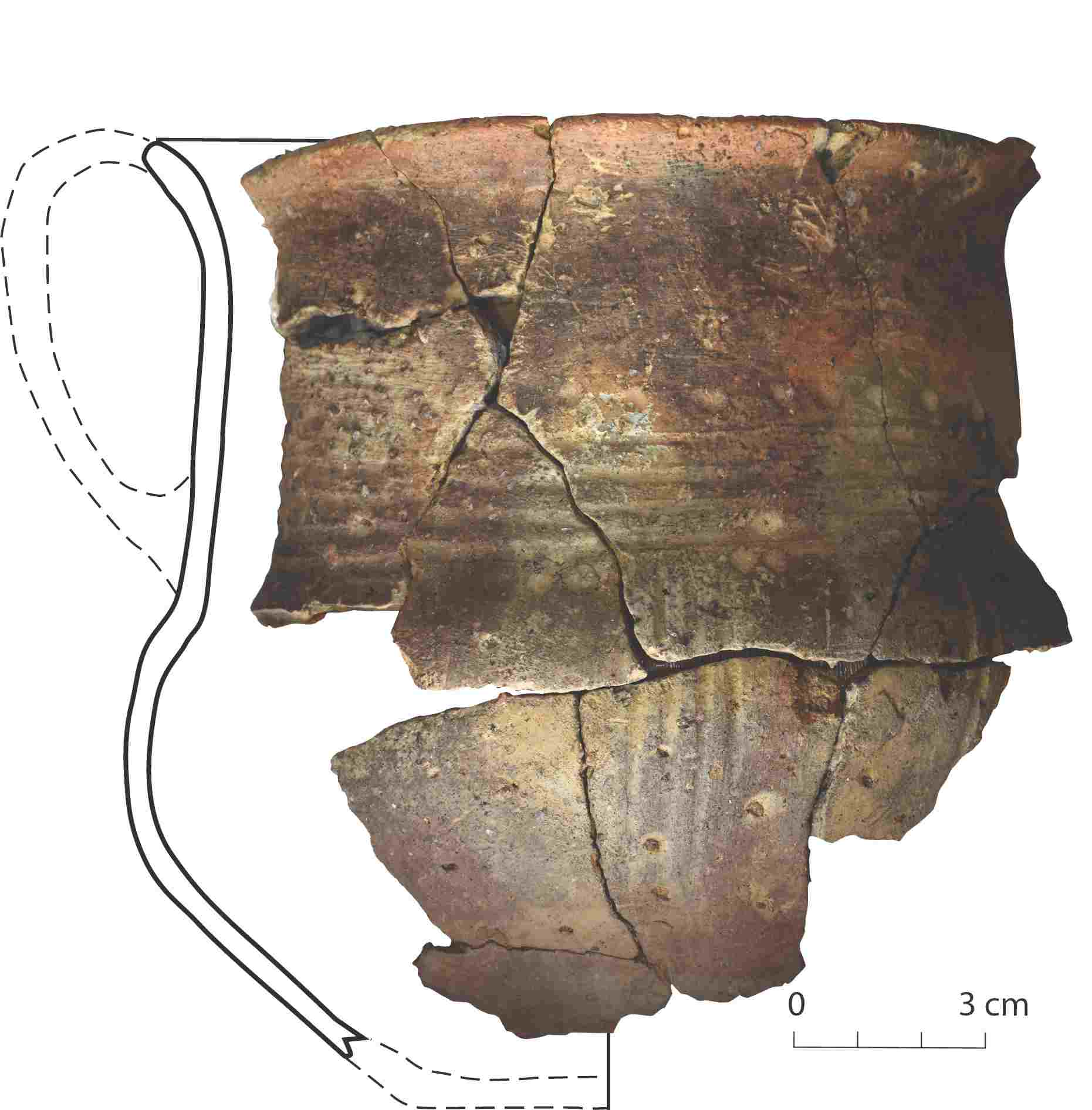
Reconstructed vessel from the regional Late Bronze Age (1100-730 BC) (Photo: B. Nessel)
Peter Haupt (JGU) and Agnieszka Tomas (Wydział Archeologii, Uniwersytet Warszawski) have started an excavation project in the Roman town of Homburg-Schwarzenacker (the ancient name is unknown) in spring 2023. The aim of the investigations, which are generously funded by the Saaprfalz District, is to examine old interpretations and, if necessary, adapt them to the new state of research. In addition to gaining important chronological insights, the first campaign also expanded our knowledge of the cultural landscape genesis in the area surrounding the town. The eastern part of the city, which is now presented in an archaeological park, stands on thick colluvial sands. According to the material found, these date back to the first century AD and are obviously the result of deforestation on the slopes above the city. When the soil was uncovered, erosion increased and the eroded sand was deposited at the foot of the slope as the gradient decreased. There is very probably a connection with the consumption of wood by Roman craftsmen. The last campaign of the German-Polish project took place in October 2024, during which interesting insights were gained into the construction and use phases of a temple district located centrally in the city. Overall, it appears that the entire settlement was clearly characterized by manufacturing industry (pottery, iron) in the early imperial period, but that there was then major investment in public and private buildings in the early 2nd century. High-emission industries were now concentrated at some distance from the urban settlement, in which crafts nevertheless played an important role.
Employees
Peter Haupt (JGU, project manager)
Agnieszka Tomas (Uniwersytet Warszawski, project manager)
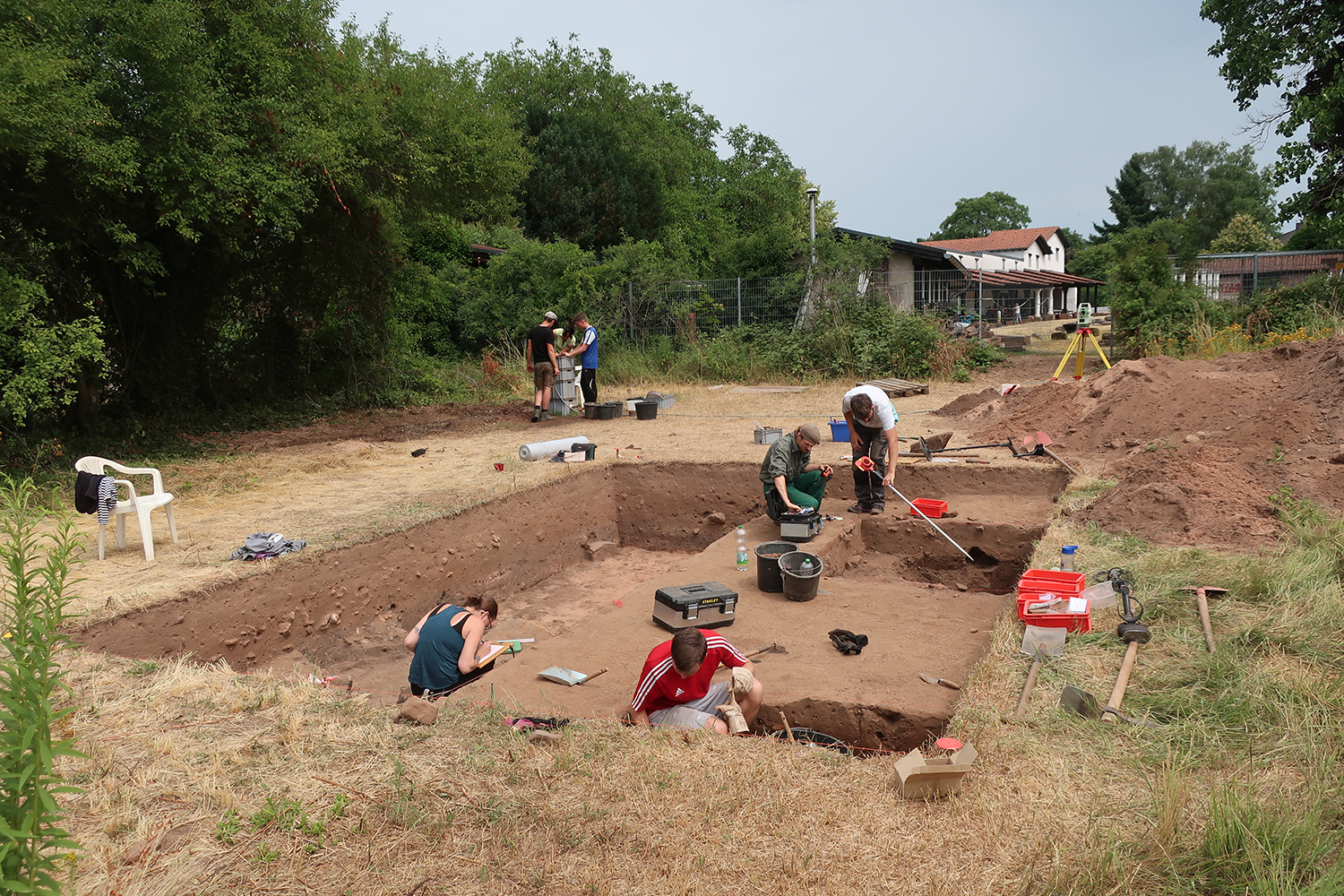
Excavation 2023. photo: Peter Haupt
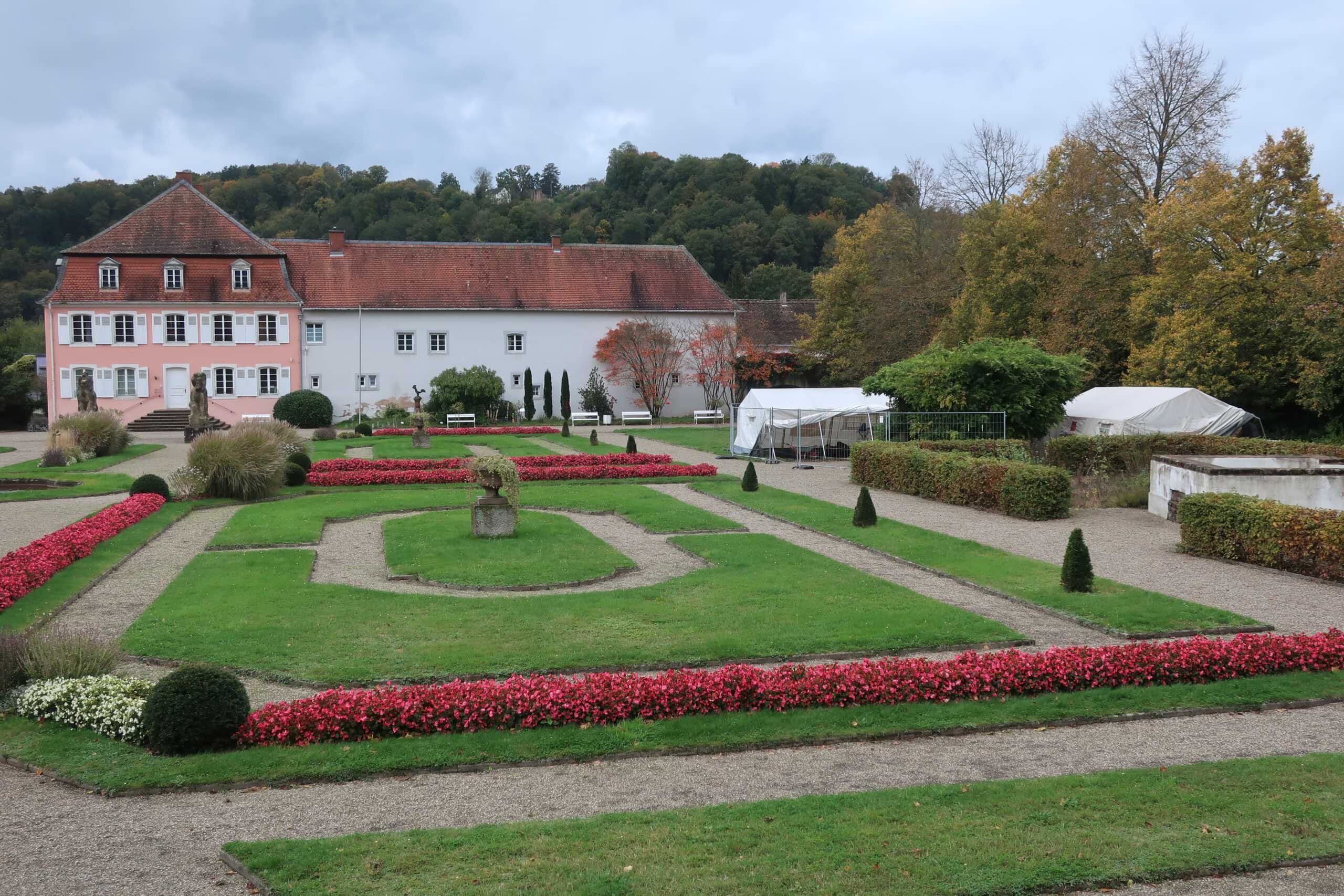
Excavation 2024. photo: Peter Haupt
The Bliesgau in southern Saarland represents a special cultural landscape in the Roman period, which promises important and new insights, particularly into the conditions handed down from the pre-Roman period. It is also a good place to work out how the transition from Late Antiquity to the Early Middle Ages took place. As part of the project, archaeological investigations were carried out at the terra sigillata manufactory in Blickweiler from 2013-2016 (Johanna Ney). Prospections were and are being carried out at various Roman period settlement sites, mostly villae rusticae next to/under medieval churches: In Gersheim, Reinheim, at Kirchheimer Hof and in Böckweiler, Roman settlement traces with later church construction were investigated archaeologically and geophysically. Further Roman farmsteads were prospected near Bliesdalheim and between Gersheim and Reinheim. The results of the project, led by Peter Haupt (IAW) and Andreas Stinsky (Saarpfalz-Kreis), will be incorporated into the international Blies Survey project, in which the wider area around the Roman vicus of Bliesbruck (France) will be examined archaeologically.
Employees
Peter Haupt (JGU, project manager)
Andreas Stinsky (Saarpfalz-Kreis, project manager)
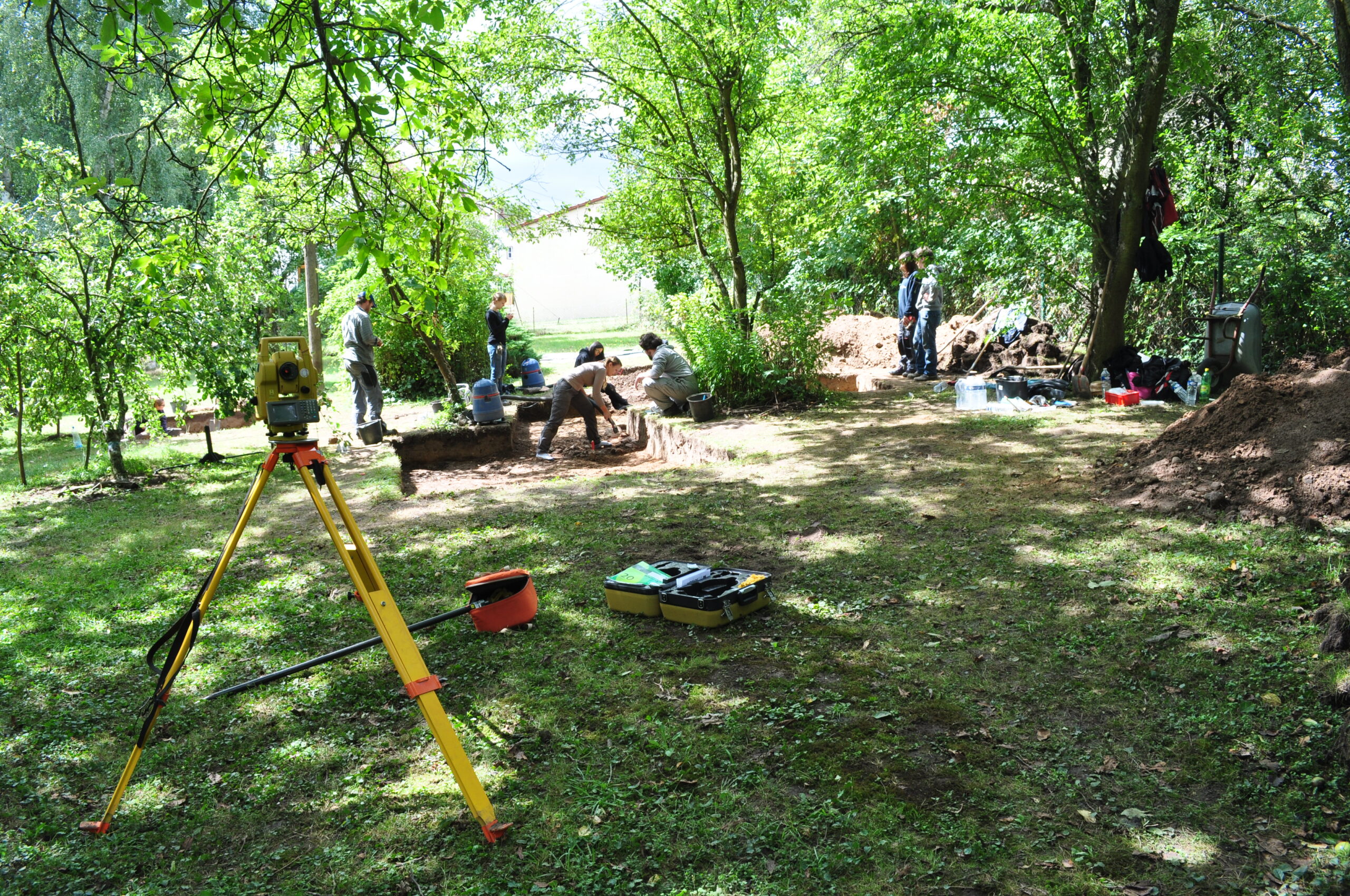
Excavations at the Blickweiler Roman pottery. Photo: Peter Haupt
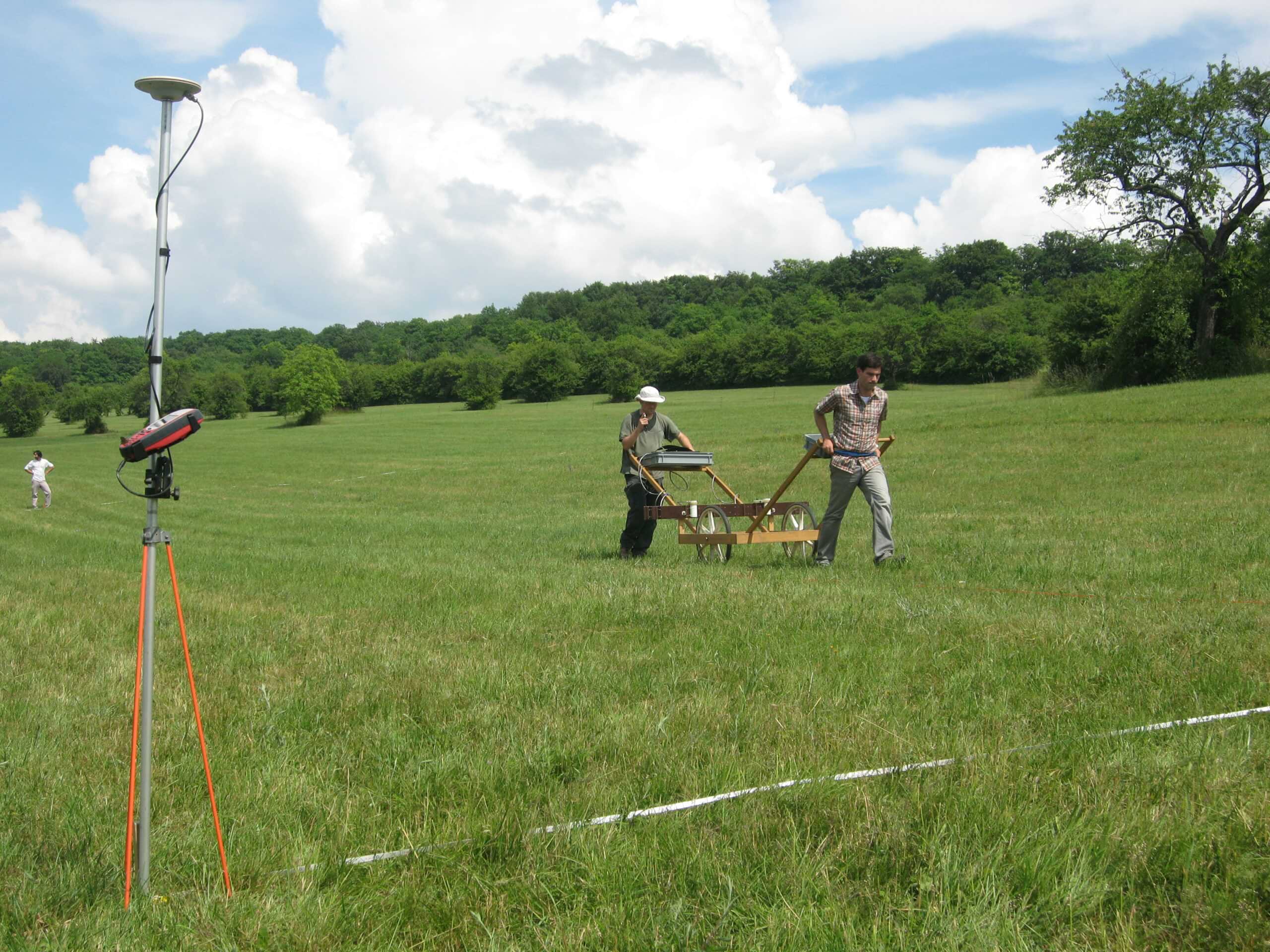
Use of the cesium magnetometer near Bliesdalheim. Photo: Peter Haupt
Archaeological-geophysical prospection
The exploration of archaeological monuments using minimally invasive archaeological and geophysical prospection methods is a high priority for the Pre- and Protohistoric Archaeology working group.
Methods such as aerial archaeology, inspections with individual find measurements, evaluation of LIDAR laser scans or the research orientation of metal detectors are used in various research projects.
Georadar, geomagnetics, ERT and geoelectrics are also used in research and teaching.
See English version below
Heritage Quest Luxembourg
Funded by the Fondation Schleich-Lentz, this project aims to discover new archaeological sites in Luxembourg by analyzing LiDAR (Light Detection and Ranging) data. With the help of artificial intelligence, sites are automatically recognized while the public is actively involved in the research process. Inspired by the Dutch Heritage Quest initiative, the project promotes collaboration between citizens and researchers to strengthen the understanding and preservation of Luxembourg’s archaeological heritage. A first field campaign is planned for 2026 and will combine field surveys with predictive modeling to validate the results.
Research team
Project manager and contact: Dr. Maxime Brami (Pre- and Protohistoric Archaeology, JGU Mainz)
AI engineer: Kevin Klein (JGU Mainz)
Contact to the volunteers: Andrea Stinner (JGU Mainz)
cooperations
- Assoc. Prof. Andrea Binsfeld (University of Luxembourg)
- Dr. Quentin Bourgeois (University of Leiden)
- Prof. Dr. Peter Haupt (Pre- and Protohistoric Archaeology, JGU Mainz)
- Dr. Eva Kaptijn (Royal Belgian Institute for Natural Sciences)
- Prof. Dr. Karsten Lambers (University of Augsburg)
- Prof. Dr. Ralf Lämmel (Computer Science; University of Koblenz)
- Michelle Pfeiffer (Institut National de Recherches Archéologiques, Luxembourg)
- Dr. Wouter Verschoof-van der Vaart (Netherlands Forensic Institute)
- David Weis (Institut National de Recherches Archéologiques, Luxembourg)
Financing
Bourse Fondation Schleich-Lentz (2025), Fonds Culturel National Luxembourg
Funded by the Fondation Schleich-Lentz, this project seeks to discover new archaeological sites in Luxembourg through the analysis of LiDAR (light detection and ranging) images. It uses artificial intelligence to automatically detect sites, while actively involving the public in the research process. Inspired by the Dutch Heritage Quest initiative, it promotes collaboration between citizens and researchers to advance the understanding and preservation of Luxembourg’s archaeological heritage. A first field survey is schedules for 2026, combining groundtruthing with predictive modeling to validate the results.
Research Team
Project manager and contact: Dr. Maxime Brami (Pre- and Protohistoric Archaeology, JGU Mainz)
AI engineer: Kevin Klein (JGU Mainz)
Coordination with the volunteers: Andrea Stinner (JGU Mainz)
Collaborations
- Assoc. Prof. Andrea Binsfeld (University of Luxembourg)
- Dr. Quentin Bourgeois (University of Leiden)
- Prof. Dr. Peter Haupt (Pre- and Protohistoric Archaeology, JGU Mainz)
- Dr. Eva Kaptijn (Royal Belgian Institute for Natural Sciences)
- Prof. Dr. Karsten Lambers (University of Augsburg)
- Prof. Dr. Ralf Lämmel (Computer Science; University of Koblenz)
- Michelle Pfeiffer (Institut National de Recherches Archéologiques, Luxembourg)
- Dr. Wouter Verschoof-van der Vaart (Netherlands Forensic Institute)
- David Weis (Institut National de Recherches Archéologiques, Luxembourg)
Financing
Bourse Fondation Schleich-Lentz (2025), Fonds Culturel National Luxembourg
A small group of hermits established themselves on the Disibodenberg near Odernheim am Glan in the early Middle Ages. One of them, Disibod, became a highly venerated saint in the following centuries, which led to the foundation of a monastery on the mountain at the confluence of the Glan and Nahe rivers a good 1000 years ago. In the first half of the 12th century, St. Hildegard lived here, whose current veneration on the Disibodenberg has largely replaced that of Disibod. The monastery was abandoned in the 16th century and finally turned into a historical park of tourist interest in the 19th and 20th centuries. In the second half of the 20th century, building history studies and archaeological excavations were carried out, but many questions remained unanswered. This is where a prospection project (Peter Haupt, IAW) comes in, which uses both geophysical methods and metal detectors to tackle questions that arise as part of the training of students. For example, it is much easier to use georadar to check assumptions about the course of foundations than it is to carry out costly excavations that interfere with the existing monument. Hoof nails and other finds from the use of paths can be used to identify and date old paths, making it possible to reconstruct the access routes to the monastery.
Employees
Peter Haupt (project manager)
Preparation of an electrical resistance tomography (ERT). Photo: Peter Haupt
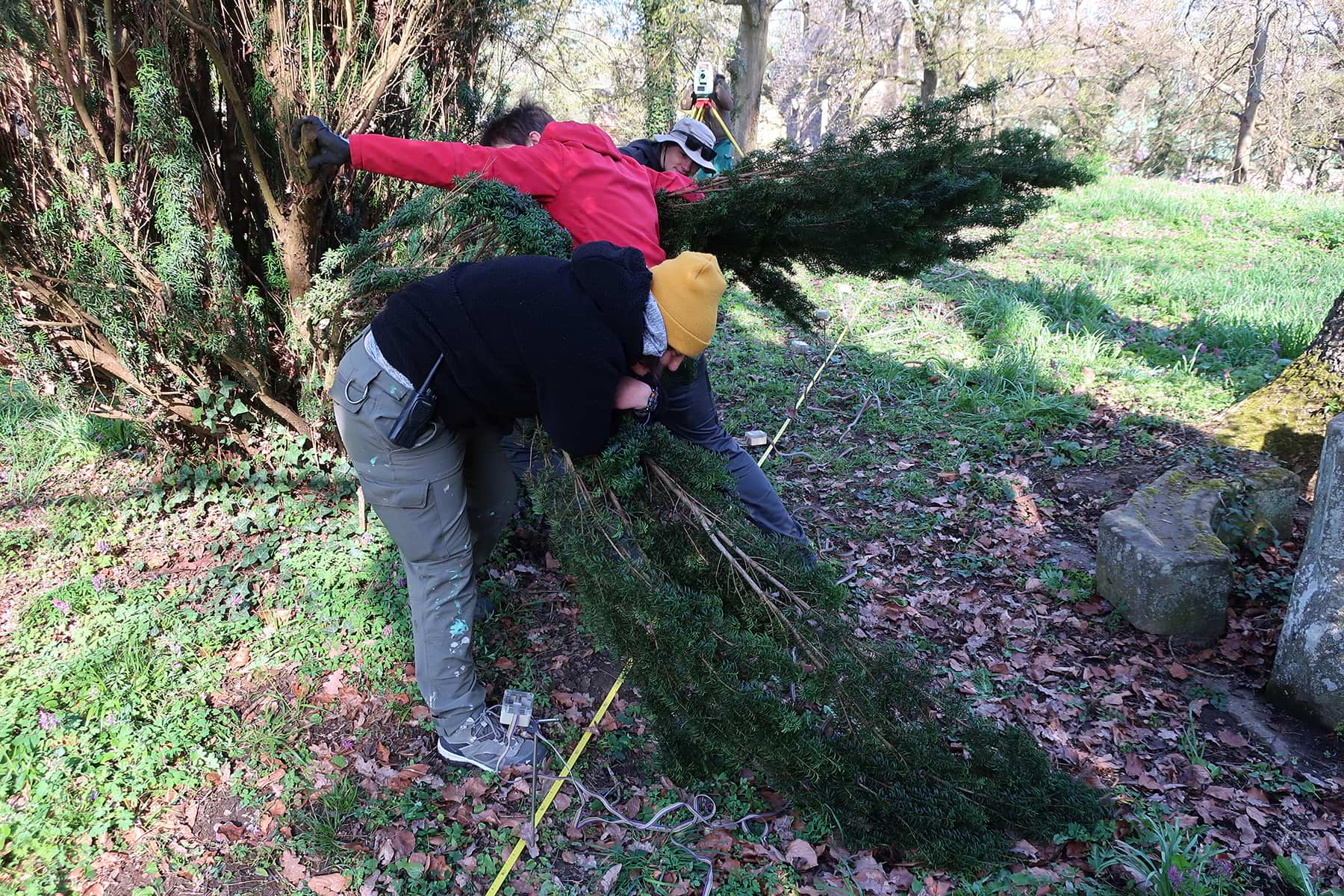
Bending trees that are in the way of the survey. Photo: Peter Haupt
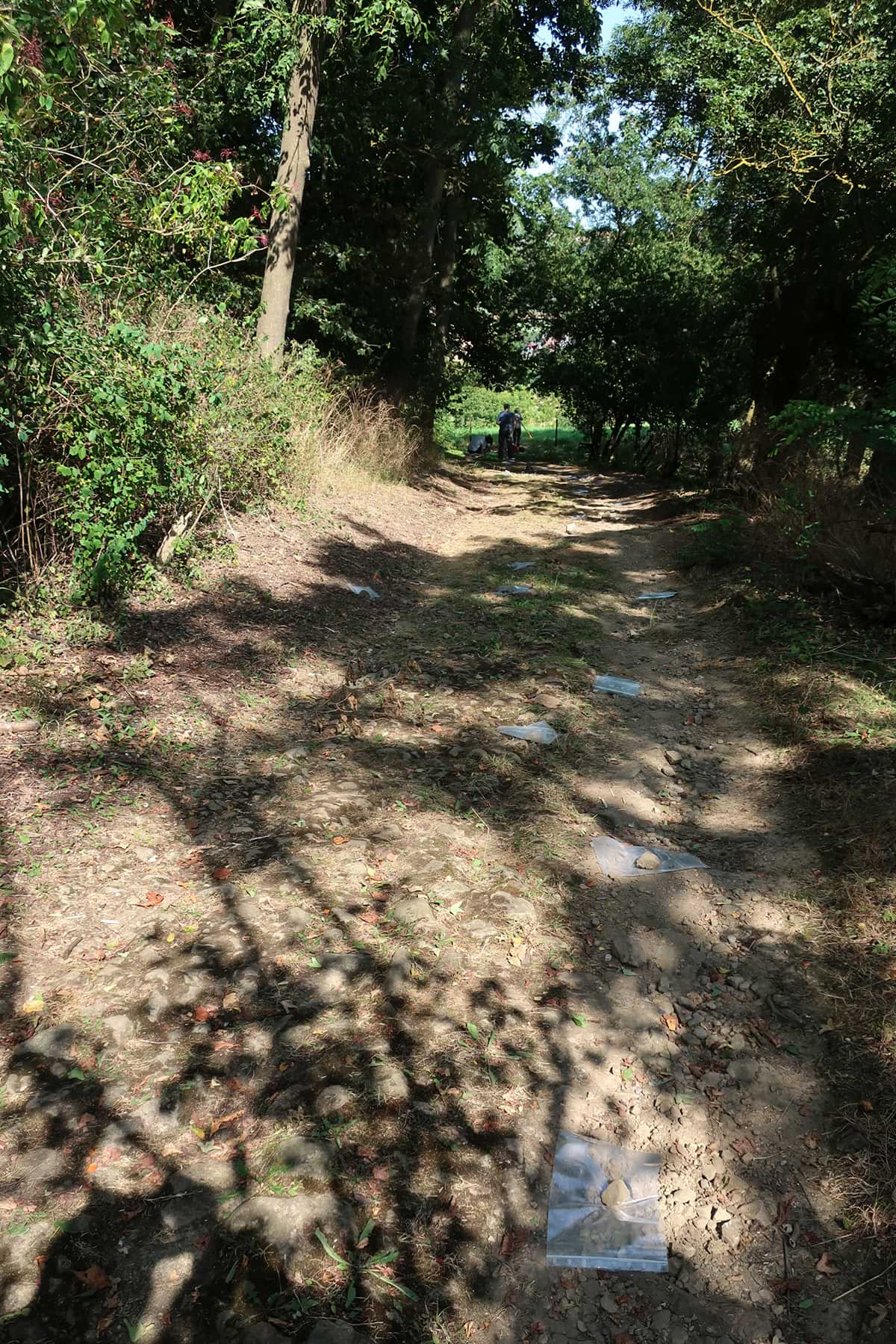
Prospection on a path at the monastery. Photo: Peter Haupt
Together with the Kaiserpfalz Ingelheim research center (Holger Grewe) and Arno Braun (Saarland University), Peter Haupt and Leon Hermann (IAW) are investigating the area around Worms Cathedral. The main aim is to identify early sacred buildings and to expand our existing knowledge. Prospections with georadar in 2023 and 2024 made it possible to gain new insights into the baptisteries south of the cathedral – which no longer exist above ground except for an excavated and preserved baptismal piscina. However, the cathedral is not only centrally located in the medieval city of Worms, but the center of the ancient Borbetomagus is also assumed to be under the cathedral district. The foundations discovered during the cathedral excavations at the beginning of the 20th century were interpreted as a forum and/or sanctuary, but these interpretations are not certain. The ongoing archaeological and geophysical investigations could also provide new insights into this.
Employees
Peter Haupt (JGU, project manager)
Leon Hermann (JGU, project manager)
Arno Braun (Saarland University, project manager)
Holger Grewe (Kaiserpfalz Ingelheim Research Center, project manager)
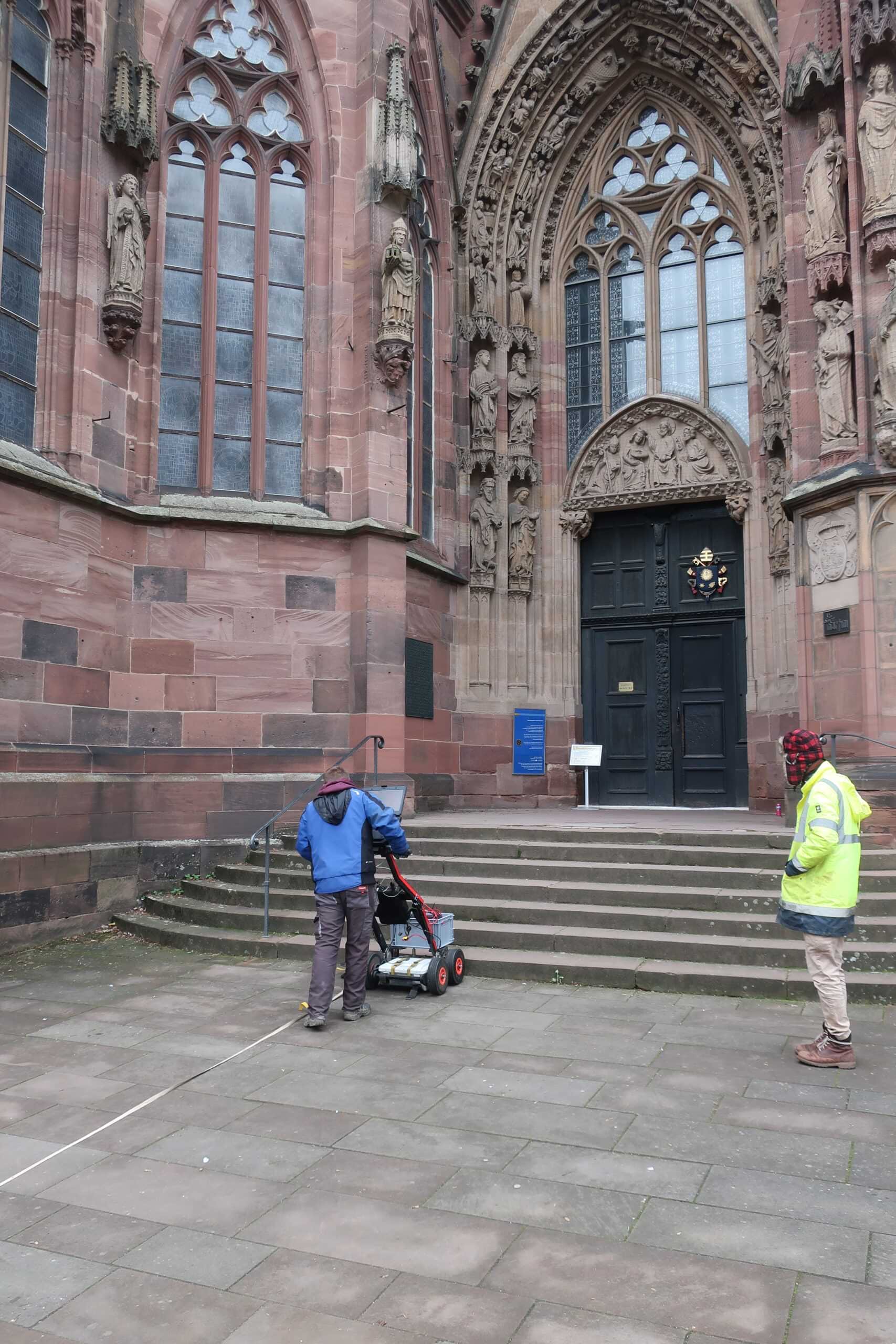
Radar measurements up to the cathedral gate. Photo: Peter Haupt
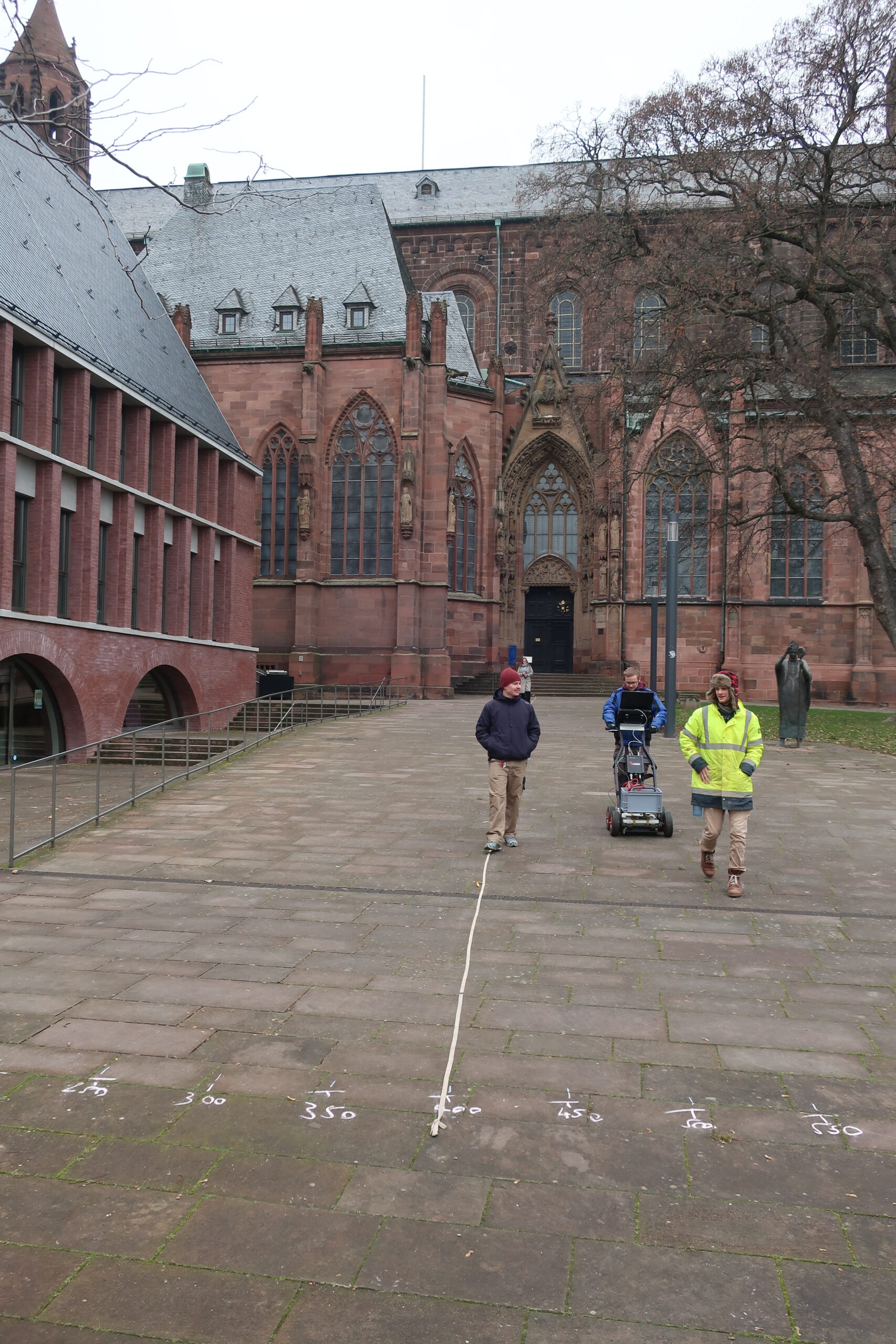
Radar measurements south of Worms Cathedral. Photo: Peter Haupt
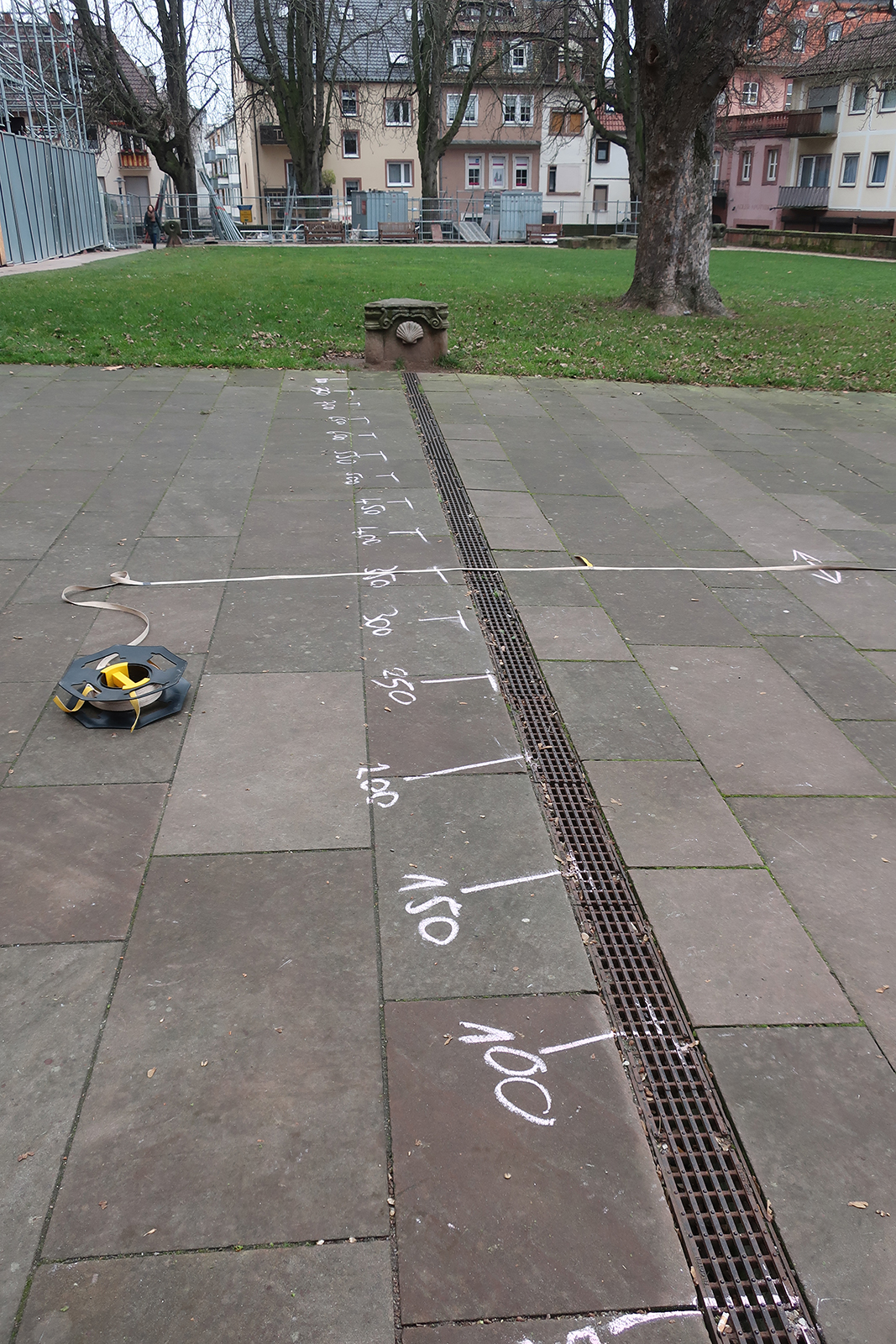
Measurement markings with road chalk. Photo: Peter Haupt
The research unit deals in particular with changes in the cultural landscape in prehistoric and early historical times. In addition to traditional archaeological methods (inspection, mapping, excavation), modern prospecting methods are used. The application of “natural sciences” methods is also important.
Landscape archaeology
Field projects on landscape archaeology:
Old mining and resource utilization in the Northern Palatinate
Iron, copper and mercury were already being mined in the Northern Palatinate in prehistoric and early historical times, at times to an extent that shaped the landscape. The aim of the project, which is being carried out in cooperation with the State Office for Geology and Mining, the GDKE, Directorate of Archaeology, Speyer branch office and the Palatinate Mining Museum in Imsbach, is to discover and explore the relevant mining and smelting sites, including the associated settlement structures.
Early mountain pasture farming on the Schlern (South Tyrol)
This project focuses on the agricultural use of the high mountains between the Bronze Age and modern times. To this end, surveys are being conducted, and a so-called burnt offering site (Middle Bronze Age to Roman period) is also being investigated. The goal is to gain insights into the chronology and characteristics of alpine pasture farming. Schlernbeitrag 2010
Fieldwork will be conducted subject to the availability of requested funds.
Contact:
Prof. Dr. Peter Haupt
Phone: +49 (0) 6131/39-33425
hauptp@uni-mainz.de
See English version below
Investigating the prehistory of Luxembourg using ancient genomes
This project, funded by the Institut National de Recherches Archéologiques, Luxembourg, investigates the local impact of the spread of Neolithic and steppe-dwelling populations on archaeological cultures west of the Rhine. Among other things, new high-resolution genomes of archaeological human remains from present-day Luxembourg are being used for this purpose. The ancient DNA analyses are carried out in the paleogenetics laboratory at Johannes Gutenberg University Mainz: https: //palaeogenetics-mainz.de/
Article in the Antiquity Project Gallery: https://www.cambridge.org/core/journals/antiquity/article/investigating-the-prehistory-of-luxembourg-using-ancient-genomes/D9D98CEFD247C07A387DD62505507A2B
Article in Scientific Reports about mother-child burials in Luxembourg and the UK: https://www.nature.com/articles/s41598-023-45612-3
The team
- Dr. Maxime Brami (project manager and contact; Pre- and Protohistoric Archaeology, JGU Mainz)
- Dr. Nicoletta Zedda (University of Ferrara)
cooperations
- Dr. Jens Blöcher (JGU Mainz)
- Laurent Brou (Institut National de Recherches Archéologiques, Luxembourg))
- Prof. Dr. Joachim Burger (JGU Mainz)
- Dr. Yoan Diekmann (JGU Mainz)
- Iliya Hadzhipetkov (Institut National de Recherches Archéologiques, Luxembourg))
- Foni Le Brun-Ricalens (Institut National de Recherches Archéologiques, Luxembourg))
- Anna-Lena Titze (JGU Mainz)
- François Valotteau (Institut National de Recherches Archéologiques, Luxembourg))
- Laura Winkelbach (JGU Mainz)
Financing
Institut National de Recherches Archéologiques (INRA), Luxembourg
This project, funded by the Institut National de Recherches Archéologiques, Luxembourg, examines the local impact of Neolithic and Steppe population dispersals on archaeological cultures west of the Rhine, using new high coverage ancient genomes from present-day Luxembourg. The ancient DNA analyses are conducted in the Palaeogenetics Laboratory of Johannes Gutenberg University Mainz: https://palaeogenetics-mainz.de/
Antiquity Project Gallery article: https://www.cambridge.org/core/journals/antiquity/article/investigating-the-prehistory-of-luxembourg-using-ancient-genomes/D9D98CEFD247C07A387DD62505507A2B
Scientific Reports article on mother-child burials in Luxembourg and Britain: https://www.nature.com/articles/s41598-023-45612-3
Employees
- (project manager and contact; Pre- and Protohistoric Archaeology, JGU Mainz)
- Dr. Nicoletta Zedda (University of Ferrara)
Cooperations
- Dr. Jens Blöcher (JGU Mainz)
- Laurent Brou (Institut National de Recherches Archéologiques, Luxembourg))
- Prof. Dr. Joachim Burger (JGU Mainz)
- Dr. Yoan Diekmann (JGU Mainz)
- Iliya Hadzhipetkov (Institut National de Recherches Archéologiques, Luxembourg))
- Foni Le Brun-Ricalens (Institut National de Recherches Archéologiques, Luxembourg))
- Anna-Lena Titze (JGU Mainz)
- François Valotteau (Institut National de Recherches Archéologiques, Luxembourg))
- Laura Winkelbach (JGU Mainz)
Financing
Institut National de Recherches Archéologiques (INRA), Luxembourg
See English version below
Investigating the prehistory of Luxembourg using ancient genomes
This project, funded by the Institut National de Recherches Archéologiques, Luxembourg, investigates the local impact of the spread of Neolithic and steppe-dwelling populations on archaeological cultures west of the Rhine. Among other things, new high-resolution genomes of archaeological human remains from present-day Luxembourg are being used for this purpose. The ancient DNA analyses are carried out in the paleogenetics laboratory at Johannes Gutenberg University Mainz: https: //palaeogenetics-mainz.de/
Article in the Antiquity Project Gallery: https://www.cambridge.org/core/journals/antiquity/article/investigating-the-prehistory-of-luxembourg-using-ancient-genomes/D9D98CEFD247C07A387DD62505507A2B
Article in Scientific Reports about mother-child burials in Luxembourg and the UK: https://www.nature.com/articles/s41598-023-45612-3
The team
- Dr. Maxime Brami (project manager and contact; Pre- and Protohistoric Archaeology, JGU Mainz)
- Dr. Nicoletta Zedda (University of Ferrara)
cooperations
- Dr. Jens Blöcher (JGU Mainz)
- Laurent Brou (Institut National de Recherches Archéologiques, Luxembourg))
- Prof. Dr. Joachim Burger (JGU Mainz)
- Dr. Yoan Diekmann (JGU Mainz)
- Iliya Hadzhipetkov (Institut National de Recherches Archéologiques, Luxembourg))
- Foni Le Brun-Ricalens (Institut National de Recherches Archéologiques, Luxembourg))
- Anna-Lena Titze (JGU Mainz)
- François Valotteau (Institut National de Recherches Archéologiques, Luxembourg))
- Laura Winkelbach (JGU Mainz)
Financing
Institut National de Recherches Archéologiques (INRA), Luxembourg
This project, funded by the Institut National de Recherches Archéologiques, Luxembourg, examines the local impact of Neolithic and Steppe population dispersals on archaeological cultures west of the Rhine, using new high coverage ancient genomes from present-day Luxembourg. The ancient DNA analyses are conducted in the Palaeogenetics Laboratory of Johannes Gutenberg University Mainz: https://palaeogenetics-mainz.de/
Antiquity Project Gallery article: https://www.cambridge.org/core/journals/antiquity/article/investigating-the-prehistory-of-luxembourg-using-ancient-genomes/D9D98CEFD247C07A387DD62505507A2B
Scientific Reports article on mother-child burials in Luxembourg and Britain: https://www.nature.com/articles/s41598-023-45612-3
Employees
- (project manager and contact; Pre- and Protohistoric Archaeology, JGU Mainz)
- Dr. Nicoletta Zedda (University of Ferrara)
Cooperations
- Dr. Jens Blöcher (JGU Mainz)
- Laurent Brou (Institut National de Recherches Archéologiques, Luxembourg))
- Prof. Dr. Joachim Burger (JGU Mainz)
- Dr. Yoan Diekmann (JGU Mainz)
- Iliya Hadzhipetkov (Institut National de Recherches Archéologiques, Luxembourg))
- Foni Le Brun-Ricalens (Institut National de Recherches Archéologiques, Luxembourg))
- Anna-Lena Titze (JGU Mainz)
- François Valotteau (Institut National de Recherches Archéologiques, Luxembourg))
- Laura Winkelbach (JGU Mainz)
Financing
Institut National de Recherches Archéologiques (INRA), Luxembourg
The Laboratory for Archaeological Chemistry (LARC) is a research unit within the Department of Prehistoric and Early Historic Archaeology at JGU and is operated as a joint laboratory by JGU and LEIZA (Leibniz Center for Archaeology). It is dedicated to the preparation and analysis of archaeological samples using biomolecular methods, such as the analysis of lipid residues in ceramics and the study of stable isotopes in archaeobotanical remains, teeth, and bones. Isotope measurements are conducted in collaboration with the Emmy Noether Group “Hominin Meat Consumption” (https://www.mpic.de/5020288/luedecke-group) and the Laboratory for Organic Isotope Geochemistry (https://www.theamglab.com/laboratory) at the Max Planck Institute for Chemistry in Mainz.
Adresse:
Leibniz-Zentrum für Archäologie LEIZA
Ludwig-Lindenschmit-Forum 1
55116 Mainz
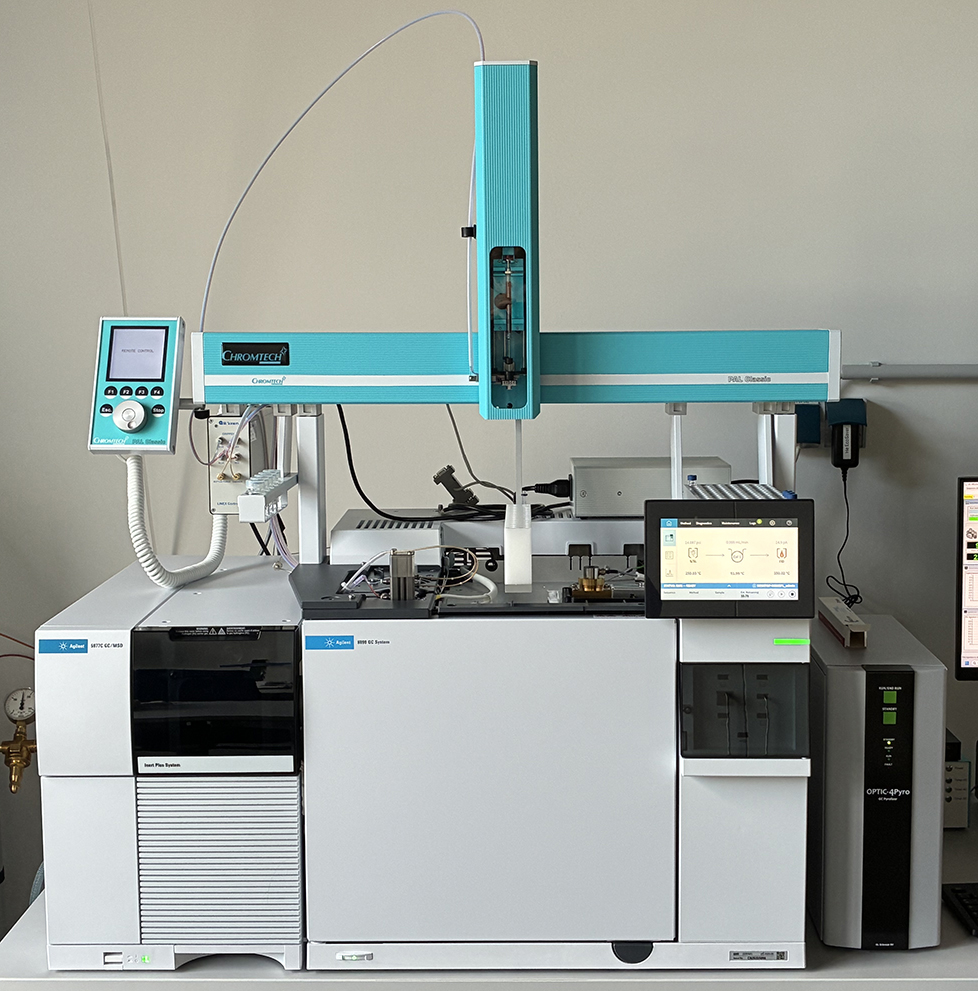
Gas chromatograph with flame ionisation detector and mass spectrometer (GC-FID/MS), with possibility for thermal desorption/pyrolysis-GC-MS (TD/Py-GC-MS): Agilent 8890B GC + 5977C MSD + GL Sciences Optic-4 Pyro Injector
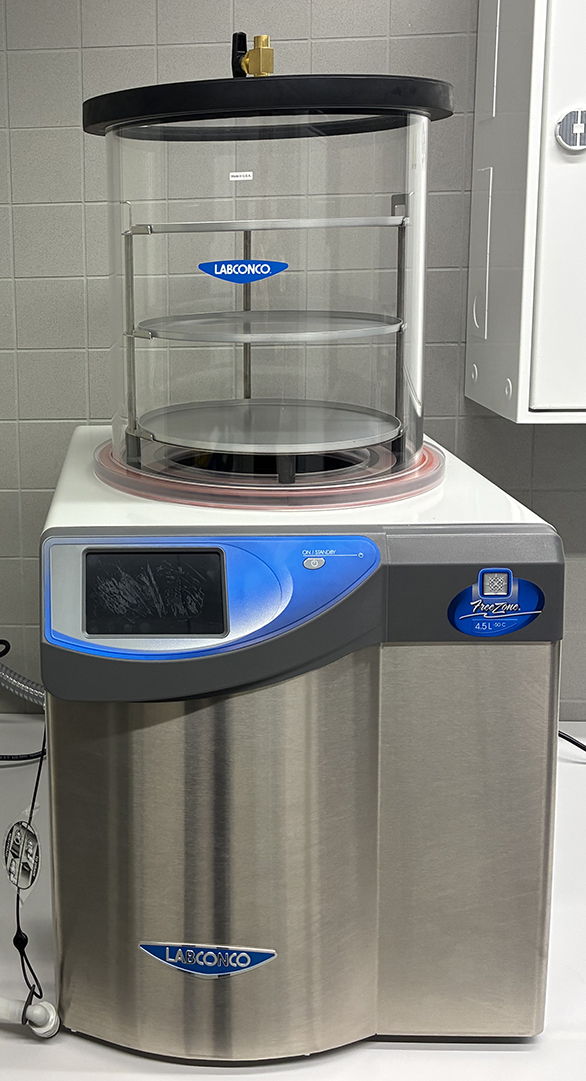
Benchtop freeze dryer
(Labconco™ FreeZone™ 4.5L -50°C)
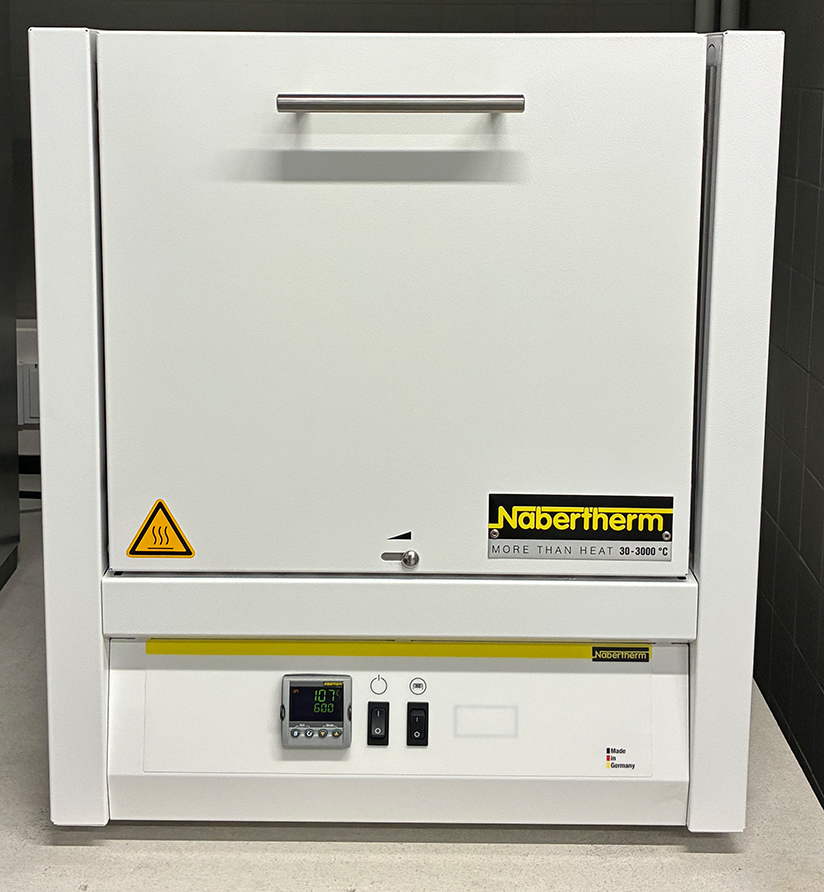
Muffle furnace (Nabertherm™ Economy LE24/11, 1100 °C)
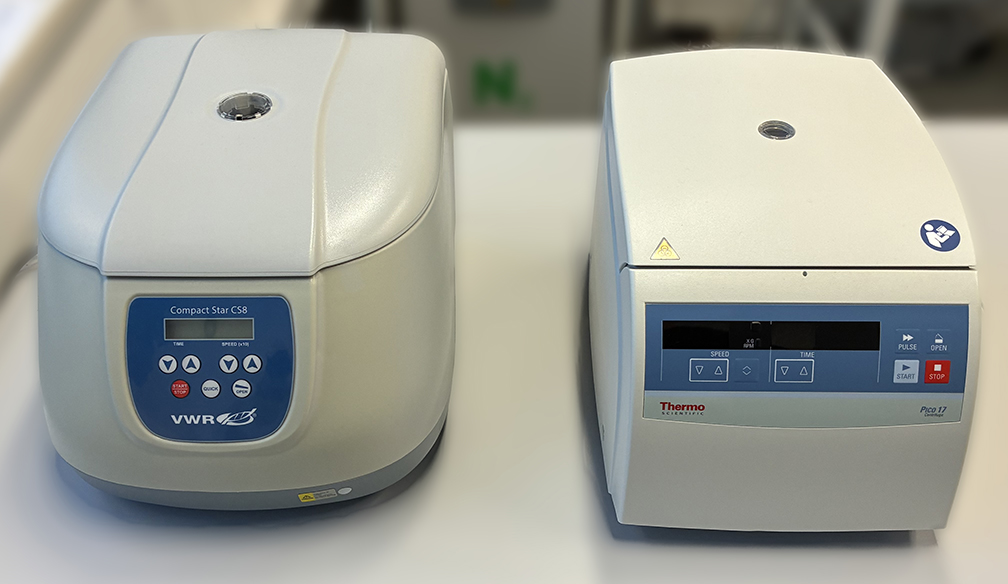
Benchtop midicentrifuge
(CompactStar CS8, max. speed 5000 min⁻¹)
Benchtop microcentrifuge
(Pico™ 17, max. speed 13300 min⁻¹)
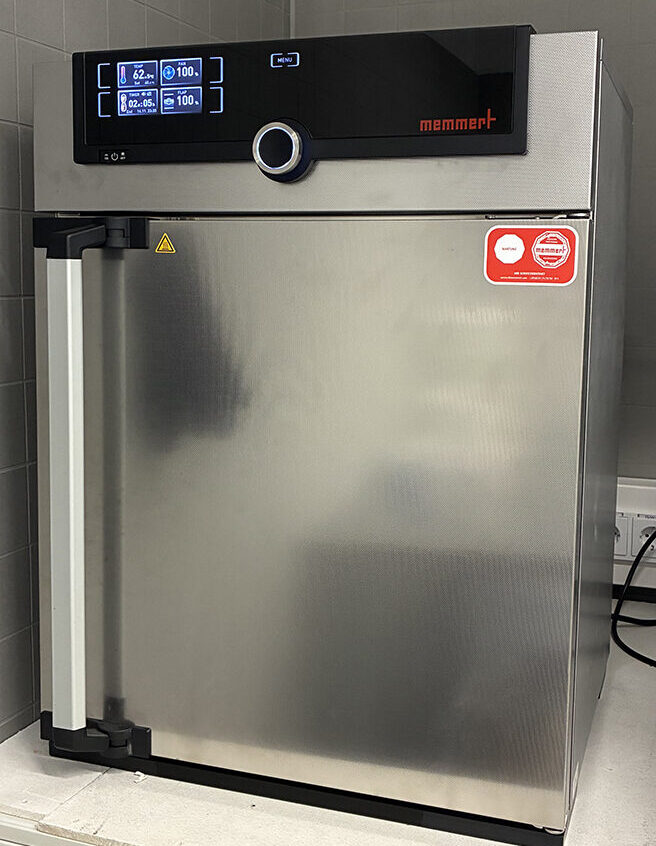
Drying oven
(Memmert™ UF with Forced-Air Convection, 55 L)
In der porösen Struktur von Tongefäßen können Lipide über lange Zeiträume konserviert werden. Durch Extraktion mit organischen Lösungsmitteln und Analyse mittels Gaschromatographie und Massenspektrometrie werden diese Substanzen charakterisiert und erlauben Rückschlüsse über die Verarbeitung von Produkten durch prähistorische Gesellschaften und die Verwendungszwecke der Keramikgefäße.
en: Due to the porous structure of ceramics, lipids can be preserved in pottery over long periods of time. By extracting lipid residues with organic solvents and analysing them using gas chromatography and mass spectrometry, it is possible to identify their chemical composition and draw conclusions about the products processed by prehistoric communities and the functions of the pottery vessels.
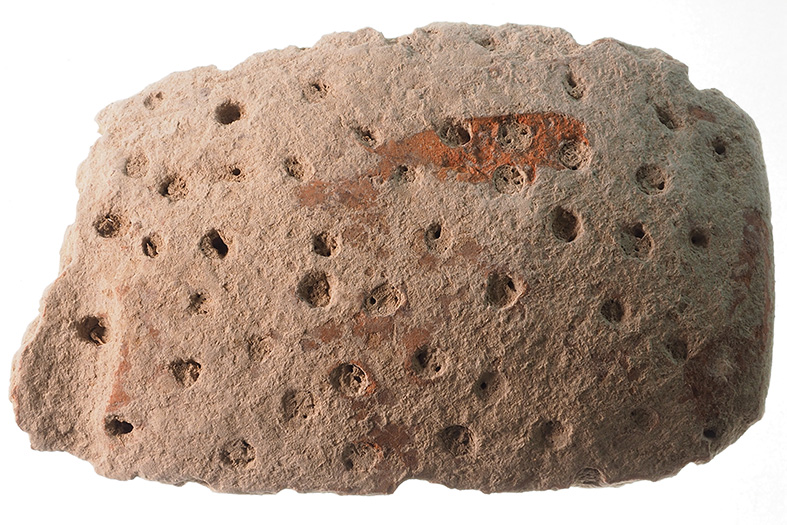
Neolithic pottery sherd.
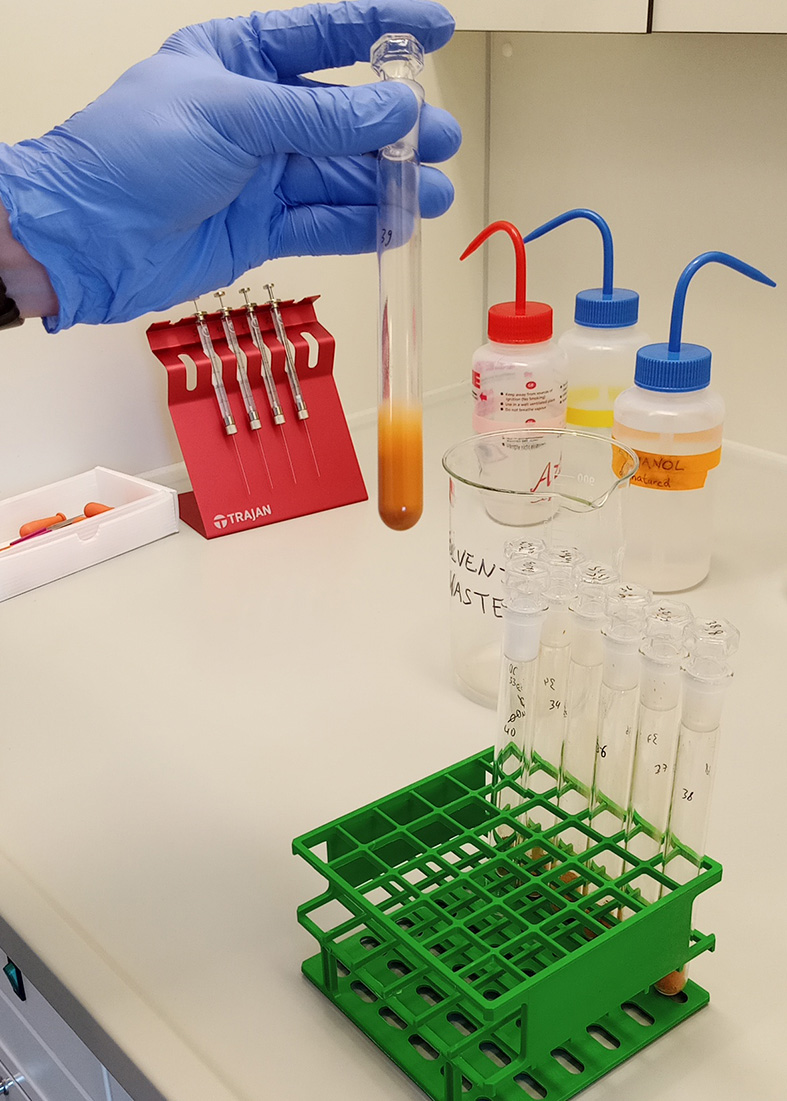
Extraction of organic substances from pottery samples.
Die Analyse stabiler Isotope von Kohlenstoff (¹³C/¹²C) und Stickstoff (¹⁵N/¹⁴N) in Skelettresten erlaubt Rückschlüsse auf Nahrungsquellen und die Nutzung von Lebensräumen, nach dem Prinzip: „Man ist, was man isst“. Anhand der Isotopenverhältnisse lässt sich die Ökologie wildlebender Tiere rekonstruieren, was wiederum Rückschlüsse über die Subsistenzstrategien der mit ihnen interagierenden menschlichen Gesellschaften sowie über langfristige Veränderungen der Umweltbedingungen erlaubt. Bei domestizierten Tieren lassen sich darüber hinaus Weidepraktiken, Fütterungsstrategien und Formen der Tierhaltung in Agrargesellschaften untersuchen. Die Analyse stabiler Isotope in menschlichen Skelettresten liefert Hinweise auf die Ernährung sowie auf mögliche soziale und kulturelle Unterschiede im Zugang zu Nahrung.
en: Stable carbon (13C/12C) and nitrogen (15N/14N) isotope ratios of skeletal remains provide insights into dietary sources and habitat use, based on the principle that “you are what you eat.” For animal remains, these isotopic signatures can help reconstruct the ecology of wild species, which in turn informs us about the subsistence strategies of the human societies that interacted with them, as well as long-term changes in past environments. In the case of domesticated animals, isotope data can reveal aspects of herding practices, foddering, and broader patterns of animal management in agricultural societies. When applied to human skeletal remains, stable isotope analysis provides direct evidence of diet and can shed light on food consumption patterns, resource use, and social or cultural differences in access to food.
Die Analyse von Strontiumisotopen in Zahnschmelz ist eine leistungsfähige Methode, um die Lebensräume und Bewegungen von Menschen und Tieren in der Vergangenheit zu untersuchen. Da das Verhältnis von 87Sr/86Sr im Zahnschmelz vor allem die lokale Geologie durch die Nahrungs- und Wasseraufnahme widerspiegelt, ermöglicht es die Unterscheidung zwischen lokalen und nicht-lokalen Individuen und die Rekonstruktion individueller Mobilität in Zeit und Raum. Der Zahnschmelz bildet sich während der ersten Lebensjahre schrittweise. Bei Tieren erlaubt die Analyse von sequenziellen Zahnproben zeitaufgelöste, saisonale Einblicke in die Bewegungen mittelgroßer bis großer Herbivoren, darunter sowohl wilde als auch domestizierte Tiere. Auf diese Weise lassen sich saisonale Wanderungsgebiete und Migrationsmuster rekonstruieren, wie z. B. Routen und Jahreszeiten der Migration bei Wildtieren oder die Herdenwanderung zwischen saisonalen Weideplätzen bei Haustieren.
Neben der präzisen Beprobung tierischen Zahnschmelzes für die Strontium-Isotopenanalyse führen wir im LARC auch die Veraschung modernes Pflanzenmaterials durch, um lokale Referenzwerte zu ermitteln, die für die Interpretation tierischer Wanderungen und Herkunft unerlässlich sind.
en: Strontium isotope analysis of animal tooth enamel is a powerful tool for investigating where humans and animals lived and how they moved across landscapes in the past. Because the 87Sr/86Sr ratio in tooth enamel predominantly reflects the local geology through food and water intake, it can be used to distinguish between local and non-local individuals and to reconstruct individual movements within time and space. Tooth enamel forms incrementally during an individual’s life. In case of animals, this allows time-resolved, seasonal insights into movement for medium- to large-bodied herbivores, including both wild species and domesticates. This makes it possible to reconstruct seasonal ranges and mobility patterns, such as the timing of movements, migration routes, and transhumance between seasonal pastures.
In LARC, we specialise in the precise sampling of faunal tooth enamel for strontium isotope analysis. We also ash modern plant material to help establish local bioavailable strontium baselines, which are essential for interpreting animal mobility and provenance.
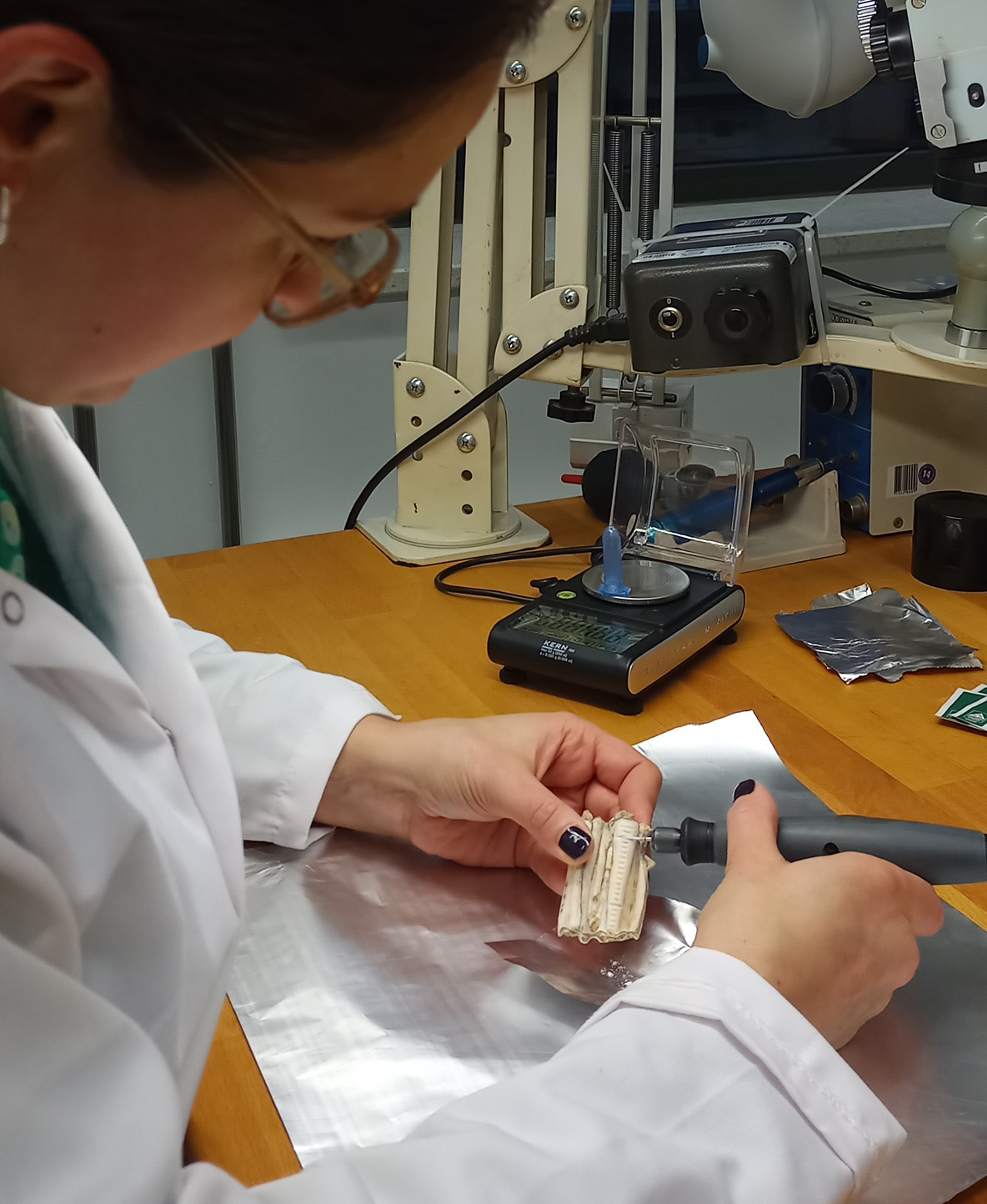
Sampling of a sheep’s tooth for isotope analysis.
Die Isotopenverhältnisse von Kohlenstoff und Stickstoff verkohlter Pflanzenreste spiegeln Umweltbedingungen wider, die durch die Pflanzenphysiologie vermittelt werden. Das Verhältnis von ¹³C/¹²C steht in Zusammenhang mit der Wasserversorgung der Pflanzen, während das Verhältnis von ¹⁵N/¹⁴N Bodenbedingungen und die Nährstoffverfügbarkeit widerspiegelt, einschließlich des Ausmaßes der Düngung. In der Archäologie werden die Isotopenverhältnisse von Kohlenstoff und Stickstoff genutzt, um landwirtschaftliche Praktiken – etwa Bewässerung und Düngung – zu rekonstruieren sowie Umweltbedingungen und landwirtschaftliche Strategien vergangener Gesellschaften zu untersuchen.
en: The isotopic ratios of carbon and nitrogen in charred plant remains record environmental conditions mediated by plant physiology. 13C/12C ratios are related to water status, while 15N/14N ratios reflect soil conditions and nutrient availability, including levels of manuring. In archaeology, these isotopic ratios can be used to reconstruct past farming practices, such as irrigation and manuring, as well as to assess environmental conditions and agricultural strategies in past societies.
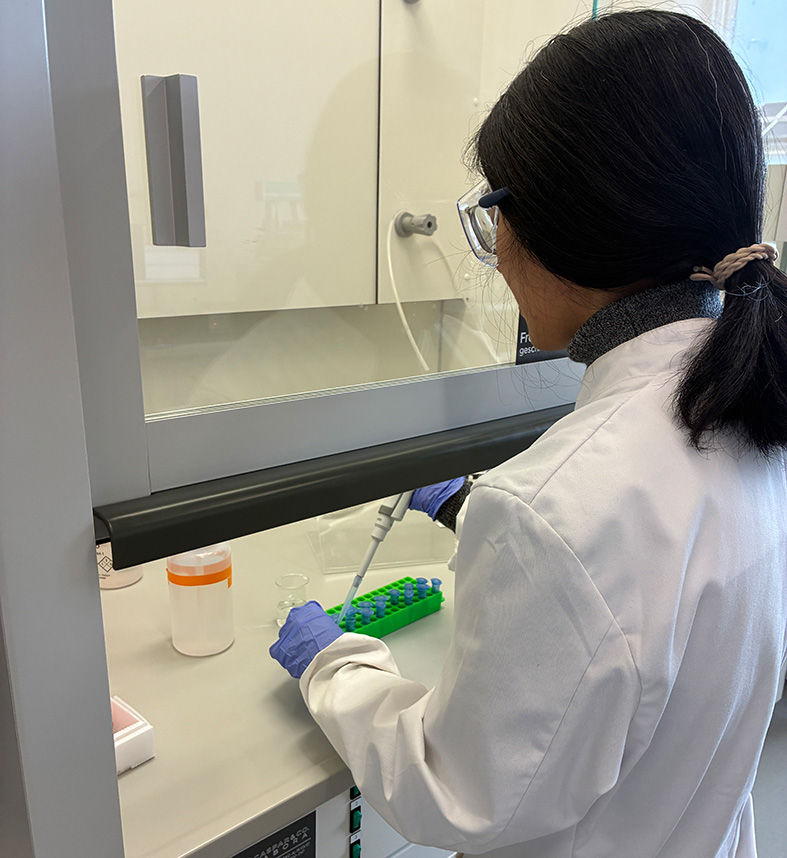
Chemical pretreatment of archaeological grains to remove contaminants.
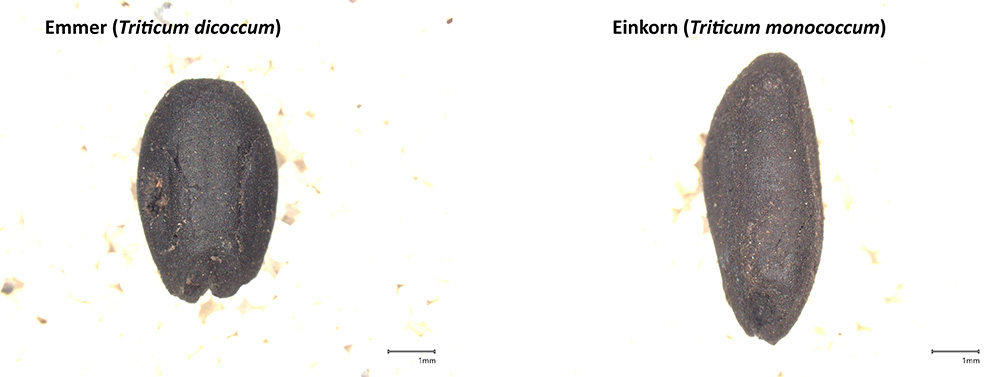
Charred hulled wheats from Neolithic archaeological sites.
Library
Opening hours:
Mo-Do 08:00-17:00 Uhr,
Fr 09:00-15:00 Uhr
Location: Hegelstraße 59, 55122 Mainz, 4th floor
If you are traveling from a distance, please call ahead to confirm that the library will be open as usual on that day.
Phone: +49 (0) 6131/39-30009
The collection can be accessed via the Mainz University Library’s online catalog. It is mainly intended as a reference library.
All downloads of our pages are permitted for scientific, non-commercial use. All other exploitation rights are reserved!
MAO 1
Peter Haupt, Römische Münzhorte des 3. Jhs. in Gallien und den germanischen Provinzen: Datenbank
The database, which is current as of 1998 (Access 97, author: Peter Haupt) contains 1,724 coin-dated hoard finds with a terminus post quem between 180 and 284 CE. The area of work encompasses Germany (the Germanic provinces and Belgica), France, Switzerland, and the Benelux countries.
The database is part of the doctoral dissertation “Roman Coin Hoards of the 3rd Century in Gaul and the Germanic Provinces,” which was published in 2001 by Bernhard Albert Greiner (Remshalden). There you will find further explanations regarding the database as well as the analytical section. Download:hortfunde,mdb ( approx. 2.6 MB)
From time to time, partially corrected and updated versions of the “Hortfunde” database will be made available for download here. Currently, version 5 dated January 14, 2004 (unzipped) is available for download. It currently contains 1,776 coin-dated hoards. Reports of new finds and previously overlooked finds are gratefully accepted by the author.
MAO 2
Oliver Gupte, Die knieförmig gebogenen Fibeln der römischen Kaiserzeit: Grabtabelle und Vorbemerkungen
The grave table and the accompanying preliminary remarks belong to the doctoral dissertation published in the UPA (110, 2004). Status: Summer 1997 MAO 2
MAO 3-6
“Archaeological contributions to gender research”; advanced seminar in the summer semester 2003* Directed by: Dr. M. Struck
*The seminar was financed with funds for the advancement of women from the Johannes Gutenberg University MainzIn the 1990s, so-called gender research developed from women’s studies, which assumes that gender is present everywhere and transcends all social relationships. Gender research presents itself as an interdisciplinary branch of science. The aim of the seminar was therefore to explore the extent to which archaeology, with the help of its material sources, can contribute to research into the understanding of gender roles and the distribution of gender roles in prehistory and early history, i.e. the period of widespread absence of writing. To this end, the seminar participants were asked to research the respective state of research on the individual prehistoric and early historical periods. As Classical-Roman conditions are also important for the early history of Central Europe, they were also dealt with.
It has been shown that although the archaeological investigations carried out so far have led to an expansion of our understanding of prehistoric and early historical societies through the introduction of the social category of gender, the sources only allow for very limited statements. Only for the Stone Age can archaeology refute the hypothesis of a primordial matriarchy, which has been put forward by other disciplines, due to a lack of evidence. For this reason, the seminar participants spoke out in favor of correcting the title of the seminar, as it was actually about “Contributions of gender research to the interpretation of Prehistory sources”. It seems most appropriate to speak of “archaeology and gender research”, which also expresses the interrelationships.
As gender research in German-speaking archaeology is still in its infancy, we want to make some term papers from the seminar, which serve as an overview of research, available to a wider public via the Internet and hope that this will encourage further employment with this problem area.
Mainz, May 2004 A. Deicke, N. Richter, M. Struck and R. Zumann
Results of gender research for the Palaeolithic (Rudolf Zumann) MAO 3
Results of gender research for the Neolithic (Nadine Richter) MAO 4
Results of gender research on the female population of Roman Britain with special reference to archaeological sources (Aline Deicke) MAO 5
Results of gender research on Classical Rome from the Republic to the Middle Imperial Period (Manuela Struck) MAO 6
MAO 7
Patrick Jung & Isabel Kappesser, tabulae MoGontIacenseS. Spatial processing and visualization of archaeological finds and features using the example of Roman Mainz(Mogontiacum). MAO 7
MAO 8
Christian Meyer, Man the Hunted MAO 8
MAO 9
Peter Haupt, Patrick Jung & Ines Klenner, Annotated Bibliography on the Archaeology of Rhenish Hesse (as of March 18, 2010) MAO 9
MAO 10
Patrick Jung, Die römische Nordwestsiedlung (“Dimesser Ort”) von Mainz. A contribution to the settlement history of Mogontiacum. Appendix 3: Name stamps on terra sigillata from Mainz.
The database report is part of the doctoral dissertation published in the UPA (for further explanations see pp. 177-185). MAO 10
MAO 11
Peter Haupt, Ein Nachtrag zu Datierung und Rekonstruktion des augusteisch-tiberischen Militärlagers von Belginum (Mainz 2010). Manuscript from the year 2003. MAO 11
In the 1990s, the former Mainz Institute of Prehistory and Early History published its own series of publications: Die Archäologischen Schriften des Instituts für Vor- und Frühgeschichte der Johannes Gutenberg-Universität Mainz. This series published work produced at the Institute, primarily doctoral dissertations. The series will no longer be continued as there is no longer the capacity for supervision and distribution. Final theses in particular can now be found in Universitätsforschungen zur prähistorischen Archäologie (UPA), published by Dr. Rudolf Habelt GmbH (Bonn), as well as in other relevant publishing houses.
In den Archäologischen Schriften erschienen:
1 Ronald Heynowski, Eisenzeitlicher Trachtschmuck der Mittelgebirgszone zwischen Rhein und Thüringer Becken (1992).
2 Heino Neumayer, Merowingerzeitliche Grabfunde des Mittelrheingebiets zwischen Nahe- und Moselmündung (1993).
3 Manuela Struck (ed.), Römerzeitliche Gräber als Quellen zu Religion, Bevölkerungsstruktur und Sozialgeschichte (1993).
4 Eva Hanel, Die merowingischen Altertümer von Kärlich und Umgebung (Verbandsgem. Weißenthurm, Kr. Mayen-Koblenz) (1994).
5 Angelika Hunold, Der römische vicus von Alzey (1998).
6 Michaela Aufleger, Tierdarstellungen in der Kleinkunst der Merowingerzeit im westlichen Frankenreich (1997).
7 Monika Brückner, Die spätrömischen Grabfunde aus Andernach (1999).
The Leibniz Center for Archaeology(www.leiza.de) is a globally active research institute for archaeology with its headquarters in Mainz. It is one of the research museums of the Leibniz Association. Research and mediation range from the earliest history of mankind to the early Middle Ages. The LEIZA is an important partner of our institute, as one of its departments, the MONREPOS Archaeological Research Center and Museum of Human Behavioral Evolution, is affiliated here.
Leibniz Center for Archaeology
Ludwig-Lindenschmit-Forum 1
55116 Mainz
+49 (0) 6131 / 8885-0
A strong alliance! Archäologie im Rhein-Main Gebiet
Mainz as a place of study offers students an important locational advantage, as the Rhine-Main region has the highest density of archaeological institutions in Germany.
With the Romano-Germanic Central Museum (Mainz) and the Romano-Germanic Commission of the German Department of Archaeology, two of the largest non-university archaeological research institutions are located here.
The State Offices for the Preservation of Historical Monuments in the two neighboring state capitals of Mainz and Wiesbaden and several museums offer students and graduates numerous qualification opportunities.
Die Römisch-Germanische Kommission (RGK) ist eine Abteilung des Deutschen Archäologischen Institutes. The Institute’s mission is to conduct, promote and publish research into prehistory and early history, primarily in ancient Europe from the earliest periods to the Middle Ages.
German Department of Archaeology
Romano-Germanic Commission (RGK) Frankfurt a.M.
Palmengartenstrasse 10-12
D-60325 Frankfurt a. M.
Phone: +49 (0)69/97 58 18-0
Fax:+49 (0)69/97 58 18-38
info.rgk@dainst.de
The Directorate-General for the Cultural Heritage in Rhineland-Palatinate (GDKE) is responsible for researching, safeguarding, collecting and disseminating the cultural heritage of the state of Rhineland-Palatinate. The six directorates under the umbrella of the GDKE Rhineland-Palatinate are the former Archaeological Monument Preservation, the former Building and Art Monument Preservation, the State Museums and Castles, Palaces and Antiquities. The GDKE is based at the Erthaler Hof in Mainz.
General Directorate of Cultural Heritage
Schillerstrasse 44
Erthaler Hof
55116 Mainz
The individual directorates are:
Directorate for the Preservation of Monuments
Directorate of Castles, Palaces and Antiquities
Ehrenbreitstein Fortress Cultural Center and Koblenz State Museum
Rheinisches Landesmuseum and Center of Antiquity Trier
The task of hessenARCHÄOLOGIE is to safeguard and conserve the archaeological and paleontological monuments of the state of Hesse. Cooperation between the IAW and hessenARCHÄOLOGIE passes through the research on the Kapellenberg.
On numerous excavations in Hesse, students at the institute gain their first experience in practical monument conservation.
hessenARCHÄOLOGIE
Schloss Biebrich / Ostflügel
65203 Wiesbaden
Tel. 0611-6906-131
Fax 0611-6906-137
Im Bereich der Kaiserpfalz Ingelheim wurden 1993 archäologische Forschungen wieder aufgenommen, die der karolingischen Palastanlage sowie deren mittelalterlichen und neuzeitlichen Nachfolgesiedlungen gelten. Numerous Mainz students have already worked here in internships and continue to do so. Today, the Imperial Palace of Ingelheim is open to tourists and, in addition to a museum , the research center is the center of archaeological research and knowledge transfer.
Contact:
Research center:
Imperial Palace Research Center
Mainzer Street 68
55218 Ingelheim on the Rhine
Phone: +49 6132 782-392 / -393 (Mon-Thu)
E-mail: kaiserpfalz(at)ingelheim.de
Museum at the imperial palace:
François-Lachenal-Platz 5
55218 Ingelheim on the Rhine
Tel: 06132 / 714701
E-Mail: info-museum@ingelheim.de
In recent years, the Institute of Prehistory and Early History has repeatedly organized joint exhibition projects with the Museum of the City of Alzey (“Before the Romans came – Celts in the Alzey region” in 2003/2004, “IN ALTEIO – Alzey in Late Antiquity” in 2006/2007). In addition, the Roman collections in the closed stacks were recorded in an image database as part of a course.
Contact:
Antoniterstraße 41
55232 Alzey
Phone 06731 495-720
museum@alzey.de
In order to facilitate the activities of the Pre- and Protohistoric Archaeology research unit beyond the limits of the administrative guidelines, there are corresponding associations.
The purpose of the Förderverein für die Vor- und Frühgeschichtliche Archäologie der Johannes Gutenberg-Universität Mainz e.V. (formerly Förderverein des Instituts für Vor- und Frühgeschichte der Johannes Gutenberg-Universität Mainz e.V.) is to support the teaching and research activities of the Institute. Funds are used to make purchases that strengthen the infrastructure of the Institute. Students also benefit directly, e.g. through printing cost subsidies for the publication of final theses. Becoming a member is therefore worthwhile!
Contact:
Association for the Promotion of Pre- and Early Historical Archaeology at Johannes Gutenberg University Mainz e.V.
Chairperson: Dr. Birgit Heide
Hegelstr. 59
55122 Mainz
Sparkasse Mainz BIC: MALADE51MNZ
IBAN: DE83550501200000034801
Support association membership form
The Förderkreis Altsteinzeit e.V. was founded in 1984 and supports the work of the Monrepos Archaeological Research Center and Museum for Human Behavioral Evolution of the Roman-Germanic Central Museum. Members of the association receive invitations to all events. In addition, field trips to excavations and special exhibitions at other museums are offered to members of the Friends. The Friends currently have around 300 members.
Contact:
Friends of the Altsteinzeit e.V.
Chairperson: District Administrator Rainer Kaul
Managing Director: Boris Quade
Birch Street 22
56581 Kurtscheid
Phone: +49 6131 39 322 60 02631 / 806 46 26
Sparkasse Neuwied (BLZ 574 501 20)
Account no: 53033
Adresse
Arbeitsbereich Vor- und Frühgeschichtliche Archäologie
of the Institute for Classical Studies
Hegelstraße 59 (3rd and 4th floor)
55122 Mainz
Phone: +49 (0) 6131/39-30009
Office Monday to Thursday: 7.00-11.30
4th floor room 04-204
academic advisory office

